Showing posts with label Archaeology. Show all posts

Wednesday, November 22, 2023

A Revolutionary War Textile Fragment from Fort Montgomery

Thanks to my colleague historian Matthew C. White and Grant Miller, the Historic Site Manager at Fort Montgomery State Historic Site, I'm happy to share a bit of information about one of my favorite things: archaeological textiles. Most such artifacts that we have from the 18th century survive as the result of specific formation processes, most often either because they landed in anaerobic (usually waterlogged) environments like shipwrecks and dense mud, or because they were in close contact with metal objects which helped preserve them. Once in a blue moon, fragments show up on regular old terrestrial digs for site-specific reasons that are hard (for me, at least) to explain. 

Continental soldiers constructed Fort Montgomery as a defensive post on the Hudson in 1776. British, Loyalist, and Hessian forces captured it on October 6, 1777, and destroyed it a few days later. Beginning in 1916, sporadic archaeological projects investigated the fort. The most intensive excavations were done between 1967 and 1971 under a scholar named Jack Mead. You can read more about what these studies produced in "The Most Advantageous Situation in the Highlands": An Archaeological Study of Fort Montgomery State Historic Site, Charles Fisher, ed. (Albany, NY: The Cultural Resources Survey Program, New York State Museum, 2004).

In the summer of 1971, Mead's team was working in the North Redoubt of the fort (specifically in the five-foot square known as Section 50, Box L, Square 18B) when they uncovered a relatively large textile fragment alongside a few scattered pieces (now catalogued as A.FM.1971.346). At the time and occasionally since, various people have wondered whether the fragment was a coat or jacket sleeve, given its distinctive shape. The wool textile has at least two layers of a relativley coarse, plain weave of about 28 yarns to the inch. More recent examination by professional conservator Sarah Stevens did not detect any evidence of seams, stitching, or thread. The fragments were found in close proximinity with ten musket balls and a British uniform button. Some 262 musket balls and all sorts of other interesting objects were found in the Redoubt overall. 

The New York State Office of Parks, Recreation and Historic Preservation was kind enough to share a variety of research material and the original excavation slides with me and grant permission for them to be published here. Here's the fragment in 1971 and in its current state and more recently. If you're sharp-eyed enough to notice that the extant fragment seems to be a mirror image of the original in situ, that's because it was apparently flipped over at some point into its current state in storage.

New York State Office of Parks, Recreation and Historic Preservation

New York State Office of Parks, Recreation and Historic Preservation

Indeed, it's pretty easy to see a sleeve-like shape here. Below, I've highlighted that shape and rotated the view of the fragment before it was lifted. If you aren't as used to seeing parts of clothing in flat pieces of fabric, this is approximately the shape of an "upper sleeve" with the "sleeve cap" at top and the cuff edge at bottom, and I've inserted an image of a modern upper sleeve pattern to help (note that period men's upper sleeves were close to but not quite this shape).


New York State Office of Parks, Recreation and Historic Preservation

From here

But, like most other folks that have puzzled over this object, I don't think it's a sleeve. It's hard to make any firm conclusions without seeing it in person, but there really doesn't seem to be any evidence for seams, hems, lining, or anything else besides its shape to suggest this identification. And the more I puzzle over the original excavation slide images, the more I think that you can see related fragments that originally extended past the misleading outline of a sleeve shape. 

See what you think. Here's our pal again:

New York State Office of Parks, Recreation and Historic Preservation

Now below, here's a great, in-focus closeup of the center of the fragment (key in on the large white object, apparently a cut root or sapling according to folks in the know, at the upper left corner here, which is in the upper center of the above image). I've crudely highlighted the weave directions of the upper layer (red) and the lower layer (blue) and also tried to emphasize how much the weave direction is wiggling a bit with the clearly not-parallel green lines that are nonetheless definitely in the same piece of fabric. This sort of movement happens readily in fabrics that are relatively loose or thin.

New York State Office of Parks, Recreation and Historic Preservation

Below, then, I think you can see how closely the top layer weave alignment matches a smaller fragment that is closer to the large white stump. I've highlighted that alignment in the red, below. When you relocate this fragment in the overall view, you can see that if it was originally part of that top layer, it extends well beyond the outline of the sleeve. 

New York State Office of Parks, Recreation and Historic Preservation

New York State Office of Parks, Recreation and Historic Preservation

Of course, saying it's probably not a sleeve (which isn't a new conclusion, I'd emphasize) doesn't get us much closer to saying what it is. It's certainly a relatively thin, loosely-woven wool. There's about one bazillion possible explanations that we probably can't discount: raw fabric for garment construction? bunting for a flag? flannel for some sort of medical use? 

If my back was to the wall, my best guess (echoing some older speculation by New York State staff and because of its context in the redoubt) would be that it's the sort of flannel that was sometimes used for artillery cartridges (bags to hold gunpowder). But this isn't a silver bullet: why would unsewn cartridge cloth be in the redoubt and not stored elsewhere? On the other hand, all sorts of non-military detritus was found in the redoubt, including enough building materials and ceramics to lead archaeologists to speculate that there may originally have been a structure within the redoubt.   

What's your guess?

Below are the other images of the fragment in situ and in storage, in case they're more useful to you!

New York State Office of Parks, Recreation and Historic Preservation

New York State Office of Parks, Recreation and Historic Preservation

New York State Office of Parks, Recreation and Historic Preservation

New York State Office of Parks, Recreation and Historic Preservation

New York State Office of Parks, Recreation and Historic Preservation

New York State Office of Parks, Recreation and Historic Preservation

New York State Office of Parks, Recreation and Historic Preservation

New York State Office of Parks, Recreation and Historic Preservation

Sunday, September 11, 2022

The Things They Carried, 1762

 Longtime readers of this blog will know that in the everyday material culture of military experiences, including things like what Union soldiers carried in their pockets and the interior decoration of Civil War soldiers' winter huts. A passing reference in May and Embleton's classic Ospery volume, Wolfe's Army, led me on a hunt for a 1762 document detailing the weight of a soldier's equipment. I found a transcription of this document with help from R. Scott Stephenson and John U. Rees in The Papers of Col. Henry Bouquet (1942, Series 21648, Part II / Volume 10, 77-78), a transcription series from the mid-20th century undertaken by the Commonwealth of Pennsylvania and based on original manuscripts in the British Museum.

The document was prepared by Lt. Alexander Baillie, 1st Battalion, 60th/Royal American Regiment, in the summer of 1762 and documents the weight (in pounds and quarter pounds) of every piece of equipment officially carried by a British grenadier on campaign in America in the Seven Years'/French and Indian War. It's detailed enough that you could recreate everything a man carried except the small things that made him unique (personal mementoes and idiosyncratic objects). 


David Morier's "Grenadiers, 46th, 47th and 48th Regiments of Foot, 1751" (part of a larger series, from the Royal Collection Trust) gives us a glimpse of British grenadiers in full marching order shortly before the date or Baillie's report. Note that these grenadiers are shown wearing their distinctive embroidered caps while Baillie's report notes (felt) hats.

In the interest of making this document more widely available (as far as I know, it hasn't been published or posted outside of the printed Papers), I've included it in full below. I should note, though, that this is now a transcription of a transcription, and I've made some minor formatting alterations below, and so it would be well worth a serious researcher's time to revisit the original (undigitized) manuscript and its context.


Lieut. Alexander Baillie to Col. Henry Bouquet

Return of the Weight of the Cloathing, Arms, Accoutrements, Ammunition, Provision, Necessary’s &Ca. of a Grenadier, upon a March.

                                                                                                    Augt. 28th 1762

                                                                                                    Weight

                                                                                                    Lbs. Qrs.


A Regimental Coat, with Hooks, Eyes, &ca.             5. 2.

Waistcoat                                     2. 1.

Pair of Breeches                                     1. 2.

Hat with Cockade, Button, Loop, & Hair String             1.

A Shirt with Sleeve Buttons                                             1.


A Stock with a Buckle.     

A Pair of Knee Buckles.

A Pair Stockings & Garters                 3.


A Pair Shoes with Buckles                               1. 2.


A Regimental Firelock, with a Sling 

& Buckle / Hammer Cap & Stopper                    11. 1.


A Waist Belt with a Buckle                 2.

A Hanger, Sword Knit, and Scabbord             2. 2.

A Bayonet and Scaboord                          1. 1.

A Tomahawk, and Cover                          1. 3.


A Cartridge Pouch with Belt, Buckles, 

& Match Case                                                                     3.

Containing 24 Cartridges                             2. 1.

Brush & Wire, Worm, & Turnkey.

Oyl Bottle & Rag

2 Flints, & a Steel.                         1.


A Knapsa[ck] with Strap, and Buckles               1.   2.

Containing 2 Shirts. 2 Stocks. 2 Pair Stockings.                        2.   3.

A Pair Summer Breeches                               1.     1.

A Pair Shoes                                       1.     1.

A Clothes Brush, pair Shoe Brushes, 

        & Black Ball                                                                       1.

A Pair Leggins & Garters / A Handkerchief                         1.     1.

2 Combs, a Knife, & Spoon                     2.


A Haversack, with a Strap                                 3.

Containing Six Days Provisions                 10.         1.

A Blanket with Strap & Garters                 3. 2.

A Canteen with a String, & Stopper, full of Water           3.         1.

                                                     63. 3.


Monday, March 16, 2020

Oh, Well

A couple months ago, I took an unusual path out of work after dark and passed by an excavation pit in the middle of one of Old City Philadelphia’s original street blocks. I’m always curious about what such digging is turning up, but it took a while to figure out exactly where I was. Beginning in the 1680s, William Penn and other planners envisioned an city built on an orderly grid pattern. They mostly got it, especially when you compare Philadelphia’s street plan to those of other cities, like Boston, the developed more organically into spiderwebs instead of grids. But early in the Philadelphia's history people subdivided their property and cut alleyways in between the main streets. These alleys came and went over time, to the extent that whole websites and articles (like this one, this one, and this one) are now devoted to puzzling out their names and which ones still exist. My personal favorite is Little Boy's Court, purportedly the only street with extant 18th-century cobble- and pebblestone paving (and also adjoining the site where developers partially destroyed an 18th-century burying ground in 2017 before archaeologists began salvage operations and study of the human remains).

A Google street view of Little Boy's Court


The excavation I came across is at the corner of today’s Bank Street and Elbow Lane, in the block bounded by Second and Third Streets and Chestnut and Market Streets. If Google is any guide, there hasn’t been a structure there for some time. But by the looks of it, someone is digging a new foundation for a building. That’s the sort of digging in Philadelphia that usually disturbs archaeological remains. But, as I’ve written elsewhere, there’s no legal mandate or practical apparatus to enforce archaeological excavations on private sites (unless a federal permit is required). That means that most such excavations destroy archaeological remains without any documentation.

A Google map of the block in question. The lot is the blank gray rectangle above Bella Bridesmaids


I was particularly excited – or, perhaps, disheartened – to see a distinctive standing column of bricks on one edge of the excavation. Because it was empty, I knew it was a well shaft rather than a privy (privies – used as toilets – were gradually filled and remain so when uncovered today). Unfortunately, but the time I returned to photograph it in daylight two days later, it had already been removed by excavators. You could see a few artifacts scattered around the pit: mostly 20th-century bottles. But thanks to Matt Dunphy, I did secure a few images of the well and another view of the site before its destruction.

A view of the well against Elbow Lane. This view was taken facing south, standing on the narrow alley now called Bodine Street

Looking north from Elbow Lane (Bodine Street is on the left), you can also see a brick archway near the bottom of the excavation. This shot was taken standing almost directly above the well


I got curious about this lot’s history and the well’s potential origins. In the eighteenth century, the southern end of Bank Street was called White Horse Alley, and Elbow Lane was a more literal elbow: coming down from High (now Market) Street and making a ninety-degree westward turn in the middle of the block. Without going into too much detail (or, frankly, too much research on my part), it’s interesting to find a few traces of the lot in digitized sources and to speculate on who might have used the well.

Despite their apparent orderliness, it’s notoriously hard to puzzle out the history of Philadelphia houses for a couple reasons. Most importantly, addresses have changed, most notably when they were renumbered around 1856. This latter change involved the implementation of the "Philadelphia System," now common in many other places, in which each block of a given street is assigned to a set of 100 numbers. In other words, for example, houses stand in the 600 block. When you cross a major street, the next house numbers begin at 700 and 701, on either side.

Scharf and Westcott’s famous 1884 History of Philadelphia noted that there was a brewery on the corner of Elbow Lane and White Horse Alley as early as 1737. George Gray (namesake of gray’s ferry) operated the brewey beginning in 1752, and his widow Mary kept up the business after his death. 

I think that the brewery must have been on the southwest corner of the intersection, and that the structure on the lot I saw under excavation was the three-story brick house listed as being on the northwest corner in this 1791 advertisement:


From Dunlap's American Daily Advertiser, January 10, 1791

Shoemaker had been in the house since at least 1774, when he took out an insurance policy for the house from the Philadelphia Contributionship (whose digital archives are one of the great and overlooked gems of Philadelphia's historical sources). It was an impressive place for the alley. At the time, it was 14 ½ feet wide and 28 feet deep and included two rooms on its first and second floors, plastered walls, stairs, and a plastered garret (its third story). Behind the house stood a 10 foot by 10 foot one-story kitchen. Either the kitchen or, perhaps, the kitchen and the whole house were 7 years old in 1774.

Shoemaker's policy from the Philadelphia Contributionship

The only city directories published before Shoemaker’s death list an address for him on Second Street, and it’s hard for me to tell exactly which number was assigned to the Elbow Lane lot. That makes it difficult to determine who bought Shoemaker’s house in 1791 (though it would be rather easy with an in-person title search, I imagine). The 1795 city directory was the first to be organized by lot (rather than alphabetically), so it gives us a glimpse of the residents of Elbow Lane at the time:


Though I only viewed them from the street above and in these images, the bricks and the well itself on the Elbow Lane edge of the lot looked, to me, to date from some time in the 19th century rather than to the earlier periods of occupation noted above. Perhaps it was even meant to offer water to others besides the residents of the building, given its proximity to the street itself. 

Unfortunately, other than the images and cursory research here, there’s no longer a trace of this well or the other archaeological remains of the lot. Maybe someday I’ll do a bit more archival digging and see if I can come up with the later history of this lot. For now, we’ll leave the scene in 1791. And not for nothing, but that’s just in time to avoid one of Philadelphia’s first epidemics, the yellow fever outbreak of 1793. Sometimes it’s hard to escape the present, even in the past.  

Tuesday, November 26, 2019

A Pipe Kiln Waster and Imperfection

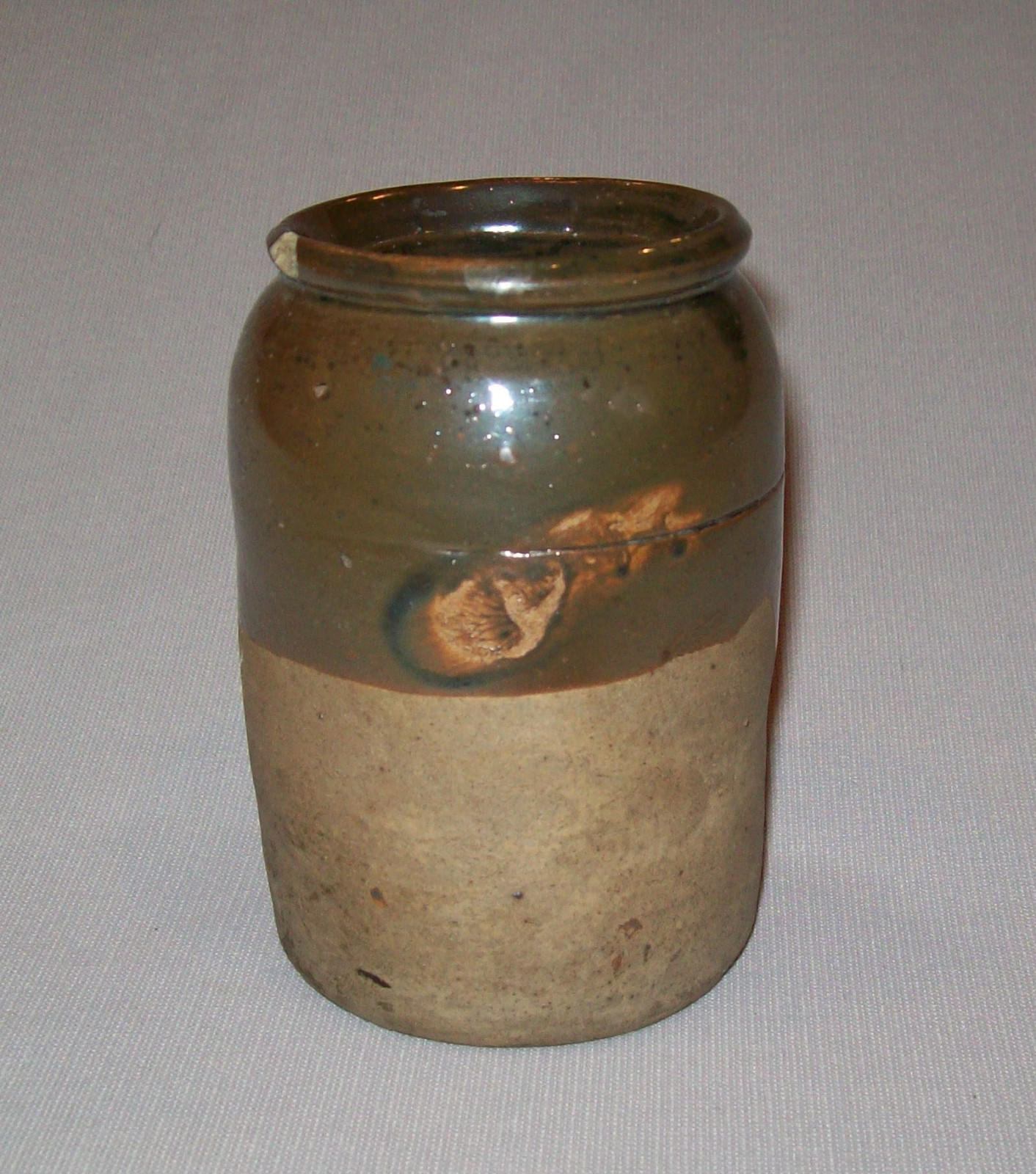
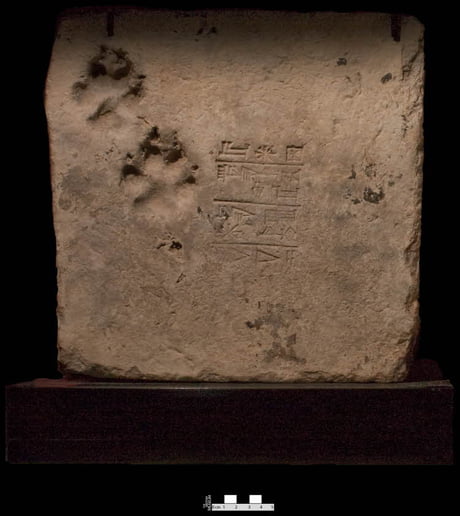
I've long been attracted to antique ceramics that exhibit accidental signs of their production. Aesthetic flaws that might take away from decorative value are what draw me to old pottery. As Nicole can testify, I pick up and flip over old stoneware crocks at the antique shops we visit to look for these things. I love misshapen crocks, pieces of other pottery adhered to finished ones, scars from the small clay "furniture" used to stack things in a kiln, and "turkey droppings" of excess glaze. Sometimes you can detect the streaks and impressions of the potter's hands and even individual fingerprints. Old bricks occasional feature animal footprints from creatures that got into a brickyard as things were drying. Dramatic kiln failures, unsuitable for sale, were called "wasters," and discarded at the kiln sites themselves.

    Kiln Waster, 1640-1660, Musueum no. C.10-2005  Clay brick with footprint of a cat paws, Ur 2112 BC – 2004 BCE
Examples of turkey droppings, a potter's fingerprint, a 16th-century Dutch kiln waster, and a 4000-year-old tile with a cat footprint from Ruby Lane, Ebay, the V&A, and here.

What could be more interesting than these little material signatures of some past failure? I far prefer flawed objects to perfect ones. And sometimes it's not accidental. Navajo rug weavers deliberately introduce flaws into their work. Japanese culture values wabi-sabi, an acceptance of natural imperfection. That sort of acceptance is not a strength of "Western" cultures, even if many people believe that perfection is best left to God.

Detail of Navajo textile
A "spiritline" in a Navajo rug that Western eyes might read as an unacceptable imperfection. From the Smithsonian Museum of American History, here.

My most moving experience during a recent class I took on historic window restoration was when the craftsman leading the workshop was examining a century-old plate glass window and detected, in the awkward streak of glass on top of the pane's surface, evidence of an accident during production. "This is an amazing piece of glass," he said, staring into the pane, "See that streak, that odd blob? Someone messed up. That's someone in the shop tripping and accidentally throwing a bit of glass onto this finished pane." You could almost hear the echoes of a glassblower cursing his clumsiness across a century of time.

Since seeing it on my colleague Brenda Hornsby Heindl's blog in 2013, I've also coveted a particularly sculptural failure she acquired, a fused waster of mid-nineteenth century pipe heads uncovered on a kiln site in Ohio. This accident could hardly be more artistic, to my eye, if someone had tried to create it on purpose.


I was in Gettysburg this past weekend when, in one of the town's innumerable relic shops, I came across a small example of a similar accident, this one from the 1860s kiln of John Taber of Wolfeboro, New Hampshire. Taber was a prolific potter who produced distinctive redware clay pipe heads (smoked by inserting a reed stem into a socket next to the bowl) which have been found on archaeological sites across the country. In the late twentieth century, it seems that someone (not an archaeologist) dug Taber's kiln site. Many of the recovered pipe heads have subsequently made it onto the antiques market. The dealer I visited had a number of intact pipe heads, but what caught my eye was a waster: two heads that had collapsed and fused together.


Normally I don't buy "dug" materials. You can find plenty of things in antique shops that have been excavated by people for fun from battlefields, privy pits, and homestead sites. Without any written documents or records, and with none of the attention to detail that professional archaeologists deploy to capture information about the past through the buried records, these individuals effectively loot our collective heritage for fun and profit. Purchasing dug items encourages the ongoing excavation of similar things.


In this case, however, I couldn't resist an ethical compromise. It's unfortunate that whoever dug Taber's kiln site doesn't seem to have left any record of what they found. But in this small artifact, we can see the shadow of an accident that happened 150 years ago. It reminds me that things rarely end up as we intend. It reminds us to look for the beauty in the imperfect. No good for smoking - no good for most anything in 1865 - this bit of trash, it turns out, is quite good for thinking.

Monday, February 26, 2018

More from the Wreck of the Mast Ship St. George

Longtime readers of this blog or new visitors may have seen my post (which originated on Nicole's blog) four years ago about cloth-covered buttons from the 1764 wreck of the British mast ship St. George near Hampton, New Hampshire.


From The New Hampshire Gazette and Historical Chronicle, December 7, 1764.

Just recently, a descendant of Christopher Toppan, who oversaw the salvage of the wreck in the winter of 1764-1765, contacted me to say that she had in her possession similar buttons. Even more remarkably, Lori Cotter and her cousin Michael Toppan also have a document detailing payments made by Christopher Toppan to townspeople for salvage work on "The St. George, Mastship lost on Hampton Beach." The document, and its association with surviving buttons, finally proves the identity of the ship, its connection to Toppan, and the story of the buttons, things that remained uncertain when I last wrote. 


But perhaps even more remarkably, Lori also shared images of two original packages of buttons. Based on the handwriting and paper, they are a remarkably rare-thing: eighteenth-century packaging material. It's possible these were assembled as the wreck's cargo was salvaged, but I suspect that they are actually the buttons' original shipping containers. In that case, they were assembled after the buttons were completed in England in 1764. Then the packages (containing large quantities of 7 1/2 and 9 1/2 dozen buttons, distinguished between larger "Coat" and smaller "Waiscoat" sizes) were probably placed in a crate or bale for transatlantic shipment. As far as I know, these may be the only eighteenth-century packages of imported buttons that exist. Thanks to Lori and her family for so carefully preserving them and sharing their story. You can read more about the early history of Hampton in a book Lori transcribed from an ancestor's records, available here.


Saturday, April 29, 2017

The Arch Street Bones Project

This could be a long blog post. I have a lot of things to say about the surprise discovery of the remains of the historic burial ground of the First Baptist Church of Philadelphia, uncovered during a construction project on Arch Street last fall. As an archaeological site, the burial ground was partially destroyed by construction equipment operating there. It was only through the intervention of some dedicated (volunteer) archaeologists that any real archaeology was completed at all, and that work was speedy and only a few steps ahead of the backhoes. I could easily lament the rather shameful disengagement of various local and state agencies who claimed they lacked jurisdiction over human remains and/or the site.

And we could certainly discuss the lack of any real enforcement mechanism for the cultural heritage guidelines Philadelphia and Pennsylvania have on the books. I have strong feelings about how a city that prides itself on its cultural heritage simultaneously ignores the rampant destruction of archaeological resources on private land (often despite the laudable advocacy of organizations such as the Philadelphia Archaeological Forum). In 2014, for example, a site at the corner of Third and Market that included a number of eighteenth-century foundations, privies, and wells was destroyed and looted by private collectors. All legal. All to the great detriment of each of us, because each of us owns the legacy of the people, many anonymous, enslaved, and forgotten, whose only traces are things like broken bits of pottery thrown down a well and the human bones that lie buried under our feet. These are artifacts that can tell profound stories about our ancestors.

Photo by Evi Numen, from hyperallergic.com

But I want to get right to the point. Now that the eighteenth-century human remains found on Arch Street - over seventy individuals and many more fragmentary bits - are above ground, they are in urgent need of proper storage, conservation, and analysis. However you feel about the conditions of their recovery, we can probably all agree that the least we can do for the people who were buried on Arch Street - and for ourselves, because of all the things we can learn about our predecessors from studying their bones - is restore some sense of individuality and humanity to their remains. Thanks to the dedication of a few key volunteers, the Mütter Museum, the College of Physicians of Philadelphia, and other institutions, this work has begun. It needs your support.

Take a minute to consider the Arch Street Bones Project, the crowdsourced funding campaign to support the urgent needs of this collection. You might be surprised at how much we will learn about the past.

Tuesday, February 18, 2014

Experimental Archaeology: Early American Whirligigs and Whizzers

It's been a snowy winter here in Delaware, leaving lots of time for reading, research, and working on small projects. After so many snow days and road problems, I've been thinking about how people entertained themselves indoors in the past. Among other things, I wondered about the toy "whirligigs" and "whizzers" found at early American archaeological sites. Here's an example from Ephrata Cloister in Pennsylvania, for instance. It's a pretty simple toy, requiring only a string and a pierced, weighty object. When twisted and held taught, the object quickly spins back and forth.

Whirligig as applied to this type of toy was in use by the seventeenth century, according to the OED, and this type of artifact is common in eighteenth-century contexts, according to Ivor Noel Hume (A Guide to Artifacts of Colonial America, 1970, 320-321) and others. I think the term "whizzer," although common among archaeologists and the public, may be anachronistic, as I've been unable to locate its origin or a period reference.

I was wondering in particular why some are round and others have teeth around their edges. So, I got to work with a few basic tools - a knife, a plain file, and a rat tail file for smoothing out the cut holes. For my whirligigs, I used some old (reproduction) Revolutionary War British army buttons.

Tools and raw material (pewter button) atop a page from Lynn L. M. Evans's Keys to the Past: Archaeological Treasures of Mackinac (2003, 41) showing an original whirligig and an illustration of one in use.

It takes less than half an hour to turn a pewter button into a toothed whirligig. That involves filing off the shank, piercing holes by twisting a knife around in a precise spot, and filing the teeth around the edge. The pewter buttons I used are harder than lead, so original whirligigs made from repurposed lead cloth bale seals or flattened musket balls would have been even faster to make. 

I made four whirligigs, each with minor variations, to test whether any particular type worked better or made a louder noise. I assumed the teeth had something to with the noise factor.

Some experimental whirligigs.

I had expected these toys to whine or hum when spun. In fact, the toothed ones actually only make a fine rushing sound (a whizzing sound, in fact). The one without teeth is silent when spun, except for the sound of the string twisting (which is actually relatively noisy). I can't discern any difference in sound between the fine-toothed and coarse-toothed examples. The one in which I drilled holes far apart (at the bottom of the above image) also works, but it's harder to start and keep spinning than the others. Some excavated whirligigs have a third, central hole, but I'm still at a loss to explain that. I'd be happy to hear from anyone who has an idea. In the mean time, I'll be playing with these entrancing little toys.


After reading this and mastering the whirligig herself, the ever-astute Nicole Belolan asked what it was about the whirligigs that made them "fun." She speculated that it has more to do with the unique physical sensation of the tensing and loosening string than with any sight or sound. We live in a world filled with visual and auditory entertainment, and toys that entertain us through the sense of touch are relatively uncommon, at least once we move beyond infancy. Nicole also speculated about whether early American children might have competed to see who could keep their whirligig going the longest, as their hands and arms grew tired from the work, in the same way that more recent children compete at dribbling balls or spinning hula hoops.  

Sunday, August 4, 2013

New Button Discoveries

Readers of this blog may have noticed my affinity for buttons, as demonstrated in past blog posts such as this one and this one. It's been a great summer for Revolutionary War military buttons here in Virginia and elsewhere.

At Colonial Williamsburg, archaeologists working on the Anderson Armoury complex this spring came across a nice French button from the 53rd Regiment, which served as artillery during the war.

A button from the French 53rd Regiment, from here.

More recently and almost as close by, a student in the Watermen's Museum Archaeology Camp (Yorktown, VA) found a button from the French 85th Saintonge Regiment Infantrie washed out of a hill near the battlefield. You can read more here, including about the museum's plans to present the student with a resin cast copy of the button and donate the original to the Park Service, which maintains the battlefield. Thanks to Nicole for bringing this one to my attention.

Button of the 85th Saintonge Regiment Infantrie found at Yorktown, from here.

Up in New York, the folks at Chrysalis Archaeology, a cultural resources firm, recently uncovered several Revolutionary War buttons in their excavations near the South Street Seaport. You can read more about the buttons here. Thanks to Joseph Privott for bringing these to my attention.

British military buttons recovered by Chrysalis Archaeology in New York City, from here. I'm away from my library and unsure which unit wore the "J 5" button at left. 

Meanwhile, the First Oval Office project continues, and I'll be posting more about our progress in a few days. Check us out on facebook or via the webcam in the mean time!

Tuesday, March 26, 2013

Glacial Textiles - A Norwegian Tunic

Glacial melting is a troubling problem for us all, but a small silver lining in this very dark cloud is the discovery of new archaeological artifacts. You may remember that I've written about glacial discoveries before on this blog. Another such find comes from southern Norway, where archaeologists recently carbon dated an ancient tunic discovered near a melting glacier to around 300 A.D. It's the latest in a series of glacial artifacts that include a mitten dating to 800 A.D. and various other objects. You can read more here. It will be interesting to see what else emerges while we begin to confront the other problems of global warming.

The Norwegian glacier tunic. Reuters/Alister Doyle from here.

As is often the case, Nicole deserves credit for bringing this story to my attention. Besides being a great partner, she also serves as my reliable digest of material culture news.

Sunday, March 17, 2013

Archaeological Round-up: Ships and Skeletons

Spring is almost upon us, and that means another season of archaeological work across the world. In London, excavations are already well under way. The massive Crossrail train project, accompanied by extensive archaeological work, recently uncovered a set of graves, possibly part of a fourteenth century emergency cemetery for victims of the Black Death. You can read more here.

London plague victim graves under excavation. AFP Photo/Handout/Crossrail, from here.

In New York state, similar surveys related to work on the Tappan Zee Bridge over the Hudson River prompted one local paper to speculate on the potential for underwater archaeological sites, including those of a number of known shipwrecks.

Meanwhile this month, in Maine, storms exposed another archaeological site of interest. The remains of a ship's hull, possibly a late-eighteenth- or early-nineteenth-century sloop or "pinky" schooner are currently visible near York. This particular ship apparently appears every few years after storms before being gradually covered again by sand and mud. Readers of this blog may remember that I've written about similar finds before. Between intentional and accidental discoveries, 2013 is shaping up to be an interesting year for archaeology.

Shawn Patrick Ouellette/Staff Photographer, Maine Sunday Telegram, from here.

Monday, February 4, 2013

Ulysses Grant's Civil War Coat

Sometimes, I'm amazed at how many truly phenomenal antiques still remain in private hands. Such is the case with the only surviving Civil War uniform of General (later President) Ulysses S. Grant. This "blouse" or "sack coat" was supposedly worn by Grant during the surrender of Confederate General Robert E. Lee at Appomattox Court House in 1865. The coat is owned by Texas collector Ray Richey, who founded the Texas Civil War Museum to house his collection. It's be under wraps for some years, but Grant's simple coat will soon be on public display for the very first time, according to this story. As to its authenticity, well, that's up to you to decide for yourself.

The coat has a chest of 35.5" and a waist of 31" and has replacement buttons. The original buttons, along with much of Grant's other clothing, were probably given away or sold as souvenirs by his wife Julia after Ulysses died in 1885. This uniform is really in a league of its own when it comes to Civil War objects. It's too bad that, according to Richey, "it's never going to leave Texas." As Indiana Jones once said, "that belongs in a museum." And I can't help thinking that the museum where this coat belongs is at Appomattox, not West Texas.


Collector Ray Richey and Grant's Appomattox coat, from here.

On an unrelated note, readers may remember that, back in September, I wrote about the possible discovery of the grave and remains of England's Richard III. Today, researchers announced that DNA from the skeleton confirmed what physical features already suggested. Spinal deformities, battle injuries, and all, the remains are those of Richard III.