Showing posts with label Civil War. Show all posts

Thursday, November 16, 2023

A Brief Update in Civil War Interiors

Back in 2020, I wrote a post about the interiors of the log huts that soldiers used in winter encampments during the Civil War. While I haven't turned up many further references in that regard, I did run across an illustration recently in Military Images magazine that might be of interest. It's a depiction of the quarters of Surgeon Benjamin Walter Carpenter of the 9th Vermont Infantry as they appeared in Newport, NC, on May 30, 1864, depicted by the regiment's then-colonel, Edward Hastings Ripley. Sharp eyes will be able to make out plank chairs, various objects on shelves and hanging on the wall, and a sleeping cat under the desk.


You can view this illustration and learn more about Carpenter and Ripley via the Bennington Museum.

Saturday, March 25, 2023

A Twenty-Year Anniversary

Time is a curious thing, especially when you spend part of your life dressing like people from the past. It’s been over twenty years since I started reenacting, but the most peculiar part about that is that I can so clearly remember excitedly waiting for the summer of 2012 to write my ten-year anniversary post. And it’s been eleven years since then??

As I wrote in 2012, reenacting has influenced my life in profound ways. My closest friends are reenactors (or at the very least they wear costumes at work). I can directly trace the path I took to graduate school and my current job at the Museum of the American Revolution back through a chain of mentors and museum professionals that I met through reenacting. That path goes all the way back to a newspaper article that appeared in my hometown paper in 2002 about a Civil War reenacting unit that was forming in town. I called a phone number, starting going to meetings, and in June of that year my parents let me go off with a bunch of people who spend weekends dressing like Civil War soldiers. It all worked out ok.

Here's is just a sample of where reenacting has taken me since my last recap in 2012:

Second Lieutenant, Union Army, July 1863
Here I am standing at the High Water Mark at Gettysburg on July 3, 2013, holding a federal officer's sword carried there on July 3, 1863.

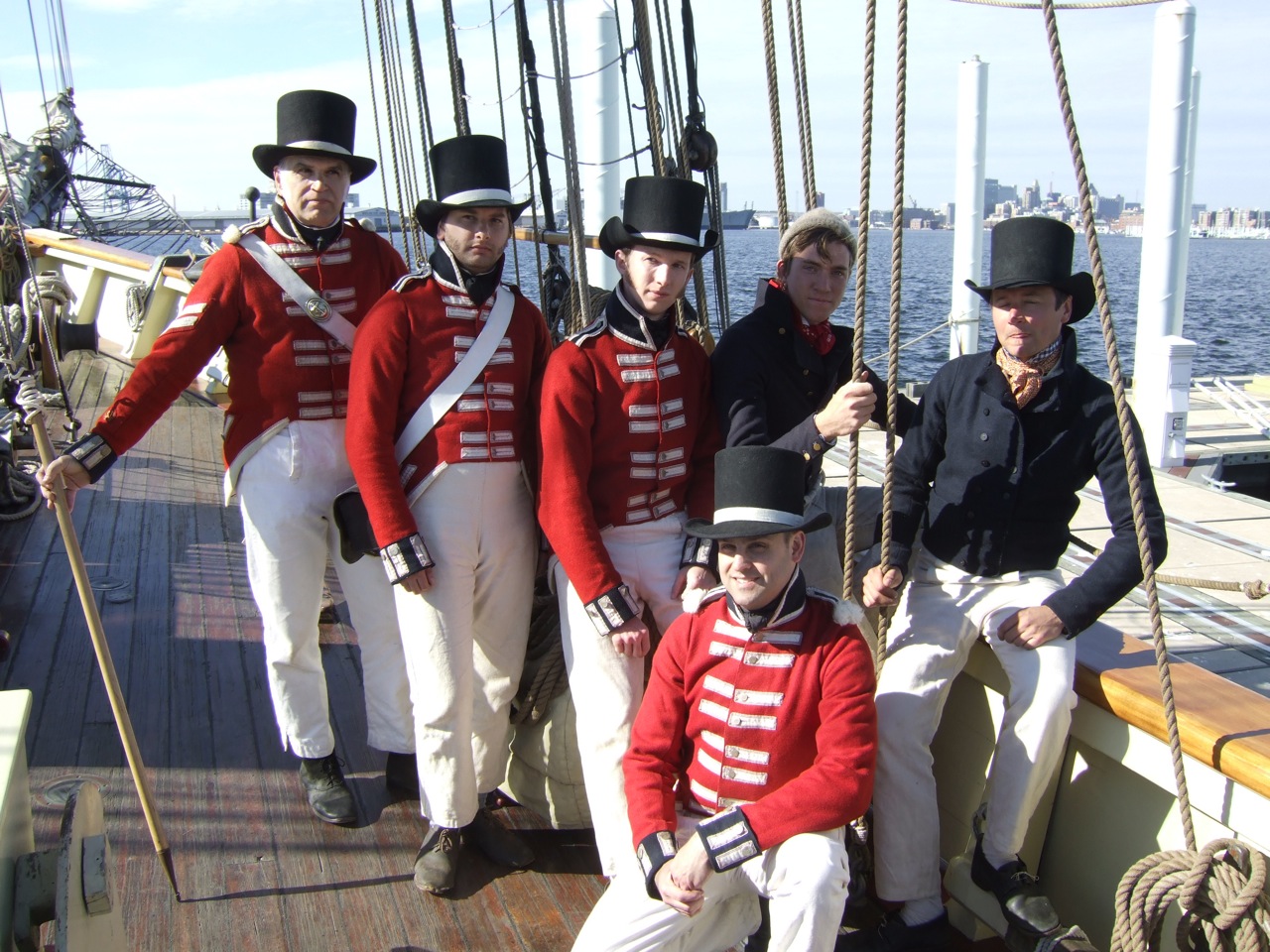
Royal Navy Marine, 1812-1815
A film shoot for Maryland Public Television, 2013.


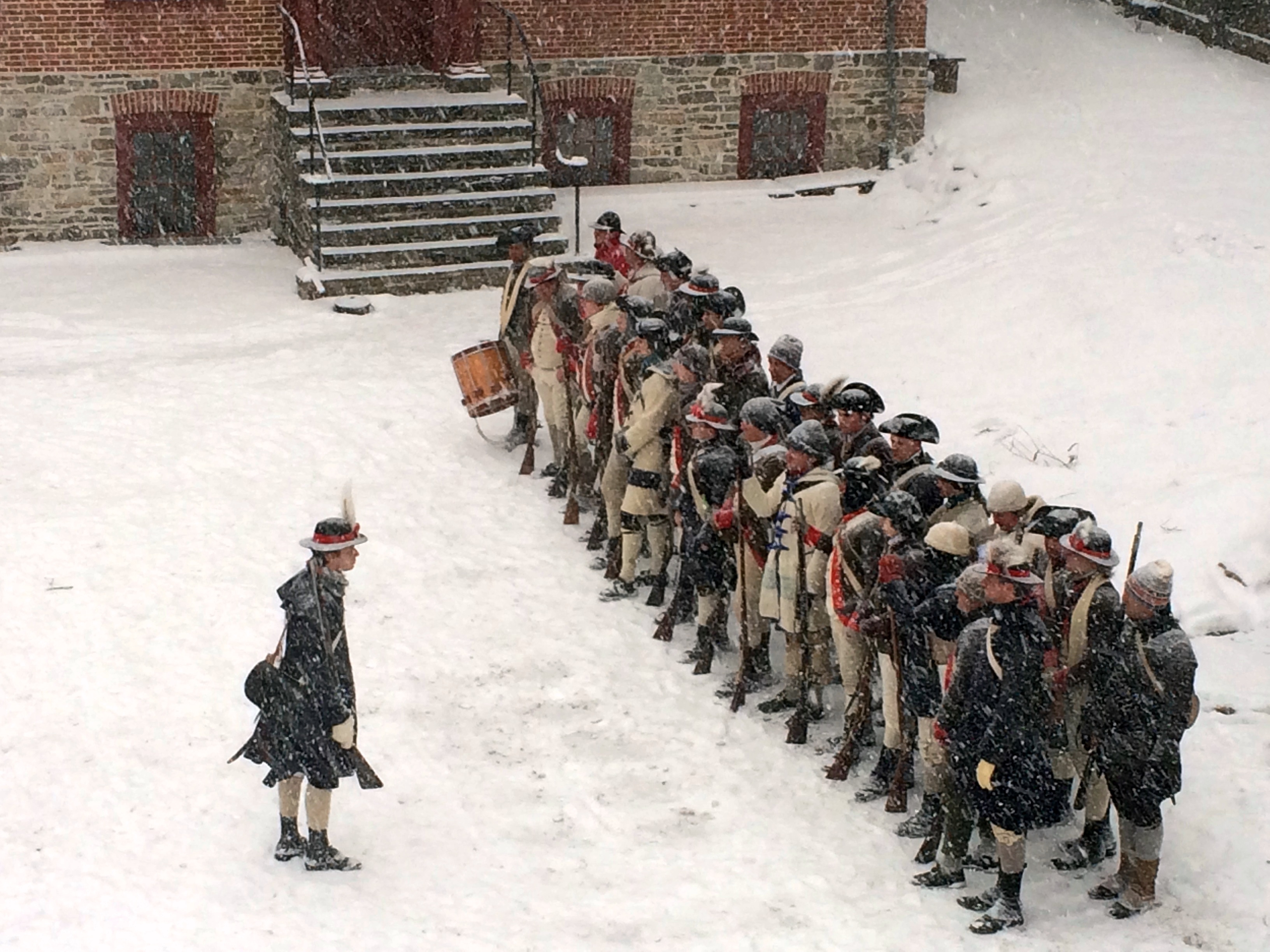
4th Connecticut Private Soldier, Spring 1778, Valley Forge, Pennsylvania
A National Park Service living history event in 2014.

Royal Navy Able Seaman, Caulk's Field, Maryland, 1814
A blurry photo taken in the evening as we stood with our boarding pikes, but a crystal-clear memory from 2014.


Second Lieutenant, Union Army, April 1865
The 150th anniversary living history event commemorating the surrender of the Army of Northern Virginia at Appomattox Court House.

Second Lieutenant, Union Army, Gettysburg, 1863
A tintype photograph.

Philadelphia Associator, January 1777
A January 2017 event that I wrote about here.

Alexander Hamilton, December 1778
From a film shoot for Hamilton Was Here: Rising Up in Revolutionary Philadelphia, a special exhibition at the Museum of the American Revolution.

Second Lieutenant, Union Army, Crampton's Gap, Maryland, 1862
From an event in 2018.

Tyler, New York City, Summer 2019
2019 was a busy year at the Museum, and it included both a summer-long collaboration with the New-York Historical Society that I regularly commuted up for AND me getting hit in the face by a door at the Museum, as you can see here.

Tyler, Riverton, New Jersey, Summer 2020
Like most people, I spent a good chunk of 2020 online. I still got to dress up occasionally.

British-American Sailor, Chesapeake Bay, 1776
Part of a film shoot aboard the Schooner Sultana for our True Colours Flag Project.

Second Lieutenant, Union Army, Circa 1863
A lower-res image of as long as my hair ever got, in 2021.

Commander-in-Chief's Guardsman, Philadelphia, 1778
Part of our 2021 photoshoot for the Virtual Tour of Washington's War Tent.

Grenadier, 5th Regiment of Foot, British Army, Philadelphia, 1777-1778
My best impression of an 18th-century satire, 2022.

Philadelphia Scotsman, circa 1778
A made a lot of kilts (though not quite all the ones you see here) in 2022!

Second Lieutenant, Union Army, Gettsyburg, 1863
With some old friends at Remembrance Day in 2022.

South Jersey Citizen, 1778
Just last weekend at the Hancock House!

Tuesday, August 11, 2020

Horace Phillips


Three summers and a thousand years ago. So begins the 1975 film The Man Who Would Be King. I’ve always liked this line. Especially now, in the age of Covid-19, when the passage of time seems to be doing strange things – accelerating one day and standing still the next – it helps me think about how some things seem so recent and yet so long ago. Now, on the cusp of finishing my dissertation in history, I’ve also been thinking back on my very first research project.


Twenty-three summers and a thousand years ago. I was nine in the summer of 1997, and my mother had decided that it was time for my brother and me to understand how to do research at the library. I’ve been interested in the Civil War for as long as I can remember, but I can’t remember how we chose the research project. Our goal was to find a Civil War soldier who was buried in our town who had left a diary we could read.That was easier said than done in 1997 in Traverse City, Michigan. Most of what I remember about that summer is inspired by a binder of papers that I’ve carefully preserved. Missing from that archive is a particular booklet I can picture quite clearly. Or perhaps it was a photocopy in a file at the library. It listed Civil War diaries and letters in state archival collections. I can only imagine that this is where we first found Horace Phillip’s name, associated with a diary at the Bentley Historical Library at the University of Michigan, and how we determined that he was from our town. We wrote away for a photocopy of the diary. It cost twenty cents a page. After postage and handling, the total came to $10.44. The Library mailed me a manilla envelope on August 21, 1997. And we wrote away for Horace’s pension records.


Meanwhile, based on my archive, I can see that we also consulted an array of books that I remember were held in the the Traverse City library’s “Nelson Room.” The room contained rare local history books and was a rather vaunted place to my mind as it was the exclusive domain of adults. You can see the library tags on the spines of books in my old photocopies. Michigan Men in the Civil WarMichigan in the War. I own some of those books now, but back then, before Amazon, and as a kid, the excitement of finding them on actual shelves was visceral. I also remember visiting the “town historians” in a book-filled office somewhere. I remember thinking that was the coolest job I could imagine. One of them even had a beard.


If I think about it, I can still feel the excitement of that summer of waiting. Knowing the forms you had completed were on their way to faraway libraries and not knowing when you would hear back or what you would get. Remember, this was still the age of the mail. Of photocopies and microfilm. Of taking photos and waiting with bated breath to get your roll of film developed and see what came out. We’ve lost so much of that world that it’s hard sometimes to even believe it was real, and to remember all the small joys that came with it.


Horace Phillips’s pension records arrived. I must have struggled to read the script. I had only learned cursive in third grade, the year before. Now, many years later, after having spent countless hours reading eighteenth- and nineteenth-century handwriting, I can fly through these documents. In 1997, it would have been a foreign language. So what do they tell us about Horace?


Horace Phillips was a short man, 5’ 4½”. He had black hair and hazel eyes. He was 26 when he enlisted in the 26th Michigan Infantry on August 12, 1862 (158 summers and a thousand years ago). When I was nine, 26 must have seemed like a lifetime away; it was a lifetime away. Now, at 32, I wonder what it would have been like to join the army six years ago. It was the second summer of the war, and the enthusiastic young men of Horace's Company A – farmers, lumbermen, and clerks from Traverse City – nicknamed themselves with pride, the “Lakeshore Tigers.”


However obscure in the story of the Civil War, the Lakeshore Tigers would become a fixture in my life. At its best, local history reminds us who we are and guides our way. We care about these stories because of where we are from. Sometimes, in serendipitous ways, they haunt us. As part of that summer of research, based on some ephemera in my old binder, my mother must have looked up Civil War reenacting. As I’ve written elsewhere, this was near the peak of that hobby but before it flourished online, and it was rather hard to figure out how to become a reenactor (at least in northern Michigan). And I really wanted to be a reenactor. But I had to wait a bit.


A few years later, by a stroke of luck, a Civil War reenacting unit formed in Traverse City, and I joined. Like most units, we named ourselves after a specific local company from the 1860s. The Lakeshore Tigers. Reenacting with this unit changed my life: it brought me into the orbit of the people that inspired me to go to college to study Civil War archaeology. As my network widened, it was reenactors who introduced me to eminent scholars and researchers, wrote my reference letters for grad school, and helped me get jobs. I have my job today in no small part because of conversations I had at reenactments.


Horace Phillips’s war was a different experience, of course. I don’t know much about his personal journey, but I do know that the 26th Michigan served on guard details and skirmishes in Virginia, assisted in quelling the New York City “draft riots” of 1863, and entered the spring of 1864 as part of the Army of the Potomac and the new, cataclysmic campaign to end the war in Virginia. On June 3, 1864, at the Battle Totopotomy Creek, part of the General Ulysses’s S. Grant’s Overland Campaign, Horace Phillips lost the fourth toe of his left foot to a musket ball. He spent the rest of the war in hospitals, finally ending up at Mower Hospital in Philadelphia, not all that far from where I work today.


After the war, Horace moved around a bit. He farmed. He got married (to a Mary Antoinette). He had a son, named after his father, who went by Archie. He joined the Grand Army of the Republic, suffered from his war wound and the diseases of old soldiers: rheumatism, kidney failure, spinal issues. He died in October of 1915, as the world's next great war was just beginning. 


One of the things I remember about that summer of 1997 was the difficulty of locating Horace’s grave. Though he was listed in the rolls of the largest cemetery in Traverse City, Oakwood, even after consulting with the office and groundskeeper we were unable to locate his grave. Now, of course, you could confirm that with findagrave.com. Finally – and I don’t know exactly how – we found him buried in a small cemetery in the forgotten crossroads of Yuba, north of the city. He has a simple, government-issued headstone. I’ve visited him there a few times over the years.


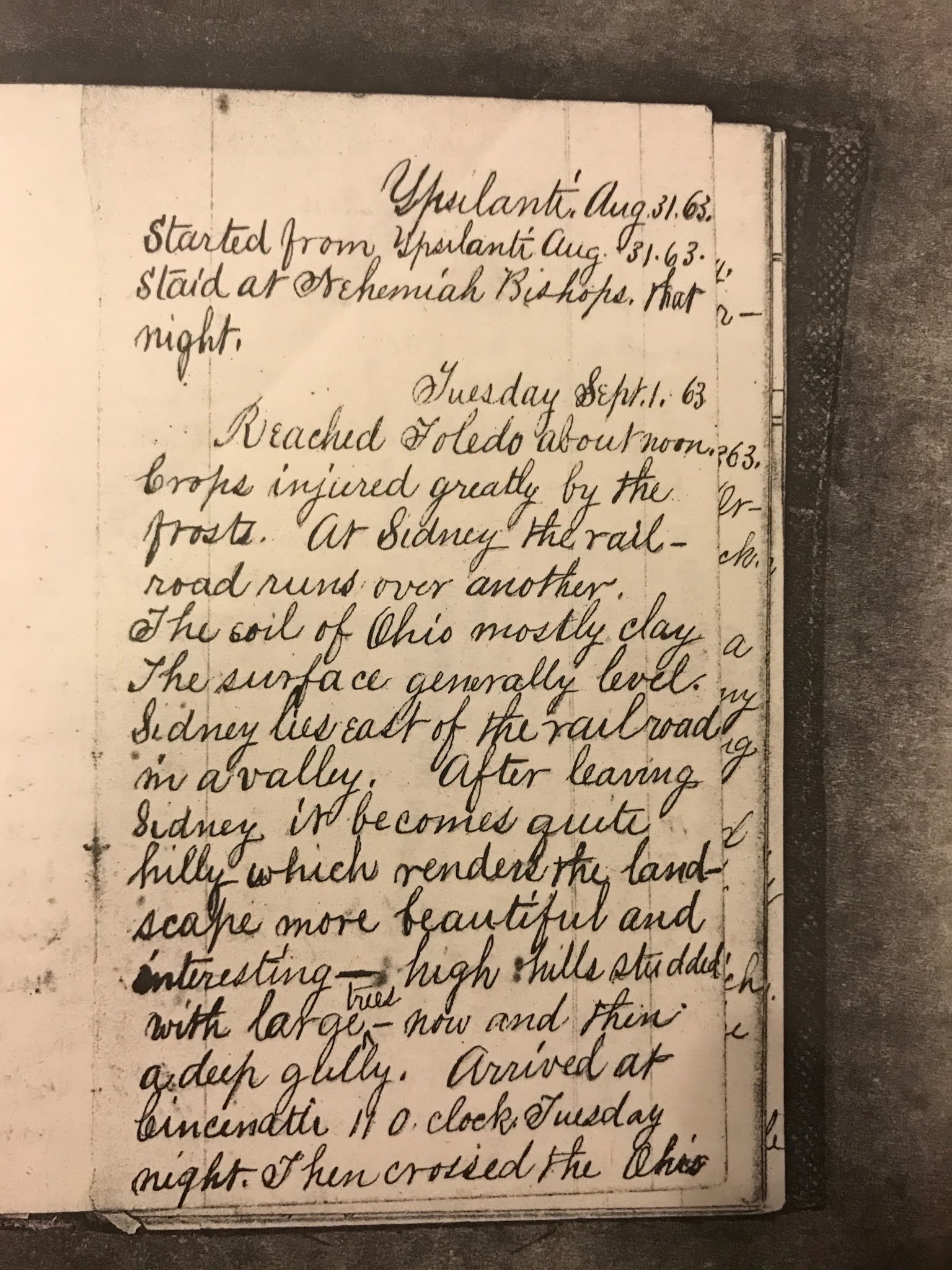
But what of his diary, the whole point of this research project? That’s where things got strangely more complicated. Reading the photocopies that arrived that faraway August today, I realize right away that it’s not the diary of the Horace Phillips I was after. This diary, though dating to 1863, is from a 17-year-old who went off from Ypsilanti, Michigan, to visit the army camps and ended up spending a few months as an assistant to a sutler, a vendor who sold things to the soldiers. But in 1997, I struggled to read the writing. I believed this must be the same man. After all, how many Horace Phillips from Michigan could there have been in the Civil War, anyway? I took notes, trying to puzzle out the differences. I never quite solved it. But I saved it, and all my notes. The first of my research files. Now my research files are mostly online, somewhere in the cloud. But there’s still nothing quite like holding things in your hands.


Some things I learned about research that summer are now quaint. Paper interlibrary loan slips. Microfilm. Waiting months for results. Our research world now moves at dizzying, digital speeds. Just this past month, I secured permission to use an image from an archive in Estonia in a matter of hours. Before the internet, I might not have ever known the image existed, much less been able to make contact or communicate with the archivists who care for it.


But so much of what I learned about research that summer is still with me. The detective work. The attention to detail. Even the frustration when your sources don’t align. Most of all, I still feel the sheer joy of being a historian. Of imagining what life was like once-upon-a-time, and of finding what bits of it might survive to help us imagine it better.


Horace Phillips – both of them, in fact – changed my life. But it was my mom who inspired this project. Her handwriting is on the pages in my old binder. She was the one who drove us around and showed us how exciting it was to discover things. These many years later, living half a country away and when I often shirk my duty and only talk to my parents every couple of weeks, I sometimes struggle to tell them how much they mean to me. They gave me the tools to craft a life doing something I love. Thanks, mom.


Monday, May 4, 2020

Winter Quarters: What Did Civil War Soldiers’ Huts Look Like Inside?

Like a lot of people right now, I’m sweeping around the dumpster of unfinished projects and loose ends. This blog is one way I’ve been keeping up with research that is disconnected (or at least adjacent) to my job and dissertation, and this post is one example of what still lurks in my research files. I’m lucky to be in a position to go through those files and do some writing amid everything else that is going on.

Since I was a kid, I’ve been interested in Civil War soldiers, and for a while now I’ve been collecting references and images to their domestic lives. Years ago, I wrote a post here about what Union soldiers carried in their pockets. For months each winter during the War, many soldiers settled into log huts in massive encampments. If you’re a Revolutionary War fan, think Valley Forge but on steroids. These huts took all different forms, and there’s no shortage of images and descriptions of how they looked on the outside. There are some great studies about how soldiers built them and of what remains of them, including by eminent archaeologists. It’s sometimes harder to figure out what they looked like inside. I’ve seen a handful of soldiers’ letters (most notably at the William L. Clements Library at the University of Michigan) where the authors sketched the interiors of their huts, and I’ll share a few other images here. Along with written records, these sources help us answer questions about the lived experience of these domestic spaces. How did they look inside? Were they decorated with mementos of loved ones or wartime trophies? How did it feel to call them home?

John D. Billings devoted most of a chapter to “Life in Log Huts” in his iconic memoir, Hardtack and Coffee. It’s the most detailed and lengthy description of huts as domestic spaces that I've seen, and it’s worth reading in its entirety. Billings tells us about fireplaces, bunks, hardtack-box tables, sardine-tin lanterns, and table settings. “A hardtack box,” he wrote, “nailed end upwards against the logs with its cover on leather hinges serving as a door, and having suitable shelves inserted, made a very passable dish-closet.” (1)

From Billings, Hardtack and Coffee, 75.

In Union veteran C.W. Bardeen’s 1910 memoir, A Little Fifer’s War Diary, he remembered that “In the absence of candles we imitated the old Roman lamp, by filling a sardine box with grease of some kind, and igniting a rag floating in it.” (2)

Confederate John Casler remembered that in late 1863, “We went to work in earnest and put in a nice log shanty, covered it with clapboards, went to an old barn near by and got some planks for a floor and bunks, built a stick chimney, and were prepared to live in high style.” (3)

Union soldier David McNeilly Steuffer’s sketch of his hut in December, 1863, from here, credited to Pearce Collection, Navarro College.

Harry Kiefer, a drummer boy with the 150th Pennsylvania, remembered: “The last cabin we built – it was down in front of Petersburg – was a model of comfort and convenience: ten feet long by six feeet wife and five high, made of clean pine logs straight as an arrow, and covered with shelter tents; a chimney at one end, and a comfortable bunk at the other; the inside walls covered with clean oat-bags, and the gable ends papers with pictures cut from illustrated newspapers; a mantelpiece, a table, a stool; and we were putting down a floor of pine boards, too, one day toward the close of winter, when the surgeon came by, and looking in, said, - “No time to drive nails now, boys; we have orders to move!” But Andy said, - “Pound away, Harry, pound away; we’ll see how it looks, anyhow, before we go!” (4)

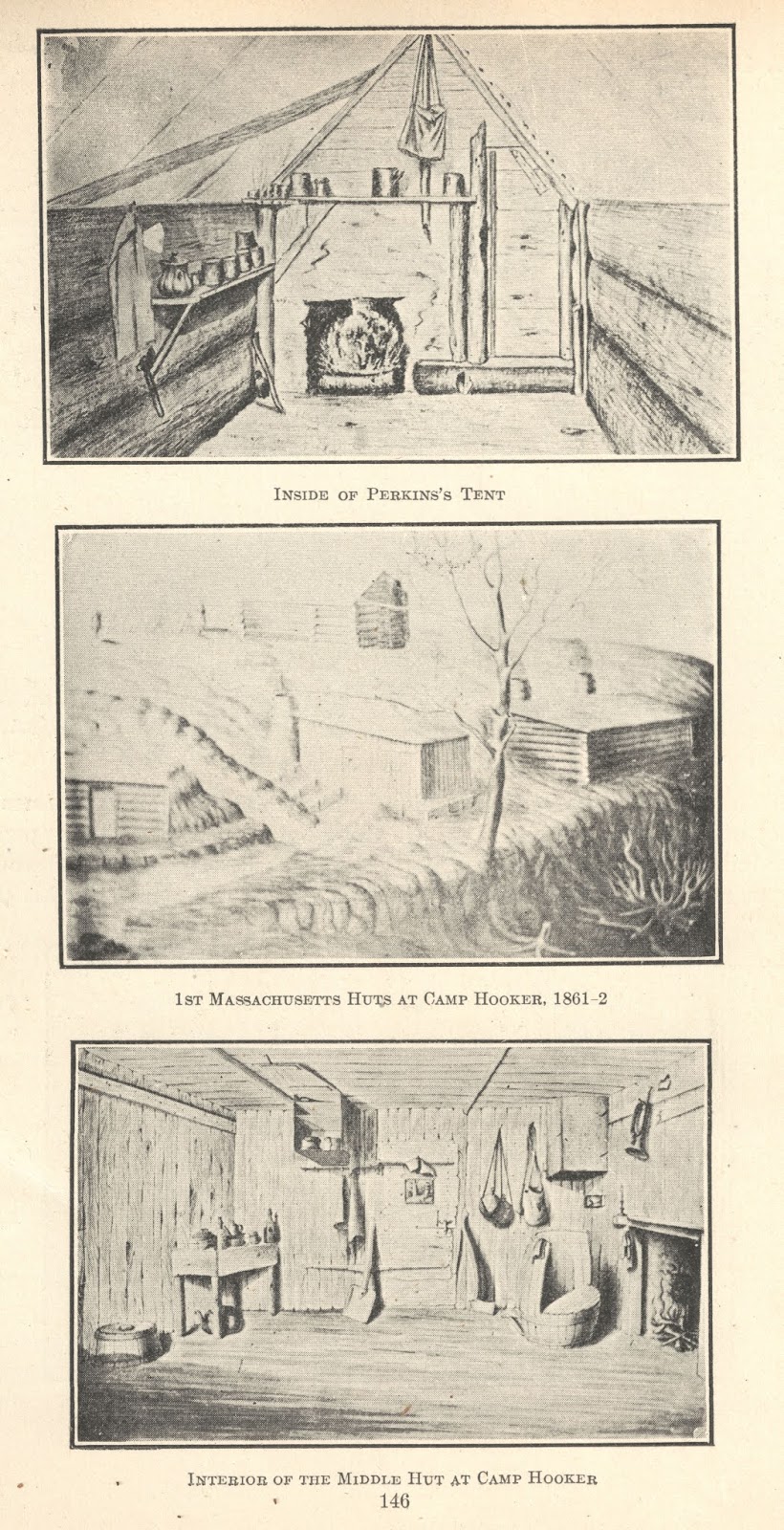
Sketches of winter quarters by Union veteran Charles C. Perkins, published in Bardeen, A Little Fifer's War Diary, 146.

Confederate Barry Benson wrote of his winter quarters in 1862-63 had “a floor laid of poles laid close together and raised a foot or so off the ground… Our bed was of broomstraw, which I always preferred to wheat straw, as not breaking up so badly.” (5)


These images are of an unsigned and undated sketch sold several years ago at Freeman’s Auction (Philadelphia) which I believe show the winter quarters of a group of Civil War officers.

But, of course, winters came to an end and campaign season – and life in tents – began each spring. Union veteran Abner Small remembered what this meant for the little homes soldiers had built. “This doomed all our furniture, the tables and chairs and desks made out of barrels and boxes, all our handy aids to housekeeping, and all the things the men had fashioned to while away the time.” (6) 

Life in log huts, after all, no matter how homey, was temporary.


 *          *         *          *          *

(1)   John D. Billings, Hardtack and Coffee (Old Saybrook, CT: Konecky and Konecky, reprint of 1887 first edition), 76.
(2)   C. W. Bardeen, A Little Fifer’s War Diary (Syracuse, NY: C. W. Bardeen, 1910), 199.
(3)   John O. Casler, Four Years in the Stonewall Brigade (Dayton, OH: Morningside Bookshop, 1971), 195.
(4)   Harry M. Kiefer, The Recollections of a Drummer Boy (Boston and New York: Houghton Mifflin Company, 1911), 55.
(5)   Berry Benson, Berry Benson’s Civil War Book (Athens, GA, and London; The University of Georgia Press, 2007), 34.
(6)   Abner R. Small, The Road to Richmond (Berkely and Los Angeles: University of California Press, 1959), 77.

Tuesday, November 26, 2019

A Pipe Kiln Waster and Imperfection

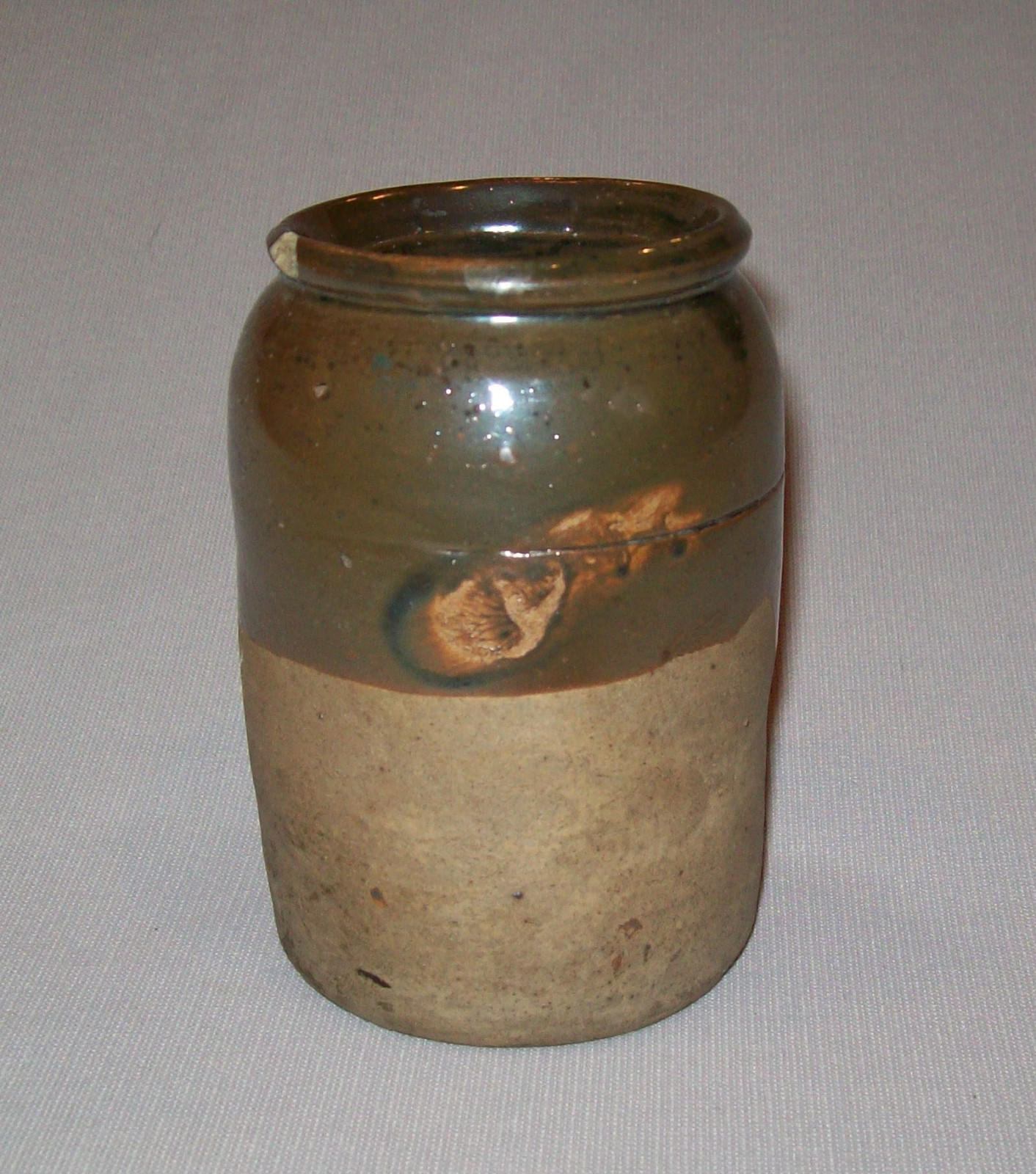
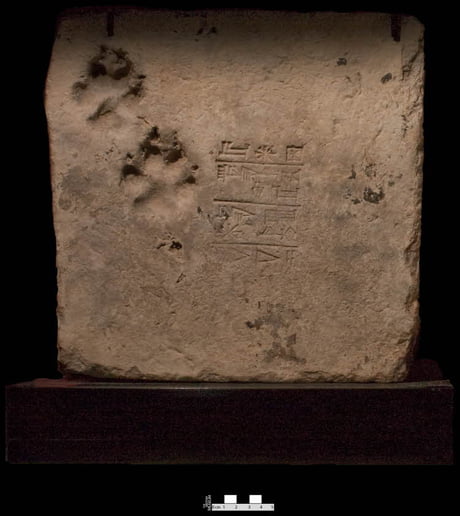
I've long been attracted to antique ceramics that exhibit accidental signs of their production. Aesthetic flaws that might take away from decorative value are what draw me to old pottery. As Nicole can testify, I pick up and flip over old stoneware crocks at the antique shops we visit to look for these things. I love misshapen crocks, pieces of other pottery adhered to finished ones, scars from the small clay "furniture" used to stack things in a kiln, and "turkey droppings" of excess glaze. Sometimes you can detect the streaks and impressions of the potter's hands and even individual fingerprints. Old bricks occasional feature animal footprints from creatures that got into a brickyard as things were drying. Dramatic kiln failures, unsuitable for sale, were called "wasters," and discarded at the kiln sites themselves.

    Kiln Waster, 1640-1660, Musueum no. C.10-2005  Clay brick with footprint of a cat paws, Ur 2112 BC – 2004 BCE
Examples of turkey droppings, a potter's fingerprint, a 16th-century Dutch kiln waster, and a 4000-year-old tile with a cat footprint from Ruby Lane, Ebay, the V&A, and here.

What could be more interesting than these little material signatures of some past failure? I far prefer flawed objects to perfect ones. And sometimes it's not accidental. Navajo rug weavers deliberately introduce flaws into their work. Japanese culture values wabi-sabi, an acceptance of natural imperfection. That sort of acceptance is not a strength of "Western" cultures, even if many people believe that perfection is best left to God.

Detail of Navajo textile
A "spiritline" in a Navajo rug that Western eyes might read as an unacceptable imperfection. From the Smithsonian Museum of American History, here.

My most moving experience during a recent class I took on historic window restoration was when the craftsman leading the workshop was examining a century-old plate glass window and detected, in the awkward streak of glass on top of the pane's surface, evidence of an accident during production. "This is an amazing piece of glass," he said, staring into the pane, "See that streak, that odd blob? Someone messed up. That's someone in the shop tripping and accidentally throwing a bit of glass onto this finished pane." You could almost hear the echoes of a glassblower cursing his clumsiness across a century of time.

Since seeing it on my colleague Brenda Hornsby Heindl's blog in 2013, I've also coveted a particularly sculptural failure she acquired, a fused waster of mid-nineteenth century pipe heads uncovered on a kiln site in Ohio. This accident could hardly be more artistic, to my eye, if someone had tried to create it on purpose.


I was in Gettysburg this past weekend when, in one of the town's innumerable relic shops, I came across a small example of a similar accident, this one from the 1860s kiln of John Taber of Wolfeboro, New Hampshire. Taber was a prolific potter who produced distinctive redware clay pipe heads (smoked by inserting a reed stem into a socket next to the bowl) which have been found on archaeological sites across the country. In the late twentieth century, it seems that someone (not an archaeologist) dug Taber's kiln site. Many of the recovered pipe heads have subsequently made it onto the antiques market. The dealer I visited had a number of intact pipe heads, but what caught my eye was a waster: two heads that had collapsed and fused together.


Normally I don't buy "dug" materials. You can find plenty of things in antique shops that have been excavated by people for fun from battlefields, privy pits, and homestead sites. Without any written documents or records, and with none of the attention to detail that professional archaeologists deploy to capture information about the past through the buried records, these individuals effectively loot our collective heritage for fun and profit. Purchasing dug items encourages the ongoing excavation of similar things.


In this case, however, I couldn't resist an ethical compromise. It's unfortunate that whoever dug Taber's kiln site doesn't seem to have left any record of what they found. But in this small artifact, we can see the shadow of an accident that happened 150 years ago. It reminds me that things rarely end up as we intend. It reminds us to look for the beauty in the imperfect. No good for smoking - no good for most anything in 1865 - this bit of trash, it turns out, is quite good for thinking.

Sunday, April 19, 2015

Appomattox at 150

I spent three days last week at Appomattox Court House National Historical Park as part of a group of volunteers demonstrating Civil War drill and discussing army life with visitors. Since getting back to the twenty-first-century, I've been thinking a lot about what drew so many people to an out-of-the-way corner of Virginia for the anniversary of the surrender of the Confederate Army of Northern Virginia under Robert E. Lee.

Entertaining some young visitors to Appomattox, April 2015.

The anniversary of the surrender, April 9th, was a rainy Thursday, but the park still received thousands of visitors. For some, the attraction was genetic. They had an ancestor "in the war," as they inevitably put it, maybe even one who was there at Appomattox 150 years ago. There were descendants of Ulysses S. Grant and of A.P. Hill, a Confederate general killed only a few days before the surrender. Many more visitors traced their lineage to common soldiers, North and South.

One older visitor stopped me in the street in front of the McLean house, where the surrender took place. "Are you a federal officer?" he asked. "Yes," I said, "I'm portraying a second lieutenant." "Well," he paused, "I'd like you to fill out my parole." With shaking hands, he held out a slip of paper, one of the reproduction parole sheets the Park Service had been printing and distributing all day. I asked him to spell his name and wrote it in the blank space. The form also asked for a company and regiment affiliation. He didn't hesitate when I asked him, so deeply did he feel a connection with a particular historical unit. "Company K," he said, "47th Virginia Infantry."

Many people came not because of any particular ancestor, but because the war has exerted some longstanding hold on their psyches. One middle-aged man remembered growing up around the 100th anniversary of the war. "I've been waiting fifty years for this!" he said. I met people from Connecticut and Tennessee who had spent countless hours on the road to be at Appomattox on April 9th. I spoke with one man from Maine, where he is a docent at a museum built by Civil War veterans. For all their different reasons, people came to stand on this particular, unremarkable patch of ground on an unremarkable Thursday in 2015. And they came in far greater numbers than I expected. Thousands watched as the actor portraying Lee exited the McLean house in midafternoon.

Lee. Win McNamee/Getty Images from here.

As the Lee actor mounted his horse and rode slowly down the lane, between rows of visitors, an older woman behind me leaned forward to stare. She grabbed her husband's arm and spoke with hushed reverence. "Isn't he magnificent?"

And, as humorous as this seemed at the time, I have to admit that it was true. He was magnificent. He was everything we imagine of Lee, stately and serene, even in defeat.

It is my experience that there are two types of Civil War enthusiasts: Lee people and Grant people. Which man we find more compelling says at least as much about us as about them. The two heroes are so different, and perhaps that's what makes their meeting at Appomattox so compelling. The Southern patrician, poised and inscrutable, meets the Northern victor, mud-spattered and casual. Here we have the two great American heroic archetypes: the honorable knight and the self-made cowboy.

Grant and Lee. Autumn Parry, from here.

The reality is more complicated and wonderfully ambiguous. Was Lee such a marble man, or a base hypocrite? Was Grant a salt-of-the-earth military genius, or merely a lucky drunk?

That is, I think, why so many people find the Civil War so fascinating. Nostalgic minds can find all the honor, nobility, and grace they want. They can find stories of good and evil, the triumph of righteousness and the tragedy of the Lost Cause. And those of us more inclined to skepticism can find equally compelling complexities and contradictions at the heart of the story. The real Lee and Grant, after all, are at least as interesting as their mythological versions.

The day after the surrender anniversary, a ceremony recreated the final act of the Army of Northern Virginia, the stacking of arms. As the Confederate reenactors slowly arranged their muskets in pyramidal stacks and piled up their cartridge boxes and bayonets in heaps below, their color-bearers passed ragged banners over the ranks so that each man could grasp the flags one last time before the final surrender. As they marched away, I noticed that many had real tears streaming down their faces.

A Confederate color-bearer passes a flag over a line of troops at Appomattox. Autumn Parry, from here.

This was not melodramatic acting. I've worked with reenactors for years. Deep down and despite the name, most are terrible actors. No, these were genuine emotions, felt by men of 2015 reliving the bittersweet final moments of the war.

The Civil War is at the core of our national creation myth. But we can each make our own myth. When Americans imagine the stately Lee meeting the disheveled Grant in the McLean house, they can see it as a moment of loss or of victory. It was both, after all. And either way, it was a fork in our national road. We struggled mightily over the basic ideas of our society. Appomattox was where we finally settled, or at least began to answer, questions about democracy and slavery, merit and aristocracy, and the shape of our society and nation.

That's why this place matters to so many people.

Sunday, March 2, 2014

Gems from the Regimental Books of the 26th Michigan Volunteer Infantry (1862-1865)

A few weeks ago, I took a day trip down to Washington, D.C., to pick up a printing press. That's a long story in itself, and one I'll save for a later post. But, I also spent some time at the National Archives doing research. Among other things, I pulled the regimental and company books of the 26th Michigan Volunteer Infantry, a unit in the Union army during the Civil War. Company A (approximately one hundred men) of this regiment was composed in part of men from my home town, Traverse City, Michigan, and dubbed by locals the "Lakeshore Tigers."

This exceptional cased tintype, sold by Cowan's Auctions, shows a federal soldier holding a hand-tinted red apple next to his knapsack with unusual stenciling indicating his membership in Company A of the 26th Michigan Infantry.

This personal connection and my own research interests prompted me to take a quick look at the books of this regiment, now held as part of Record Group 94 at the Archives and which comprise four volumes:
  • A volume containing a list of officers, a descriptive list of enlisted men, consolidated morning reports (daily numerical counts of soldiers present) recorded between April 29, 1863, and November 3, 1864, and the regimental order book (in which clerks copied army orders with some bearing on the unit)
  • A volume containing descriptive rolls and details remarks on the men in Companies A-K
  •  A volume of company orders (similar to the regimental order books, but bearing on the company level) for Companies A, D, and F, and rosters of Company F from the fall of 1862
  • A volume of morning reports for Companies A-K from April 1864 through May 1865
Although most of these records consist of rather dry statistical data and various rosters, announcements of promotions and demotions, and brief notes about desertions, disease, and casualties, interspersed among this paperwork are intriguing details about life in this Union regiment. I wanted to record and discuss some of them here, because they show how uniform regulations and commanders' wishes often butted up against the idiosyncrasies and personal tastes of private soldiers in the Civil War. Most the orders below came from regimental and division commanders, the men whose decisions about the minutiae of uniforms and accoutrements most impacted the individual soldier. In the following transcriptions, I have left spelling intact but altered punctuation and accompanying capitalization in a few places for readability. 

In camp near Alexandria, Virginia, on April 12th, 1863, the regiment prepared for a summer of marching:

"1st Captains will at one make requisitions for one Shelter Tent for each Commissioned Officer, and one for every Two Non-Commissioned Officers and Private needed for their Companies.
2nd Officers baggage will be limited to blankets, a small Valise or carpet bag and reasonable mess-kit,
3nd All extra baggage, Arms, and Private baggage, will be neatly packed and marked and turned over to Quarter-Master."

Similar concerns about weighty baggage persisted in April 1864, even though  26th and other regiments in the First Division, Second Corps were veteran marchers by then. The First Division headquarters still felt it necessary to issue a general order (number 104)  regarding marching that month. As recorded in the 26th's order books, it read:

"Comd'g Officers should see that the Surplus clothing of the me is sent to the rear under Par. 1. Gen Order No. 17, A of P. It is the old clothing rather than the new, which should be sent to the rear each man being provided with a new suit to begin the summer campaigne with, each man should be allowed to carry in addition to the suit he wears, only a change of under clothes, a woolen and Rubber Blanket an extra pair of shoes, and a few of under light articles as can be carried without materialy increasing his burden.
"In view of the fact that much of the falling out from exhastion on a march is owning to heavy Knapsacks. The Provost Guard of the Division will be instructed that when a man falls out of the ranks upon plea of exhaustion his Knapsack will be searched and all extra woolen Garments of heavy articles not authorized by orders will be thrown away upon the Spot. The name of the Commanding Officer of the Company who allowed such overloading of Knapsacks to which the belongs will be taken and reported to the Brigade Commander for his Action. This Order will be read three times at the head of each Company, and thoroughly brought to the notice of the any Commanding Officers will take care to have on hand a sufficient number of Shelter tents to fill places (when the Army moves) of the worthless ones now covering the wooden huts."

That same April, in 1864, the First Division reminded its various constituent regiments that "Men who leave the ranks to attend the calls of nature must leave their guns with their Comrades. Company Commanders may allow a sufficient number of men to leave the ranks with the canteen of the company to search for Watter. Three or four men will be enough to fill the canteens of a company. The Men will leave their guns with their Comrades. No man must be found out of the ranks with his gun or a single Canteen."

The 26th's regimental orders also offer interesting insights into how the men were supposed to carry their equipment. Commanding the regiment on January 14, 1865, Major Nathan Church instructed the soldiers to appear for an inspection with their knapsacks "carefully packed, over coats neatly rolled and strapped on the Knapsack, Canteens and Haversacks on the left side the Canteen over the Haversack." On April 19, 1865, Church prepared the men for another inspection, instructing that "Knapsacks will be neatly packed with woolen blankets rolled inside of the rubber and strapped on the Knapsacks, and in the absence of Woolen blankets, Great coats will used." Again he felt the need to remind the men that "Haversacks and Canteens will be worn on the left side, canteen over the Haversack." This last part is especially interesting, because every image with which I'm familiar shows soldiers wearing their canteens over their haversacks (see the modern photos below). If this was the universal practice, why prescribe it at all? I'm unaware of any images of or any other documentation for soldiers wearing their canteens under their haversacks. Because of the size and shape of these accoutrements, such an arrangement would seem uncomfortable, pressing the hard round metal canteen into the hip, and would also make the canteen difficult to access for drinking and refilling because it would be wedged under the haversack. And yet, Church's reminder indicates that even at the very end of the war, some men must have been wearing their accoutrements this way, necessitating the specific order.

As for other aspects of the soldiers' appearance and uniforms, a few hints appear in the orders. On December 23rd, 1862, a circular from the "First Provisional Brigade," Union Mills, Virginia, copied into the order books of the regiment reads:

"In answer to inquiries made at these headquarters how to were accoutrements of the men and to insure uniformity the following will be observed. The coats jackets or blouses will be at all times buttons and hooked and only the cap as precibed worn. No citizens hat or [unclear] covering etc. will be endured. The pantaloons and over coats light blue. Men in possesion of dark blue pants will will wear them only in camp. As regards the dark blue over coats of the 128th N.Y.V. and the black ones of the 29th N.Y.V. an exchange must be affected to given them either to Musicians and Sergeants or to the flanking companies. Enlisted men will under no condition be allowed to carry pistols or knives on their belts. To Regiments not haveing shoulder belts to support their cartridge boxes it would be suggested to make requisition for them. Every soldier leaving camp for leave of Absence or going to head-quarters or to a superior officer will wear always his side arms."

The order continues, and I'll break it down to better illustrate the distinctions it mentions (click on the modern photos for larger views):

"The haver Sack will be worn under the belts hanging on the left side so far back upon the hip that it can hardly be seen when standing before the man. The canteen over it.) In Regiments haveing the Shoulder belts.}"


Two views of the prescribed arrangement of accoutrements. Technically, I messed up a bit - the haversack strap should be underneath the cartridge box shoulder strap. Oops.

"Those without shoulder belts will wear the canteen on the right side) also back upon the hip for guard mount parade & review. Upon marches it will hang over all the belts so as to be convenient for use."

Although soldiers seem to have preferred carrying their canteens over their haversacks, this arrangement places it on the right side because the cartridge box, now connected to the waist belt rather than a shoulder belt (the box is constructed to accommodate either setup), sits closer to the center of the back. The cartridge box could weigh quite a bit, with forty rounds of lead bullets and powder, but soldiers did sometimes remove the shoulder strap in favor of this means of carrying it. 

"The shoulder belt with cartridge box will hang from the left shoulder to the right hip the box as far back as posible and the cartridge box ought never to be drawn the waist belt when carried on the shoulder belt."

So, NOT like this. Why a soldier would do this eludes me. It does help distribute the weight of the cartridge box between two straps, the belt and the shoulder strap, but it also means that to remove it you have to first undo the waist belt (with its other hanging accoutrements) and then pull the shoulder strap over your head while it dangles everything else. Again, however, this prescriptive order instructs against something only because it was obviously a problem.

"There ought to be a distance of an inch or two between the upper edge of the cartridge box and the lower edge of the waist belt. The waist belt to be sufficiently tight so as to hold the before on it. The latter will set in the same position as above designated vice touching the right waist button on the back."

A view of the cartridge box sitting under and below the waist belt.

"The waist belt plate to cover the 9th button. The bayonett frog to be behind the left hip. The cap box close to the waist belt plate [buckle] and on the right of the latter."

This front view shows the arrangement detailed above, although in this case depicts a four-button sack coat instead of a nine-button uniform coat. The bayonet "frog" is the leather throat piece, strung on the belt, which connects to the leather socket-like bayonet scabbard.

"The Knapsack above all ( and no breast straps to be worn optional on the Knapsack slings. Great coats when not worn to be folded under the flap. Blanket wraped in the india Rubber one neatly foled on the top of the Knap sack. Commanders of Regiments and companies will require their Noncommissioned officers to wear badges of their Ranks."

Albert H. Davis, Company K, 6th New Hampshire Infantry. In this image from the Liljenquist Collection at the Library of Congress, Davis wears a full set of accoutrements, including a knapsack (although his blanket is not rolled in an "india Rubber" one, issued for use as a groundcloth and rain protection, as described above). His haversack and canteen hang quite low, indicating that he hasn't done much marching yet, and he wears a regulation uniform coat, complete with decorative brass shoulder "scales." Keep in mind that this image is reversed from life, meaning we are actually viewing his left side.

The men of the 26th apparently had dress ("frock") coats like the one worn by Davis above, in February, 1865, when Major Church instructed them to wear them when on guard duty, along with white gloves. Nevertheless, the commanders of the 26th struggled to maintain uniformity among their troops. Major Lemuel Saviers reminded the regiment on April 16th, 1864, that "All Officers and men of this Regiment will be required to wear, either in Camp or on duty, the uniform Clothing prescribed by Regulations."

Although the 26th was complimented on April 21, 1864, for "the prompt manner in which they have they handle their pieces [guns] during the drill in the manuel and for their Steadiness while in the ranks on Parade," other aspects of their appearance sometimes raised concerns. On January 12, 1865, the regiment was cited for violating certain paragraphs of the army regulations (you can read them in their entirety here): 100 (grooming and hair), 125 (requiring men detailed as officers' servant to still dress and drill as soldiers), 255 (saluting while carrying arms), 256 (saluting when not under arms), and 257 (saluting when an officer approaches a sitting or standing soldier). Hair continued to be an issue for the 26th, and Major Church called attention to paragraph 100, "requiring the hair to be kept short and beard neatly trimmed," on January 14, 1865. Again, on the 16th, he instructed company commanders to "cause the evil complained of to be remedied at once." 

Given the variety of hair styles among soldiers, one wonders just how unkempt the men of the 26th had become by early 1865. Would this typical but unidentified man (tintype from eBay), for instance, have passed inspection or not?

One last, humorous anecdote. On March 11th, 1863, Major Lemuel Saviers issued a stern warning, explaining the punishments that would be meted out to any man who did not "make proper use of the sinks [latrines]" or was "caught committing any nuisance on the parade ground of the immediate vicinity of the Camp." He concluded with this rebuke:

"Common decency would require men to make a more proper use of the sinks and not allow reports to be going to Army Hdqrs that the men of this Regt do not know what a sink is made for."