Showing posts with label Flax Growing. Show all posts

Monday, June 25, 2018

Flax to Linen, the 1765 Way, Part VIII: Weaving and Conclusion

Four summers and a thousand years ago, to paraphrase a line from the 1975 film The Man Who Would be King, I planted a garden in the yard of the Cooch House outside Newark, Delaware. It proved a welcome distraction as I worked my way through several hundred books in preparation for my PhD comprehensive exams. In that garden I planted a small patch of flax, with the goal of using John Wily's 1765 Treatise on the Propagation of Sheep, the Manufacture of Wool, and the Cultivation and Manufacture of Flax as a guide to see flax seed all the way to woven linen.


It wasn't the first or the last time I grew flax; I also planted it on the Winterthur estate in 2010 and at a University of Delaware community garden in 2016. But so far it's the only time I've managed to actually actually make linen. Nicole and I retted, heckled, spun, and wove flax into linen over the course of four years, two states, and three homes. That's a pace that would make any eighteenth-century farmer laugh, but luckily my agricultural pursuits thus far have been purely avocational.

When I last checked in about this project in March of 2017, my yarns were bucked and ready for weaving. "The weaving of Linen I suppose I need say little about," wrote John Wily somewhat unhelpfully, "as it is wove in the plain Way." Without enough linen yarn to warp a large loom (or, for that matter, without a large loom to warp), I instead borrowed a friend's small tape loom, used to weave narrow trims and ribbons ("tapes") and got to work one day this spring.


The tape loom warped and ready for weaving to begin.


The tape as it nears completions.

I used about half of my stock of yarn, and weaving it into a strip was a quick job. Almost before I knew it, I had a 13"-long piece of half-inch linen tape. By a rough estimate, I think I have enough extra yarn that I could weave about twice that, meaning that my eight-square-foot patch of ground, planted at a 1765 seed density, yielded about 13 square inches of linen. I wouldn't take that as a conclusive insight into the productivity of linen in the eighteenth century. Most importantly, the yarns I spun were large and clumsy, meaning I generated far less yarn length than a skilled spinner would have.


Details of the woven tape.

Wily discussed bleaching (whitening linen) in a bit more detail than weaving, though he was honest about the limits of his knowledge: "This process I must confess I never saw performed." I decided not to bleach my linen, mostly for aesthetic reasons. My tape looks pleasingly natural and, anyway, people didn't always bleach their linen in the eighteenth century, either. Anyone with ambitions to do so only needs a grassy yard, some soft cow dung, a bit of lye, and some sour milk.

That meant I had finished making linen, long after my comprehensive exams and on the other end of a trans-Atlantic voyage, a wedding, two moves, nine cat rescues, a new job, and four years. John Wily didn't offer much insights into all those other steps, but they were part of my own process nonetheless.

In 1769, a few years after he published his book, John Wily wrote to the Virginia Gazette, still advocating for the domestic production of cloth in the face of British oppression. More than anything, it is the charming nature of his humility that reaches out across two hundred and fifty years. "To conclude," he wrote at the end of his letter, "I must beg leave to inform the readers I am but a poor Buckskin, with a slender education; therefore hope no one will be offended at this poor unpolished piece, but kindly accept of it as my honest endeavors herein to serve my country."

Saturday, March 11, 2017

Flax to Linen, the 1765 Way, Part VII: Bucking

Once you have spun and hanked (wound into coils) your flax yarns, wrote John Wily in 1765, they should be "boiled in Water and Ashes, to make it soft and pliable, that it may weave the closer and tighter together" (49).

Wily was frustratingly vague here, but other sources help flesh out his meaning. Samuel Johnson, in his 1755 Dictionary, defined "buck" as laundry, laundry water, and the act of laundering. So one could presumably buck your buck in buck. But more specifically, bucking was the first step in softening and bleaching flax for linen. A 1766 volume described in detail how flax yarns were bucked  by soaking them in water and treating them with lye (s.v. "Buck" and "Bleach"). One 1809 source even suggested boiling flax in seawater, unslaked lime, and potash before spinning it (265-266).

In 1765, a "lye" (a derivative of "alkali") was a very basic (versus acidic) solution. The most common household lye was rendered from potash. In short, water was passed through wood ashes (ashes in a pot) and a filtering medium. People used what trickled out for a variety of purposes, especially soap. Or, in the case of some farmers, softening and bleaching flax.

But, unlike other sources, Wily doesn't say to use lye or potash. He just says ashes. So, I experimented with these instructions alone. As far as ratios go, I decided to go with a source from 1769. Granted, it's talking about the treatment of grain to avoid fungal infections. But it's the closest I've found to an actual ratio: "Make some lye, such as is used for linen, in a bucking-tub, putting four pounds of water to every pound of ashes," (s.v. "Burnt-grain"). But instead of steeping the ashes in water to make lye, as these instructions suggest, I simply used the 4:1 weight ratio as the basis for otherwise following Wily's instructions.

That is, after I imposed on a friend to collect a bag of ashes from his wood stove (the handoff of this bag, of course, generated a number of tasteless jokes about drug deals and grandmother's ashes).

"You should boil it," wrote Wily," until you see it begin to lint, that is, when you see a Lint or Fuzz rise on the thread" (49).

Vague again, you Wily bastard (see what I did there?). More experimenting was in order.

After doing a small test to make sure that my linen wouldn't simply disintegrate, Nicole helped me dutifully measure out the appropriate amounts of water and ashes.


We prepared four small hanks: a control, one boiled for five minutes, one for ten, and one for twenty.

Three of the miniature flax hanks before boiling.
The problem, we instantly realized, was that it was impossible to see anything in the ashy water. I had assumed Wily meant you would be watching your flax while it was submerged, but clearly he wanted you to fish it out periodically to examine it. But even when we fished the linen out, it was hopelessly dingy and clotted with small bits of charcoal, making it impossible to see any linting. So we went with the timer method, even if it's anachronistic. This was an experiment, after all.

I was skeptical whether the ash had many any difference when we first removed the flax hanks from the water. But lo and behold, after I washed them clean and let them dry overnight, they did indeed show stark changes.


Each of our three tests showed that increasing the boiling time both softened the flax and significantly lightened its color. Wily never mentioned color changes, but that helps explain why bucking was a first step in bleaching flax to a pure white color.

I wish I had prepared a few more miniature hanks and really let them cook. I suspect a half hour would be about ideal under my stovetop conditions, but who knows what an hour or two would do? At some point, of course, the flax threads would begin to break down and the hanks would disintegrate, but I suspect that would take quite some time. People boiled linen textiles when they laundered them, after all, and they didn't disintegrate.

With my bucking experiment over, there is only one final step in this long saga of my journey from flax to linen: weaving. And that's a story for another day.


Thanks to Joseph Privott and Mark Hutter for their insights on bucking, Matt Mickletz for his ashes, and Nicole Belolan for her able assistance in all things.

Volumes linked above:

Temple Henry Croker, et al., The Complete Dictionary of Arts and Sciences... (London: Printed for the Authors, 1766).

Evert Duyckinck, Valuable Secrets in Arts, Traces, &c... (New York: Published by Evert Duyckinck, 1809).

Samuel Johnson, A Dictionary of the English Language... (London: W. Strahan, 1755).

A Society of Gentlemen, Members of the Society for the Encouragement of the Arts, Manufactures, and Commerce, The Complete Farmer... (London: R. Baldwin et al., 1769).

Sunday, December 18, 2016

Flax to Linen, the 1765 Way, Part VI: Heckling and Spinning

In my ongoing experiment in making linen from seed to fabric (about which you can read here), I've run rather behind (two growing seasons, in fact). But I've finally found the time to heckle and spin my linen into something resembling yarn!

John Wily, the author of the 1765 Treatise on the Propagation of Sheep, the Manufacture of Wool, and the Cultivation and Manufacture of Flax, describes in detail how to make a heckle, the wooden-based, iron-toothed comb that you use to strip flax of remaining "hards," or pieces of non-fibrous core of the stalks. For the most refined flax production, Wily says, get yourself a graduate set of heckles, because you can work down to smaller teeth and thus finer flax fibers. "But," he concludes, "many People have only one, of a middle Size," (43).

Living as I do in 2016, and I have a much easier recourse to the internet than to a blacksmith capable of making the the 176 tapered, 4-inch long, steel teeth that Wily says you need to make a heckle. So I bought an antique one. It dates to the nineteenth century, and it's clearly seen some use.


Wily says to take a bunch of your flax, shake it to loosen it, wrap it around a couple fingers, and "fling the other Ends of the Flax on the Points of the Heckle Teeth." Do this enough times, and what you end up with is "the longest of the Flax," which "will make very good Thread," (45).


The problem, I discovered, was that if your initial twist of flax is too big (mine were), you end up hopelessly fouling both the twist and the heckle. Moreover, I suspect that my previous scutching/swingling had left many more hards than Wily would have liked, which also contributed to the mess.

Most importantly, I discovered, you need to keep your twist of flax well in hand, because as soon as I set it down and began to try to pick through it, the neat bunch of fibers transformed itself into a bird's nest.


I was rather crestfallen at the results. Bertie the cat was rather crestfallen to be trapped indoors.

What I ended up with was one small twist of pretty decent flax. As you can see from the picture below, as I heckled the flax, the lengths of my fibers decreased because I was breaking more and more of them as I worked them through the heckle's teeth.
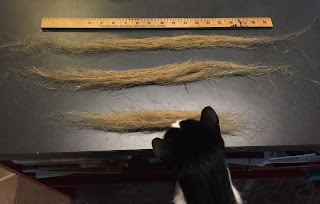
Bertie inspects the flax.

I also salvaged a wad of "tow," the shorter, bird's nest fibers. Over a couple nights, I managed to pick most of the hards out of the tow wad so that I ended up with a softball-sized, puffy ball of tow. 

Tow before I removed the hards (visible here as lighter-colored splinters).

I took these rather underwhelming materials to a friend, Heather Hansen, who is an accomplished spinner and knitter. Luckily for me, Heather has a flax wheel and the knowledge to operate it. Lucky because, I'll be honest, the spinning part of this process is what I find most confusing, even now that I've done it with Heather.


In theory, spinning makes sense. You just twist the fibers together like a very tiny rope, and this tension holds them together. But in practice, spinning flax on a wheel is like playing a drumset (I've never played a drum set, but I can barely rub my stomach and pat my head at the same time, so you get where this is going). You power the wheel with foot peddles, the wheel spins and engages with various mechanisms, and you manipulate the raw flax with your hands so that it is gradually spun and sucked up onto a revolving spool. Even with Heather's patient tutelage, I found the my hands and feet were often out of sync. I ended up spinning too fast, creating something that looked far more like twine than thread, or breaking the yarn.


Luckily for me, Heather was able to produce a more continuous thread (I contributed by operating the foot peddles). Even with my tow ball, which I had neglected to card as Wily instructed. He recommended processing tow with cards, the same sort of toothed paddles used for processing wool, in order to gather up and align short flax fibers. In fact, Heather, perhaps because she is more familiar with spinning wool, found it easier tow work with the ball of tow fibers than with the finer bunch of flax.


Our result is clearly much heavier than the yarns that early Americans would have wanted for weaving fine linen textiles, but it's still within the realm of possibility for use in things like upholstery webbing.


All told, we ended up with 236 inches (19.66 feet) of tow-based thread and 388 inches (32.33 feet) of finer linen thread. A better heckler could almost certainly have salvaged more fiber from my bird's nests, and a practiced flax spinner could have spun far finer threads and thus produced much more.

But for what it's worth, my 52 feet of yarn is the product of my eight square feet of mediocre soil, planted at the seed ratio Wily recommended in 1765 (which, when reduced down from acres, means two teaspoons of seed per eight square feet). If we assume that average for a whole acre of flax planted in 1765, based on the math I did when I planted back in 2014, we get a result of 278830.5 feet of linen yarn, or a remarkable 52.8 miles! And that's certainly on the far low end of what you could produce with an acre of flax.

So just how much finished textile can 52 feet of coarse linen thread produce? To find out, I need to boil my thread and weave it. Why boiling, you ask? Stay tuned to find out.

Monday, August 17, 2015

Flax to Linen, the 1765 Way, Part V: Scutching/Swingling

In my ongoing experiment in making linen from seed to thread (about which you can read here), I've progressed through growing, harvesting, retting, and breaking. After breaking flax, early Americans moved on to "scutching" or "swingling" the plants to remove broken pieces of the woody cores from the fibrous bark of each stalk. 

John Wily explained that there were two methods for what he called swingling flax: "one is performed by a Wheel, the other with a wooden Knife, which is the common Method." (41)

You can watch a video about scutching wheels here (skip to about 3:00 to see the wheel in operation). Wily believed a wheel only made sense for larger producers, and for the rest of us he offered a very simple description of making a scutching board, the base upon which you rest the flax when striking it with a scutching knife:

     Get a Piece of Plank about 5 or 6 Inches wide, 1 Inch thick, and 3 Feet long; plane one Side of it a  
     little overlong, tenant one End of it in a Block about 14 Inches long and 10 wide, so that the said
     Plan may stand upright; then within 3 Inches of the Top saw it within one Inch of being through,
     then split off the sawed Part for the Flax to lodge on, and leave the other Part as a Guard to keep
     you from striking your Hand with the Knife. (42)

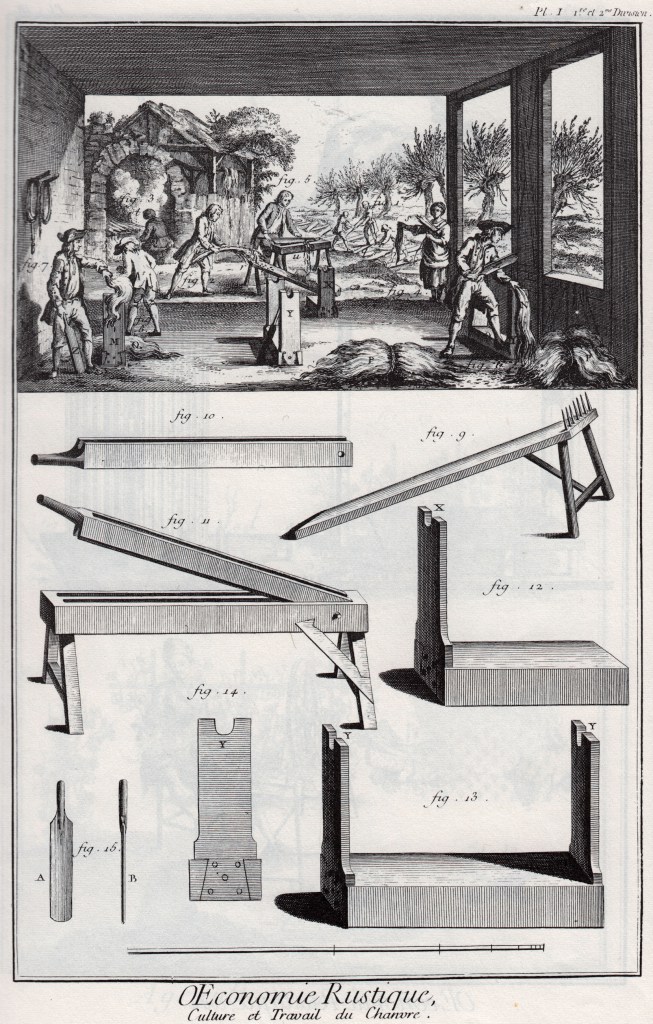
It takes a while to make sense of these directions, especially because most swinging boards I've seen have a piece cut out from the middle of the top of the board, as in Diderot's plate (Figs. 12-14; the objects around the lower right corner).

Diderot's flax tools, from "Sifting the Past".

But eventually I figured out that Wily meant to leave a higher portion one one side of the board. I later learned by experience that this portion should be on the side of your dominant hand. That's how it protects your other hand, holding a bunch of flax, from accidental strikes.

My scutching board with its extending protective piece on the upper left.

The scutching knife, Wily wrote, should be "almost in the Shape of a Dagger, the Blade to be about 16 or 17 Inches long, 2 and a Half broad, and 3 Quarters of an Inch thick at the Back" (42), but I varied a bit from his instructions. There are indeed scutching knives that look exactly like daggers. But I made one that resembled something more like a cricket bat or a fraternity paddle, based on Diderot's example in the plate above.


Rather than tenoning my board into a block, I simply seated it in the the ground and got to work. The idea behind scutching is simple: you're using the knife to strike and scrape what you don't want (chaff from the plant cores) from what you do (flax fibers). As artist Linton Park's 1885 painting illustrates, this was often a community event.


I was skeptical that such a simple process (scraping it with a piece of wood?) would have much effect on the flax, but it was in fact remarkably effective. Almost immediately, the roots and upper portions flew off the fibers.

Flax fibers (top) and chaff removed from stalks (bottom).

Although there are videos of more capable scutchers out there, here's my attempt.


I was, however, rather frustrated with how much fiber I was inadvertently scraping off along with the chaff, so after I had scutched all of the flax, I went back over what was left for another go. My final result was thus one bunch of quality flax and another with more tangled and chaffy fibers, the sort of coarse, short-fiber flax known, after further processing, as "tow."


Fine flax fibers (left) and tow flax (right).

With these fibers in hand, the next step in processing flax into linen is "heckling." That involves a rather sinister-looking tool, the heckle, that I'll discuss in my next post.

Saturday, July 25, 2015

Flax to Linen, the 1765 Way, Part IV: Breaking

You might remember that when we last left off with my rather quixotic project to turn a handful of flax seeds into linen fabric, I had finished "retting" the flax, breaking down the gummy substances in each stalk. Since then, I've passed my Ph.D. exams, sailed across the Atlantic Ocean, and failed to recreate historical waterproofing, among other things. My neglected flax sat in the pantry patiently through all of this.


Writing in 1765, John Wily offered two options for "breaking" flax, separating the woody core of each stalk from the fibrous, thread-destined bark. The first, and by my understanding the most common, was with a "brake," a simple machine that mashed a handful of stalks between its jaws. You can see a French brake as well as a variety of the other flax tools I'll mention in future posts in this plate from Denis Diderot's mid-eighteenth-century Encyclopédie.


Diderot's flax tools, from "Sifting the Past".

And if you're really interested in flax processing, check out this video on different types of flax brakes. Wily gave detailed instructions about building a brake, but I decided to try the other method he mentioned. It was less effective on a large scale, but its simplicity and an absence of historical study made it more appealing to me. 

Wily described breaking flax using "a Hand-Mall called Beatles," but he presumed that his reader was already familiar with the basic tools. Eventually, I figured out that by "mall" he almost certainly meant "maul," a large wooden hammer. But I have yet to find any surviving examples or images of flax beatles (though, apparently, beatle sometimes also referred to the scutching knife used in the step following breaking). The quest is complicated by the ubiquity of a certain British rock band in any internet keyword search.

Google: "Showing results instead for Lennon Beatle" 

Tyler: "NO! Linen beatle. LINEN BEATLE!"

Anyway, I finally went to town on my flax using a wooden mallet I had on hand. As Wily instructed, "lay it on some smooth solid Timber or Stone, and then take the Mall or Beatle in the right Hand, and begin at one End of the Handful and beat and turn it over until it is well mashed or broken..." (41, Colonial Williamsburg reprint of Wily's Treatise).

My makeshift beatle.

Half-broken flax, beatled on the right.

The woody core separating from the fibers.

I was rather nervous about this process, because it would be the real test as to whether I had retted my flax for the right amount of time last summer. Too few days, and the fibers would still be stuck to the cores. Too many, and the fibers would have begun to rot and would break short along with the rest of the stalks. But everything worked out quite nicely. As I was breaking the flax, you could hear the sounds change as I hammered each bunch and the stalks broke down. And the flax itself went from a depressing gray hue to a more (get ready for it) flaxen color.


Breaking is only the first step in refining the flax, but with a broken bunch in hand, I'm now ready to move on to the step called swingling or scutching. And I promise it won't take nine months to get there. 

Sunday, September 14, 2014

Flax to Linen, the 1765 Way, Part III: Gathering, Rippling, Retting

"To know when your Flax is fit to gather," recommended John Wily of Williamsburg, Virginia, in 1765, "you must observe the Leaves turning yellow, and the lower Ones dropping off the Stalks..." (33, Colonial Williamsburg reprint of John Wily's Treatise)

Sure enough, my flax showed signed of being "fit to gather" by early July, just about three months after I planted it and after a good growing season. So out Nicole and I went, on July 11th, to harvest the flax.

"The Method to gather your Flax is to pull it up by the Roots with one hand." (33)

"If the Seed is not full ripe, as it seldom all ripens together, you may let it lie in the Field two or three Days." (33)

Once farmers removed flax from the earth, the first step in harvesting every bit of useful material from the plants was to remove the seeds, which they could sell to special processors who extracted linseed (think linen+seed) oil, used for a variety or purposes including as a paint medium, from the seeds.

Flax Seeds

In order to remove the seeds from my flax plants, I needed a "Rippling Comb," for which Wily provides instructions: "Get a Piece of Plank about eighteen Inches long, three broad, and one thick; then have fourteen or fifteen teeth made of iron or steel, about six Inches long, in the Shape of a flooring Brad; then bore as many Holes lengthwise in the Plank as you have Teeth to put in it, letting the Teeth stand about a Quarter of an Inch apart." (33)

Someday, I'll get a truly authentic Rippling Comb. For now, lacking either a local blacksmith or my own forge, I went to my local hardware store and bought a box of the largest flooring brads I could find (essentially unchanged since 1765), a bit shorter than Wily's recommendation. Wily's directions seem almost foolproof, but I soon discovered two problems. First, my plank was inclined to split down the line of the brads even when I bored holes in advance of driving the brads in. I stopped short of Wily's fifteen teeth to prevent totally cracking my plank.

Rippling Comb

Second problem: teeth with spaces between them of 1/4" allowed my flax seeds to generally pass right through without pulling the seeds off the stalks when I did as Wily recommended: "take a Handful and strike it on the Teeth, and draw it through," (34). Either Wily meant that the teeth should be driven into the plank at 1/4" intervals (leaving only a narrow slit between the actual edges of each tooth) or flax plants in 1765 had slightly larger or more compact seed heads. This seems plausible, given that the flax I grew, marketed for flowers and seeds more than fiber, probably included more of these elements than you'd want if you were growing and breeding plants with an eye towards those that devoted the most energy to stalk (and thus fiber) production.

To counteract this problem, I had placed several of my teeth closer together, which allowed Nicole and I to quickly pull the seeds away from small handfuls of flax.


I'll get back to these seeds later. For now, it was time to ret my flax. Retting involves getting the flax plants wet for an extended period in order to break down the gummy substance that adheres the exterior bark (to be used for fiber) from the woody core of each stalk. You can discern the difference between the two parts when the flax is unretted, but you can't easily separate them.

Broken green flax

Although Wily provided instructions for retting flax by leaving it lying in dewy fields for several days or submerging it in standing water, he favored retting it in "a Stream of fresh running Water" for better cleansing the flax at a cool temperature (reducing the danger of over-retting and thus ruining your crop). Wily said to tie up your flax in "Sheaves, about the Size of a Sheaf of Wheat... with some good strong Bark, or Withe, for fear of its breaking loose in the Water," (35). The total product of my flax patch came out to something like as much as your typical wheat sheaf.


Tying a sheaf of flax with bark

I'm lucky enough to live near a "Stream of fresh running Water" as Wily suggested, and retting flax this way involves only two other tools: strong twine and a weight, in my case some rocks tied up in old stockings.


John Wily wanted to sound authoritative when he wrote his book, enough so that skeptical farmers might adopt flax for the potential cash crop he believed it was. But even Wily had to admit that "it is out of the Power of any Man to tell the exact Number of Days it will take to water or dew-rot Flax," (35). This was the riskiest part of flax production. A few hours too long in the water and you would overdo it, ending up with flax plants that, instead of producing long fibers suitable for spinning into fine and sturdy thread, had deteriorated too much and would produce only inferior, short, coarse fibers. 


Wily offered general instructions for how to tell if your flax had retted enough, and I dutifully walked down to the creek once or twice a day to remove a stalk or two, breaking them to see if they appeared "very rotten and tender" (35), as Wily described the finished goal. 

24 hours after retting began

48 hours after retting began

72 hours after retting began

Sure enough, after 72 hours in the river, the flax seemed to be quite rotten and, even more convincing given the interpretive room within Wily's description, I could see the long bark fibers easily sloughing off from the core of each stalk.

The real test will come later, when I move on to "breaking" the plants as the next step in processing the flax. Stay tuned for more.