Showing posts with label SEA Voyage. Show all posts

Monday, June 8, 2015

Whalemen and Waterproofing VI: On Graceful Failure

If I learned nothing else aboard the Corwith Cramer in 2014, it was how to fail gracefully. In everyday life, most of us have the luxury of stewing over our mistakes. You screw up at work, and it weighs on you for days. You get short-tempered with a friend, and you can't think about anything else.

On a ship, or at least the ships on which I've sailed, it's easy to make mistakes. And, boy, did I make a lot of them. I mistook halyards for downhauls, clove hitches for cow hitches, euphausiids for mysids, and, in one particularly embarrassing incident, the bunk of someone who had just fallen asleep for the bunk of someone I was supposed to wake up for a 3 AM watch change.

But at sea, things move very fast, and you have to account for your mistakes and move on quickly. A single day aboard the Cramer included five watch periods, so before you knew it, you had gone off watch, gotten a bite to eat and a nap, and come back on deck as if it was a whole new day and your mistakes long in the past. You learn, in short, to let your mistakes go, hoping that you can do better next time.

And so I thought it would be fitting to end this series on nineteenth-century maritime waterproofing techniques by discussing failure.

When I started this project, I had ambitions to recreate entire waterproof garments. But as I discussed in a previous post, many of the most intriguing period waterproofing recipes include toxic or unavailable ingredients. For a while, I considered attempting to recreate period paint- or oil-based waterproofings, but the more research I did, the more I realized that any such effort would include levels of compromise - regarding chemical ingredients, application techniques, and, not least of all, personal safety - that surpassed the payoff potential of such work. In a presentation at the New England regional conference of the Association for Living History, Farm, and Agricultural Museums this past March, I discussed the potential of using the inaccurate processes behind creating things like waterproof garments as interpretive tools alongside traditional living history interpretation. I really believe that historic sites should be more transparent about the choices they make, even if these sometimes involve inaccurate reproduction techniques like machine sewing or synthetic paints.

But for now, this project involved just me and my home kitchen, and I realized I couldn't answer a lot of my research questions (how waterproof was white lead?) with experimental archaeology.

But I didn't want to complete this project having only produced blog posts, not physical things. I had, after all, found at least one recipe that seemed straightforward and safe. I discussed it in my previous post on tarpaulin hats, and if you'll recall, I left off just as I was about to combine various compounds into sealing wax, one of two key ingredients in the hat-waterproofing recipe.

Here's where things got a little hairy. And, I apologize, I didn't take the time to stop for photographs. In his Ten Thousand Recipes, Mackenzie never explains how to combine turpentine, shellac, colophony, and lampblack to create sealing wax, but I think it's a safe bet that it involved melting them together to form a homogenous block.

What I realized, after repeated experiments on the stove top and even in a small toaster oven, was that  rosin (or at least the rosin I was using) has a strikingly peculiar tendency to burn before it melts. This discovery led to a kitchen filled with acrid smoke and some frantic internet searches about the toxicity of colophony fumes. The best I could do, in the end, was produce a flaky wad of roughly combined "wax."


But I still hoped that this would be good enough for the waterproofing recipe. After all, it said to powderize the sealing wax, and figuring this would mix the ingredients even more, I dutifully ground up half an ounce (a pitiful fraction of the massive amount of "wax" I had produced). I placed it in two ounces of ethyl alcohol in a glass jar "near a fire" just as Mackenzie said. I waited. The liquid warmed up. But the wax refused to dissolve as he said it should. With no sand for the "sand heat" he mentioned, I put the jar in a small pot of hot water on the stove, a double boiler arrangement I figured was not unlike a sand heat. 


And I waited. 

But no matter how hot I got the jar, even up to the point when the alcohol began evaporating and then boiling (173.1° F, apparently), the "wax" refused to dissolve. At best, it seemed to get rather soft and give the concoction the general appearance of a jar of watered-down coffee grounds.


I tried giving the result a whirl, just in case I was missing something. But the result was not even close to the "beautiful gloss equal to new" Mackenzie promised. I was right. It still looked like watered-down coffee grounds.


Frustration crept over me. And that's not something you want creeping around a kitchen full of boiling water and semi-molten pine rosin.

But then I realized something. It's called experimental archaeology. And experiments fail. 

I don't know where the problem was - with one of my ingredients (the unmeltable rosin, perhaps?), with my technique (does a sand heat work alchemical miracles?), or with the recipe itself (didn't any of the many publishers test this recipe before they plagiarized it?) - but there was certainly a wrench in the works somewhere. This was a failure.

But I usually learn more from failures than successes. In this project, I learned all sorts of things. 

I read sources I'd never heard of before, handled rare examples of waterproof garments in museum collections, and corresponded with curators, chemists, and collectors who contributed pieces to this puzzle. 

I discovered that the world of nineteenth-century waterproofing was both simpler and more complex than our own. By all accounts, you could make a pretty decent raincoat in the fo'c's'le of a ship if you had some canvas and a bucket of paint. The modern raincoat I took on my ocean voyage in 2014 may be more waterproof than older ones, but creating it, much less understanding its chemical components, is well beyond my abilities. Not to mention that it's become nigh on impossible to locate once commonplace ingredients such as spermaceti, natural rubber, and spirits of wine.

In the course of working on this project, I had rare chances to find out exactly what it was like to get wet at sea, and I have a newfound understanding for why nineteenth-century sailors would have risked a bit of lead poisoning for that evasive element of human comfort, staying warm and dry. 

At sea, I learned that failure is inevitable. The men and women I sailed with whom I most admire owned up to their mistakes and did better the next time. I haven't quite figured out how to fail gracefully. I certainly would have preferred to conclude this project wearing a shiny, waterproof straw hat. But I'm learning. And I know that there will be lots of opportunities to practice.

Wednesday, January 21, 2015

Sailing and Sewing aboard the Corwith Cramer

After spending six weeks aboard the SSV Corwith Cramer, 23 days of which comprised our Atlantic crossing between Gran Canaria and Dominica, I've been finding it difficult to quantify all that I experienced and learned. I was aboard the Cramer as a guest "voyager," a position that combined the roles of deckhand and visiting scholar. The Cramer is one of two ships operated by the Sea Education Association, an organization that runs semester-long programs for undergraduate students. Their voyages emphasize marine science, maritime skills, and cultural studies that vary based on changing cruise tracks.

I expected to learn about sail handling, knots, celestial navigation, the physical world of shipboard life, and how it feels to be out of sight of land for weeks at a time. And I did. But I also learned about meteorology, pelagic birds, and the "plastisphere" that develops around discarded plastics in the ocean. I worked on diesel engines, cooked for a crew of thirty, and examined the many tiny creatures that appeared in our net samples (including such bizarre animals as mesopelagic nudibranchs, phronima amphipods, and megalope). It was easy to get excited about such things because everyone on board was passionate about their field of study, be it engineering, history, sailing, or science. Conversations around the dinner table and on deck moved easily from tall ships to Caribbean politics to the physics of rainbows to the Lego movie. I shared a bit of my own passion in such informal conversations and in a presentation about material culture during one of our daily all-hands meetings.

Talking material culture at sea aboard the SSV Corwith Cramer. Photo by Jeff Schell.

I'm working on several reflective essays about my experience. In the mean time, I wanted to discuss what I worked on in spare moments between standing watch on the voyage: sewing and thinking about how and what sailors sewed at different points in history. During my time aboard the Cramer, I completed a reproduction of a sailor's jacket recovered from the wreck site of the General Carleton, a British vessel that sank in 1785. Historians Lawrence Babits and Matthew Brenckle documented the jacket in a chapter of the archaeological report available here. You'll forgive the anachronistic beard and glasses in the images below.


My reproduction of the General Carleton jacket, showing the general fit and wearing options of the garment.

I wanted to sew on board the Cramer as a way of thinking about what it must have been like for sailors aboard earlier ships to make and repair their clothing amidst their many other duties. Shipboard life and labor meant sailors often wore peculiar styles of clothes, garments that distinguished them from other workers. Clothing still matters to sailors. Today's professional tall ship sailors joke about looking like "schooner bums" when in port, and they can still recognize other sailors by the sorts of things they wear.

Ships, historically and today, are cramped places, and people are amazingly creative when they are looking for a place to work. On the Cramer, people played music, wrote in journals, read books, and crafted in their bunks, at the dinner tables in the main salon, on deck, on the "elephant table" (a seven-foot-high platform behind the foremast), and wedged into impossibly small places in the metal and wooden confines of our environment.

Sewing in the fo'c's'le. Photo by Farley Miller.

Today's sailors, much like those of the past, sew out of necessity. I was surprised how often I saw people sewing on board, given that most people I meet on land are unable to sew at all. There are several explanations for why sailors sew. First, every crewmember has only a limited wardrobe and no recourse to a clothing store, so they have to repair damaged garments if they wanted to wear them again.

Sewing in a bunk aboard the SSV Corwith Cramer.

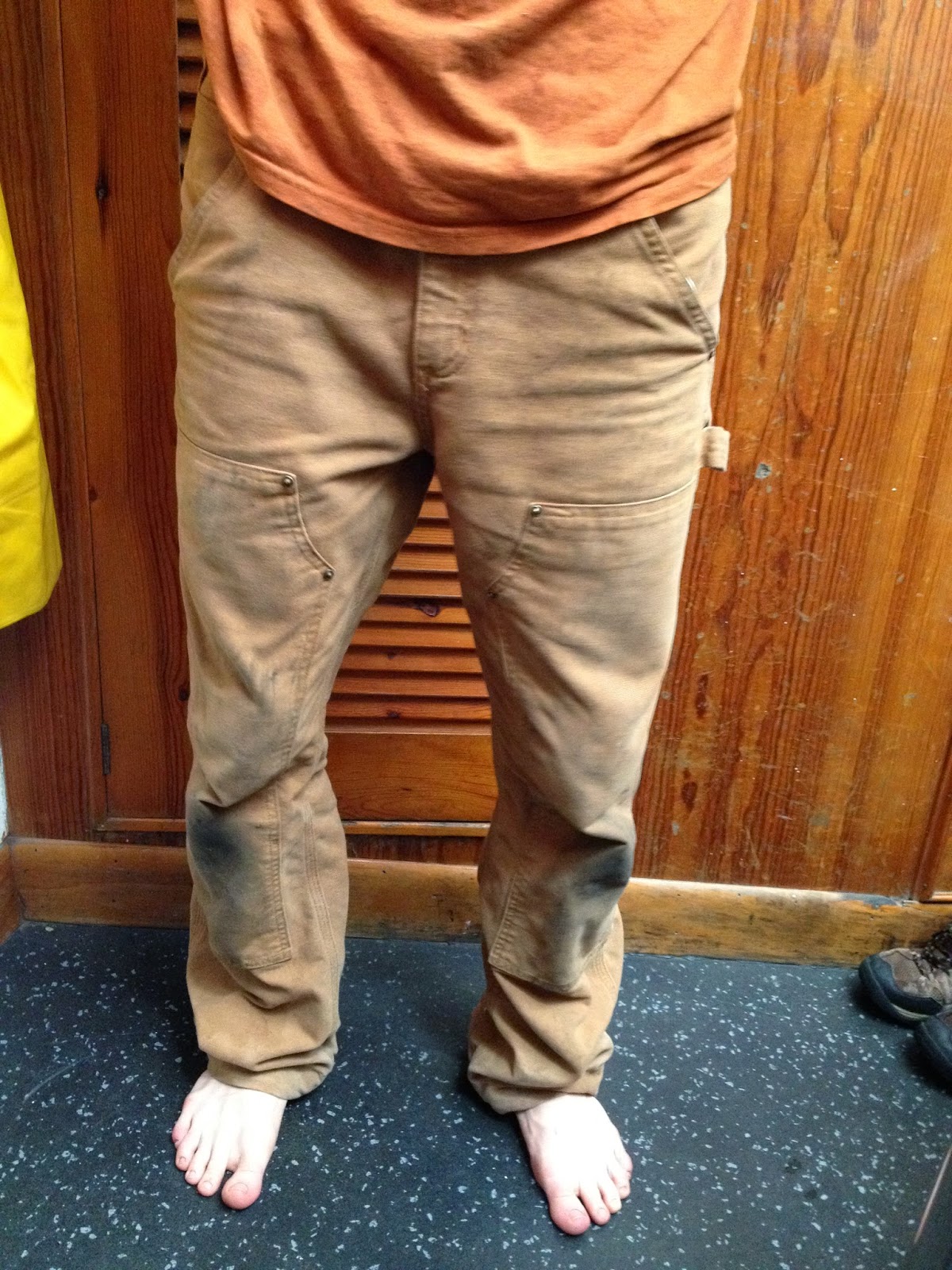
Clothing gets dirty and wears out quickly on board a ship. My own canvas pants, for example, looked like this after only a week's wear:

A week's impact on a pair of pants.

We had no washing machines aboard the Cramer, and so crewmembers laundered clothing in the open air of the deck. On any given morning, a handful of people enjoying their time off watch could be found sitting on the foredeck around small piles of dirty clothes or pinning clean ones up to dry on a line. It's amazing what you can do with two buckets, some soap, and your hands.

A shipboard washing machine aboard the SSV Corwith Cramer.

Drying laundry aboard the SSV Corwith Cramer.

Laundry hanging on the forward rail of the SSV Corwith Cramer.

But there are other explanations for why people sew so much onboard ship besides functional ones. One afternoon, I watched as a sailor patched a pair of Hawaiian-print shorts on the quarterdeck. The cotton was hopelessly torn in multiple places, and several generations of stitches, sewn cloth patches, and adhesive sail patches covered portions of the seat and leg. But these were a favorite garment, and she had worn them through several voyages. Sailors often live and travel with far fewer belongings that most people on land, so some things take on substantial sentimental value.

Sewing on the quarterdeck aboard the SSV Corwith Cramer.

Many of the crew and students on our voyage studied how plastics entered and impacted the world's oceans, and they were especially conscious about the wasteful nature of American consumer culture. All contemporary ships have to be careful with how much waste they generate, because they must transport inorganic trash such as plastics until they find a suitable land depository. We were very careful on the Cramer about what we used and threw away. Crewmembers carefully repaired clothing at sea when such garments might have ended up at Goodwill or the dumpster on land.

Sewing in a bunk aboard the SSV Corwith Cramer.

Depictions of earlier sailors at work and descriptions of their personal effects often include small boxes containing sewing tools. Almost as soon as I began sewing aboard the Cramer, I wished I had brought more small containers. Sewing doesn't take many tools, but even a pair of scissors, some thread, and few needles seems like a lot to keep track of when you don't have much space and your whole world is rolling back and forth. I was constantly losing pins, though thankfully all were found by eagle-eyed and patient shipmates, rather than in the soles of some poor sailor's foot late at night.

Sewing a new cover for the bench vise aboard the SSV Corwith Cramer. Photo by Ger Tysk.

The only sewing tool lacked aboard the Cramer was an iron. Historically, irons were just that - bars of iron heated in the coals of a fire or on a stove. I suspect most early sailing ships had one, and my inability to press sewn seams made my Carleton jacket visibly different from the original and other eighteenth-century garments I've examined. A talented shipmate was kind enough to make me a wooden seam rubber, a tool that presses linen seams using pressure rather than heat and steam, but it was ineffective in pressing woolen seams. The most successful effort occurred when the steward, Nina, and I conspired to heat one of her cast-iron pans in our shipboard oven long enough to get it piping hot and use it as a make-do iron.

Ironing with a skillet aboard the SSV Corwith Cramer. Photo by Nina Murray.

I had a file of research on the Carleton jacket and brought along all the supplies I would need to recreate it. Other sewing projects on board had less planning behind them. A few hours out of Dominica, we realized that our shipboard stores lacked the flag of that country. Typically, foreign ships visiting a port fly a "courtesy flag" as a gesture of respect to their host. With a small flag identification sheet as our guide, several of us went to work cutting up spare bed sheets and old t-shirts, assembling them into a one-sided rendition of the Dominican flag.

A sewing party at work on our rendition of the flag of Dominica.

Sailing, I learned, is about teamwork. Moving a ship across an ocean requires you to work with the people who happen to be your shipmates. That was true in 1492, and it's true today. The Sea Education Association's motto reminds crewmembers how they should arrange their priorities while on board: "Ship, Shipmate, Self." You arrive on a ship as strangers, and suddenly you are surrounded by the same small group of people without interruption for weeks at a time. You learn about your shipmates' idiosyncrasies, and you put up with their flaws in part because you have no other choice. But more importantly, these people, your shipmates, put up with your own failings. You pick up each others' slack. "Every time you feel like you're pulling more than your own weight," our chief mate told us early in the voyage, "That's good. Because whenever you don't feel that way, someone else does."  

Teamwork is hard work. Working and living together aboard a ship or otherwise can leave people embittered and unfriendly. But sometimes, the unpredictable chemistry of a crew produces a splendid result. The most valuable thing I learned while sailing aboard the Corwith Cramer had less to do with history, biology, metereology, or navigation. I learned that when you surround yourself with good people, anything seems possible. I did much less sewing on personal projects than I expected. But I'm most proud of a project I hadn't planned, that Dominica flag. Where else could you find half a dozen people, most of whom had never sewn a stitch in their lives, ready to drop what they were doing, chop up old rags, and assemble a flag at a moment's notice, all the time smiling? The result, like a good crew, sometimes looks ragged up-close, but when you step back and let the wind do its work, it is something quite beautiful.

Tuesday, November 11, 2014

Off to Sea (Again)

I think all maritime historians have a more or less secret desire to run off to sea. Maritime history is only one of my research interests, but I'm not immune to the lure of the ocean. I've thought a lot about what it must have been like to work and live aboard a sailing ship. Now, I have the chance to put some of my ideas to the test in a voyage sponsored by the Sea Education Associaton.

Beginning on November 12, I'll be aboard the SSV (Sailing School Vessel) Corwith Cramer as a guest "voyager" during the Cramer's sail from the Canary Islands across the Atlantic to Dominica and the U.S. Virgin Islands. I'll be participating in shipboard activities, working with the eight undergraduate students who are studying science and the humanities aboard the ship this semester, and conducting my own research.

SSV Corwith Cramer, a steel-hulled brigantine constructed in 1987. From SEA, here.

It's rather hard to do traditional historical research aboard a ship, with no archives and no internet. But so what? Historians are more versatile than you might think. While I'm aboard the Cramer, I'll be editing a couple of papers, massaging them towards their final, article forms. But I'll also be doing a lot of watching and learning, about the way a sailing ship works, about how sailors move and work aboard ships, and about what it feels like to be out of sight of land for weeks at a time. This is the sort of experiential learning that makes for good historical writing, because it helps us get closer to the lifestyles and feelings of people in the past.

And I'll be sewing, working to cut and construct replicas of the undergarments Richard Henry Dana Jr. made during his two years before the mast in the 1830s. I mentioned these unique garments before in connection with my ongoing "Whalemen and Waterproofing" project, and I'll also be thinking a lot about waterproof clothing while aboard the Cramer.

I expect I'll be quite busy. I'm sure you will be, too. But if you have some spare time and you're interested in following along, tune in for regular posts on the Cramer's blog, which will soon shift to documenting our voyage, here. Check back here for a series of posts about my experience coming in early 2015.