Showing posts with label 38th Voyage. Show all posts

Monday, June 8, 2015

Whalemen and Waterproofing VI: On Graceful Failure

If I learned nothing else aboard the Corwith Cramer in 2014, it was how to fail gracefully. In everyday life, most of us have the luxury of stewing over our mistakes. You screw up at work, and it weighs on you for days. You get short-tempered with a friend, and you can't think about anything else.

On a ship, or at least the ships on which I've sailed, it's easy to make mistakes. And, boy, did I make a lot of them. I mistook halyards for downhauls, clove hitches for cow hitches, euphausiids for mysids, and, in one particularly embarrassing incident, the bunk of someone who had just fallen asleep for the bunk of someone I was supposed to wake up for a 3 AM watch change.

But at sea, things move very fast, and you have to account for your mistakes and move on quickly. A single day aboard the Cramer included five watch periods, so before you knew it, you had gone off watch, gotten a bite to eat and a nap, and come back on deck as if it was a whole new day and your mistakes long in the past. You learn, in short, to let your mistakes go, hoping that you can do better next time.

And so I thought it would be fitting to end this series on nineteenth-century maritime waterproofing techniques by discussing failure.

When I started this project, I had ambitions to recreate entire waterproof garments. But as I discussed in a previous post, many of the most intriguing period waterproofing recipes include toxic or unavailable ingredients. For a while, I considered attempting to recreate period paint- or oil-based waterproofings, but the more research I did, the more I realized that any such effort would include levels of compromise - regarding chemical ingredients, application techniques, and, not least of all, personal safety - that surpassed the payoff potential of such work. In a presentation at the New England regional conference of the Association for Living History, Farm, and Agricultural Museums this past March, I discussed the potential of using the inaccurate processes behind creating things like waterproof garments as interpretive tools alongside traditional living history interpretation. I really believe that historic sites should be more transparent about the choices they make, even if these sometimes involve inaccurate reproduction techniques like machine sewing or synthetic paints.

But for now, this project involved just me and my home kitchen, and I realized I couldn't answer a lot of my research questions (how waterproof was white lead?) with experimental archaeology.

But I didn't want to complete this project having only produced blog posts, not physical things. I had, after all, found at least one recipe that seemed straightforward and safe. I discussed it in my previous post on tarpaulin hats, and if you'll recall, I left off just as I was about to combine various compounds into sealing wax, one of two key ingredients in the hat-waterproofing recipe.

Here's where things got a little hairy. And, I apologize, I didn't take the time to stop for photographs. In his Ten Thousand Recipes, Mackenzie never explains how to combine turpentine, shellac, colophony, and lampblack to create sealing wax, but I think it's a safe bet that it involved melting them together to form a homogenous block.

What I realized, after repeated experiments on the stove top and even in a small toaster oven, was that  rosin (or at least the rosin I was using) has a strikingly peculiar tendency to burn before it melts. This discovery led to a kitchen filled with acrid smoke and some frantic internet searches about the toxicity of colophony fumes. The best I could do, in the end, was produce a flaky wad of roughly combined "wax."


But I still hoped that this would be good enough for the waterproofing recipe. After all, it said to powderize the sealing wax, and figuring this would mix the ingredients even more, I dutifully ground up half an ounce (a pitiful fraction of the massive amount of "wax" I had produced). I placed it in two ounces of ethyl alcohol in a glass jar "near a fire" just as Mackenzie said. I waited. The liquid warmed up. But the wax refused to dissolve as he said it should. With no sand for the "sand heat" he mentioned, I put the jar in a small pot of hot water on the stove, a double boiler arrangement I figured was not unlike a sand heat. 


And I waited. 

But no matter how hot I got the jar, even up to the point when the alcohol began evaporating and then boiling (173.1° F, apparently), the "wax" refused to dissolve. At best, it seemed to get rather soft and give the concoction the general appearance of a jar of watered-down coffee grounds.


I tried giving the result a whirl, just in case I was missing something. But the result was not even close to the "beautiful gloss equal to new" Mackenzie promised. I was right. It still looked like watered-down coffee grounds.


Frustration crept over me. And that's not something you want creeping around a kitchen full of boiling water and semi-molten pine rosin.

But then I realized something. It's called experimental archaeology. And experiments fail. 

I don't know where the problem was - with one of my ingredients (the unmeltable rosin, perhaps?), with my technique (does a sand heat work alchemical miracles?), or with the recipe itself (didn't any of the many publishers test this recipe before they plagiarized it?) - but there was certainly a wrench in the works somewhere. This was a failure.

But I usually learn more from failures than successes. In this project, I learned all sorts of things. 

I read sources I'd never heard of before, handled rare examples of waterproof garments in museum collections, and corresponded with curators, chemists, and collectors who contributed pieces to this puzzle. 

I discovered that the world of nineteenth-century waterproofing was both simpler and more complex than our own. By all accounts, you could make a pretty decent raincoat in the fo'c's'le of a ship if you had some canvas and a bucket of paint. The modern raincoat I took on my ocean voyage in 2014 may be more waterproof than older ones, but creating it, much less understanding its chemical components, is well beyond my abilities. Not to mention that it's become nigh on impossible to locate once commonplace ingredients such as spermaceti, natural rubber, and spirits of wine.

In the course of working on this project, I had rare chances to find out exactly what it was like to get wet at sea, and I have a newfound understanding for why nineteenth-century sailors would have risked a bit of lead poisoning for that evasive element of human comfort, staying warm and dry. 

At sea, I learned that failure is inevitable. The men and women I sailed with whom I most admire owned up to their mistakes and did better the next time. I haven't quite figured out how to fail gracefully. I certainly would have preferred to conclude this project wearing a shiny, waterproof straw hat. But I'm learning. And I know that there will be lots of opportunities to practice.

Wednesday, June 3, 2015

Whalemen and Waterproofing V: Waterproof Hats

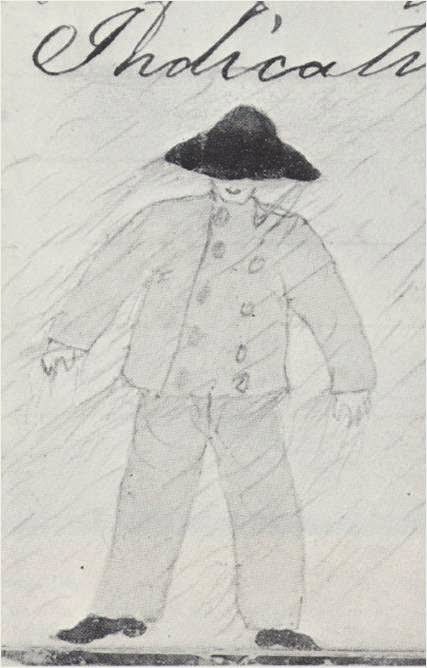
When I started thinking about historical waterproofing techniques as part of my participation in the Charles W. Morgan's "38th Voyage" last year (and writing blog posts under this label), I was keen to reproduce one of the ubiquitous "tarpaulin" hats worn by nineteenth-century sailors. I examined the waterproofed straw hat of sailor-author Richard Henry Dana at Mystic Seaport in 2014, and as I read through historic recipe books, I noticed that many mentioned hats as a common subject of waterproof treatments.

Detail of a sketch by Edward Haskell in his journal of the 1862 voyage of the merchant ship Tarquin, from Margaret S. Creighton, Dogwatch & Liberty Days: Seafaring Life in the Nineteenth Century (Salem, MA: The Peabody Museum of Salem, 1982), 3.

At last year's Fort Frederick Market Fair, a gathering of craftsmen and vendors who make and sell reproductions of historical material culture, I found just the thing I was looking for on the back shelf in a tent crammed with bric a brac.


Here was an old straw hat, the sort of thing people described as "half worn" in the eighteenth and nineteenth centuries, perfect for experimenting with a waterproofing recipe that I first encountered in Mackenzie's Ten Thousand Recipes (1867; pg. 347). This particular recipe appears verbatim in a number of nineteenth-century recipe books, and I've been able to trace it back at least as far as 1814 (pg. 41):

"A Black Varnish for Old Straw or Chip Hats.
Take the best black sealing-wax, half an ounce; rectified spirit of wine, 2 oz.; powder the sealing-wax, and put it with the spirit of wine in a four ounce phial; digest them in a sand heat, or near a fire, till the wax is dissolved; lay it on warm with a fine soft hair-brush, before a fire, or in the sun. It gives a good stiffness to old straw hats, and a beautiful gloss equal to new, and resists wet."

This seems like a straightforward recipe until you begin to take it apart.

Let's start with "spirit of wine." That's pretty simple. Spirits are beverages that have been distilled, and spirit(s) of wine was the result of repeatedly distilling wine. Today, we call the same substance aqua vitae or, in its more pharmaceutical form, ethyl alcohol. Chemically, alcohol acts as a drying agent in this recipe, speeding and stabilizing the drying process. For this experiment, the closest I could get to true spirits of wine at an affordable price was store-bought ethyl alcohol, which has some other chemical additives.


And "the best black sealing-wax"? Well, that gets trickier, given that sealing wax is not as universal a descriptor as ethyl alcohol. Luckily, Mackenzie comes through for us again, on page 357, with a recipe for black sealing wax. I suspect this was also an older recipe, but I've been unable to find it in an earlier source.

"Venice turpentine, 4 1/2 oz.; shellac 9 oz.; colophony 1/2 oz.; lampblack mixed to a paste with oil of turpentine, q.s. [quantum satis/sufficit: a sufficient amount]"

What's all this mysterious stuff, then, and where can we find it today?

Venice turpentine is a solvent made, like all turpentines, by distilling tree resin, in this case that of the western larch. It's still used today by some painters and, more commonly, in the care of horses' hooves. My supply came from Hawthorne Products, who make actual resin-derived (versus synthetic) Venice turpentine.

Shellac is easy. The female lac bug, native to southern and southeastern Asia, excretes this substance as it forms protective tubes on the branches of trees. Once processed, shellac has a variety of uses, especially as a varnish and wood finish. Of course, Mackenzie doesn't specify whether he means dried, pure shellac or the liquified, alcohol-based product sold in most hardware stores. I decided to go with shellac flakes, a wide variety of which are offered on eBay for use in various crafts, because I suspect that's what Mackenzie meant, given that he included turpentine as a solvent.

And colophony? According to the OED, it's "The dark or amber-coloured resin obtained by distilling turpentine with water." Technically, resin/turpentine is what comes out of trees. Venice turpentine and other "spirits of turpentine" are the fluids that evaporate in the distillation process, leaving colophony/rosin. Rosin is used for a variety of purposes today, including in the treatment of string-instrument bows, and there are many varieties available on eBay. It's hard to say if the one I acquired was actually distilled, but I went for it.


Venice turpentine, shellac, colophony, and candles for making lampblack.

Lampblack, used as the pigment in this recipe for black sealing wax, is a fine soot, unburned material left over from some fires (as, in an eponymous example, the soot that forms inside an oil-burning lamp globe). It's quite easy to make, as this primitive skills page testifies. In essence, you capture the smoke and soot emitted from a burning flame on a smooth surface such as a metal or ceramic plate, and then carefully scrape off the black residue. Mackenzie himself described a method (pg. 328) for gathering lampblack from a tin funnel suspended over a lamp, and as we might expect by now his instructions are identical to a set that appeared in numerous recipe books as early as 1804.


Lampblack from a beeswax candle accreting on a spoon.

The more industrial setup I came up with to harvest lots of lampblack from the bottom of a pot over a candle.

Finally oil of turpentine is, according to the OED, "a volatile oil, contained in the wood, bark, leaves, and other parts of coniferous trees, and usually prepared by distilling crude turpentine." It sounds to me like this was a crude turpentine, filled with impurities. I wasn't able to find a source for definite oil of turpentine online (though various vendors online offer suspicious "turpentine oil" and "pine oil" products). So I decided to mix the lampblack paste using regular turpentine.

With all the ingredients prepared, I was ready to mix up my sealing wax, dissolve it in ethyl alcohol as Mackenzie instructed, and paint up my hat. Sounds simple, right?

Well, about that...

Thursday, July 10, 2014

Shoes and Rigs Aboard the Charles W. Morgan

Note, 9-24-15: This post originally appeared on July 10, 2014, but it was recently and inexplicably deleted from my blog. Thanks to the foresight of folks at Mystic Seaport, I'm reposting it based on an archived copy. This may lead to slight formatting errors.


One of the first things I noticed about the professional sailors aboard the Charles W. Morgan during my leg of the 38th Voyage last month was the diversity of their clothing. This was nowhere more evident than in two particular parts of their wardrobes, their shoes and their "rigs," the leather holsters in which each sailor carries several tools. 

I suppose I had assumed that there must be some sort of agreed-upon standard for footwear, the best shoe for shipboard work. In fact, there were as many brands and styles as there were sailors aboard the Morgan. Aaron Gralnick told me that he adopted open shoes several years ago because "feet stink downstairs," and that he hates socks because they're just one more thing to put on when you have to get up and go quickly. The soles of these shoes, he finds, wear about about every two years. Nobody goes barefoot. Despite longstanding myths to the contrary, it seems that sailors in earlier periods also almost always wore shoes. You can read more about early U.S. Navy footwear here


Before boarding the Morgan, I'd never heard of a "rig" in the context these sailors use the term. Each crewmember wore a belt and a leather holster, in which they carried a knife and a marlinspike. As Aaron Gralnick told me, "My spike is a hammer, a finger, a spike, and a fid. My knife is for so much more than just cutting." Cassie Sleeper carries knife, a marlinspike, sometimes a flashlight or a spoon, and a whistle. "You don't want to find yourself in the water without a whistle," she said. She also has a pair of DeWalt clippers for cutting line in another leather holster. In the case of all of these tools, they are tethered to the belt or rig with a line long enough to allow easy use but not so long that, if dropped, the tool might hit and damage the deck. 

Rigs show individuality. Some people decorate their rig with embossed designs or elaborate stitching, and some ships have standard patterns new crewmen can use. Aaron had even heard stories of current sailors seeing someone wearing a certain style of rig and knowing which ship they'd come from.


Thanks to the crew of the Morgan for their hard work during our trip and for providing such fine examples of skilled professionals at work. It was great to watch them operate the ship and to see what they chose to wear while they did so. 

Saturday, June 21, 2014

Aboard the Charles W. Morgan on the 38th Voyage

Note, 9-24-15This post originally appeared on June 21, 2014, but it was recently and inexplicably deleted from my blog. Thanks to the foresight of folks at Mystic Seaport, I'm reposting it based on an archived copy. This may lead to slight formatting errors.


It's been almost a week since I was aboard the Charles W. Morgan for my leg of the 38th Voyage (due to a weather delay, we ended up sailing on Sunday, the 15th). Some surprise visitors to our house have been preventing me from writing about the trip sooner. Someone abandoned a mother cat and four kittens on our property, but I'm happy to say that they are all now doing just fine and waiting for good homes.

Not 38th Voyagers. They might have potential as a ship's cats some day, though.

Anyway, the Voyage was amazing. We boarded the Morgan on Saturday evening in New London and spent the night at the dock there. About fifteen of us slept in small two-tiered bunks in the fo'c's'le until a wake-up shout at 5 A.M. We spent the rest of the day at sea, partly under tow from a large tug. Around mid-day, though, we cast off the tow rope, the crew set almost every sail, and the Morgan cruised under her own power for two hours. That was what I was waiting for, and it was just as exciting as I expected. 

The Charles W. Morgan under sail.

Aloft on the Morgan.

When I wasn't watching the crew move around the deck and go aloft, talking with the other Voyagers (including an artist, an economist, a dress historian, a literary scholar, a wildlife conservationist, an ethnomusicologist, and maritime historians) or marveling at the dozens of pleasure boats of all sizes that followed us on our journey, I took some time to speak with the crew about what sorts of clothing they pack and choose to wear as professional sailors in 2014.

Aaron Gralnick has been sailing tall ships almost ten years, and he brings five days' worth of clothes on sea voyages, figuring that, in that time, "I'll either get on shore and find a laundry or we'll be at sea and people won't care." 

Aaron Gralnick

Among other things, his wardrobe includes a fleece jacket and foul weather pants and a coat. Aaron told me that he isn't a fan of hoods on raingear because they impede his hearing, but that he does wear a waterproof hat and gloves (the latter only when on deck, not aloft). Sailors have two foul-weather options these days: "Grundens," a brand of completely waterproof clothing, and more breathable options. The former are completely waterproof but not breathable and thus too warm for some weather, while the latter breathe but are not quite as waterproof. For Aaron, as for nineteenth-century sailors, "good foul-weather gear is worth its weight in gold."
Aaron Gralnick

Aaron has found that most of his work clothing lasts two or three seasons, and he usually packs a dress shirt and a tie, wrapped up and buried in his sea bag, as his "schooner bum camouflage" for going ashore. "Stuff has to last," Aaron told me, "because you can't just run to REI in the middle of the season." So, he says, you have to be particular but also realize that you only have so much space for your stuff aboard ship.

Overhearing me talk about the historical preferences of sailors for short jackets, Aaron pointed out that he often wears a vest, but rolls it up in back to better access his knife and marlinspike, part of the "rig" carried by each crewmember (watch for a forthcoming blog post on these).

Cassie Sleeper has been a professional sailor since 2007 (for many such people, that means working aboard ship 9-11 months a year). Because she doesn't go home to Los Angeles during the working season, everything she needs goes into a 55-lb. seabag, a backpack, and a purse. It takes her two days to pack. First, she gathers everything she thinks she needs and lays it all out. The next day, she starts taking stuff out, thinking about what she actually requires for a given voyage in a given season and climate. Sometimes, she tries layering everything on at once to see what she could wear in cold weather. By the end, she usually ends up with two pairs of work pants, two or three pairs of work shorts, three work shirts, a pair of long underwear, her foul weather gear, enough socks and underwear for at least a week ("Your underwear is going to be hanging out to dry on the ship, so you have to consider what kind to bring.") and two dresses or sets of nice clothes ("Sometimes, on a ship, you forget you're a girl, so when you go into port you dress up."). 

Cassie Sleeper

Cassie's foul weather gear includes a $400 raincoat with clear hood side panels. She finds that Grundens are harder to move in but that the linings of breathable coats wear out in patches. She also usually packs a pair of work shoes, foul weather shoes (if her work shoes aren't waterproof, as the ones she was wearing on this voyage were), work sandles, and a pair of nice shoes. "We're all sort of brand-name people," Cassie told me, pointing out the commonality of Carhartts pants as an example.

Cassie Sleeper

"You bring cheap clothes," Cassie says, "because you're going to ruin them." It takes her about a year and a half to go from new jeans to work jeans to ruined jeans. The pants she was wearing on this voyage were new last October.
Cassie Sleeper

Ryan Loftus has been sailing tall ships for three years. Like most of the crew, he wears Carhartts or Dickies pants. He also packs cheap shorts and white tee-shirts for long voyages ("They're durable, and you don't care if they get destroyed"). 
Ryan Loftus

Ryan's foul weather gear includes a Grundens jacket, bib pants, and rubber sea boots. His work pants last him a year or two, depending on the work, and he usually packs three sets of work clothes and three sets of casual, a pair of work shoes, a pair of Chacos sandles, and sea boots. Ryan pointed out that the T-shirt he was wearing was new that day, and the shorts he was wearing were new as of the ship's first sail a few days before.

Ryan Loftus

Watching and talking with the Morgan's professional crew gave me a lot to think about when it comes to how sailors, in 1814 or 2014, weighed choices about fashion and function. And, although part of me hoped it would rain a little so I could see what sort of rain gear they broke out, I was mostly happy to be out on such a historic ship on such a beautiful day. You can follow the ongoing progress of the Morgan here.

Thanks to the staff of Mystic Seaport, particularly Katharine Mead and Erik Ingmundson, and the crew of the Charles W. Morgan, for all their work making the New London-Newport leg such a success.

Thursday, June 12, 2014

Off to Sea

Note, 9-24-15: This post originally appeared on June 12, 2014, but it was recently and inexplicably deleted from my blog. Thanks to the foresight of folks at Mystic Seaport, I'm reposting it based on an archived copy. This may lead to slight formatting errors.


I'm heading off for Mystic Seaport tomorrow for my leg of the 38th Voyage of the Charles W. Morgan. She's currently anchored in New London, Connecticut, and by this time tomorrow, I should be comfortably ensconced in one of the berths in the fo'c's'le. On Saturday, we'll sail from New London east along the coast to Newport, Rhode Island. During this time, I'll be observing how the crew moves around the ship and talking to them about how their clothing choices combine fashion with function. If it's rainy, I might even get a chance to try out my own new rain gear, a recent gift from Nicole (more on that later). Being on board the ship under sail will give me plenty to think about as I work to reproduce nineteenth-century maritime raingear later this summer.

The Charles W. Morgan under sail, June 7, 2014, from here.

The Morgan has been out for her first trials under sail over the past few days, and the New London-Newport cruise will be the first leg in a journey that will take her up to Boston and back to Mystic over the course of the summer. You can follow the Morgan's voyage over the course of the summer using this cool chart. I'll have much more to share when I get back.

Saturday, May 31, 2014

Whalemen and Waterproofing IV: The Recipes

Note, 9-24-15This post originally appeared on May 31, 2014, but it was recently and inexplicably deleted from my blog. Thanks to the foresight of folks at Mystic Seaport, I'm reposting it based on an archived copy. This may lead to slight formatting errors.


This is the fourth of four posts in which I discuss the evidence related to waterproof clothing used by New England whalemen in the mid- and late nineteenth century. You can read about documentary evidence here, visual evidence here, and material culture here. This material informs my project to recreate waterproof garments for the 38th Voyage of the Charles W. Morgan, an undertaking I'll continue to cover in future posts here.

The Charles W. Morgan passing the New London Ledge Lighthouse under tow on the first leg of her 38th Voyage, May 17, 2104, from here.

By the mid-nineteenth century, when the Charles W. Morgan sailed, weatherproofing treatments included oilskin and oilcloth, painting, vulcanization and the application of natural rubber, and other chemical treatments. These categories are somewhat artificial, especially when you pay attention to the overlap of ingredients in recipes. I've found no evidence for the use of pine tar in the nineteenth century despite references to "tarred" clothing (I think the word survived after sailors and others abandoned the actual material). Later, in The Waterproofing of Fabrics (1903/1914), Stanislaus Mierzinkski recommended synthetic tar for "cheapness and durability," (67, thanks to Joseph Privott for bringing this book to my attention).

Speaking of chemistry, I've included substantial quotations from primary sources below for those who may be interested in the chemistry of historical waterproofing. I won't pretend to understand the molecular nature of these recipes, but I would welcome any insights from professional or avocational chemists. I've also added links for some of the more peculiar ingredients, should you be interested in reading about those details as well. These are just a sampling of recipes, not a comprehensive compilation. For drawing my attention to both Mackenzie's and The Techno-Chemical Receipt Book, I owe a debt to Claudia P. Iannuccilli's "Clothing of New England Whalemen, 1840-1869" (MS Thesis, University of Rhode Island, 1994).

For those of you less interested in chemical recipes, look out for the "verdict" section below each original recipe, where I discuss the feasibility of recreating certain waterproofing methods. Please forgive the wordy nature of this post

Oilskin and Oilcloth
Oil-based waterproofing recipes abounded in the mid- and late nineteenth-centuries. Of course, the simplest oilskin production technique was simply to apply repeated coats of oil. Richard Henry Dana mentioned this method, as I discussed previously, and it appears in Henley's Twentieth Century Book of Recipes, Formulas, and Processes (1907). This book also mentions some other intriguing and simple recipes, including diverse ingredients such as bullock's blood, pipe clay, and rosin, but it post-days my period of interest, the nineteenth century. Earlier recipes include this one, intended for a variety of fabrics and based on linseed oil and several chemicals, from Mackenzie's Ten Thousand Recipes (331-332):
To make a Composition for rendering Canvas, Linen, and Cloth durable, Pliable, and Water-proof. To make it Black. First, the canvas, linen, or cloth is to be washed with hot or cold water, the former preferable, so as to discharge the stiffening which all new canvas, linen, or cloth contains; when the stiffening is perfectly discharged, hang the canvas, linen, or cloth up to dry; when perfectly so, it must be constantly rubbed by the hand until it becomes supple; it must then be stretched in a hollow frame very tight, and the following ingredients are to be laid on with a brush for the first coat, viz., 8 qts. of boiled linseed oil, 1/2 oz. of burnt umber, 1/4 oz. of sugar of lead, 1/4 oz. of white vitriol, 1/4 oz. of white lead.
The above ingredients, except the white lead, must be ground fine with a small quantity of the above-mentioned oil, on a stone or muller; then mix all the ingredients up with the oil, and add 3 oz. of lampblack, which must be put over a slow fire in an iron broad vessel, and kept stirred until the grease disappears. In consequences of the canvas being washed and then rubbed, it will appear rough and nappy; the following method must be taken with the second coat, viz., the same ingredients as before, except the white lead; this coat with set in a few hours, according to the weather; when set take a dry paint-brush and work it very hard with the grain of the canvas; this will cause the nap to lie smooth.
The third and last coat makes a complete jet-black, which continues its color: Take 3 galls. of boiled linseed oil, and ounce of burnt umber, 1/2 oz. of sugar of lead, 1/4 oz. of white vitriol, 1/2 oz. of Prussian blue, and 1/4 oz. of verdigris; this must be all ground very fine in a small quantity of the above oil, then add 4 oz. of lampblack, put through the same process of fire as the first coat. The above are to be laid on and used at discretion, in a similar way to paint.
Verdict: Not suitable for reproduction due to potentially toxic ingredients.

Here's a simpler recipe, from the 1886 Techno-Chemical Receipt Book (383):
To Make Sacking Water-proof. Dissolve 1 part of rosin in 20 parts of coal-tar oil, and filter the solution. Let the sacking lie in it for 5 days, and then rub it with litharge or lime. Then dissolve 1/2 part rosin in 4 parts of coal-tar oil, immerse the sacking several times and rub again with litharge or lime. 
Verdict: Not suitable for reproduction due to potentially toxic ingredients.

Painting
In White Jacket (1850), Herman Melville described constructing a jacket from an old shirt and various other materials. He hoped to use the shipboard paint stores for the final step: "Six brushes-full would make it water-proof," (123). He was foiled, however. "It had been my intention to make it thoroughly impervious, by giving it a coating of paint. But bitter fate every overtakes us unfortunates. So much paint had been stolen by the sailors, in daubing their overhaul trowsers and tarpaulins, that by the time I--an honest man--had completed my quiltings, the paint-pots were banned, and put under strict lock and key." (3-4)
Ships carried a variety of paints, such as the "black, red, green, yellow, and white ship's paint" described as aboard an East Indiaman in the 1859 edition of Jack Ariel (185). Shipboard paint could include a variety of chemicals. As the 1860s-70s patents of Massachuesetts citizens Tarr and Watson and succeeding litigation indicate, paint mixtures for ship bottoms, included Stockholm (pine) tar and benzine or antinomy and copper oxide. You can see an inventory of the paints (and many other objects) aboard the whaleship Virginia in an annotated 1847 list here. The whole point of paint on a ship was the same as paint on a fabric jacket. Paint protected organic materials and metal from water and thus deterioration.

Verdict: Difficult, though not impossible, to reproduce a proper period paint recipe, depending on ingredients.

Vulcanization and Rubber
Besides vulcanized cloth, waterproofing recipes sometimes incorporated raw natural rubber (caoutchouc). Both the 1886 Techno-Chemical Receipt Book (322) and the 1867 Mackenzie's Ten Thousand Recipes (348) offered similar recipes for waterproofing leather. Here's the one from Mackenzie's (the first recipe also appeared in that book's 1825 edition, 48):
To Prepare Water-proof Boots 1. Boots and shoes may be rendered impervious to water by the following composition: Take 3 ox. of spermaceti and melt it in a pipkin, or other earthen vessel, over a slow fire; add thereto 6 drs. of India-rubber, cut into slices, and these will presently disolve. Then add, seriatim, of tallow, 8 oz.; hog's lard, 2 oz.; amber varnish, 4 oz. Mix, and it will be fit for use immediately. The boots or other material to be treated are to receive 2 or 3 coats with a common blacking-brush, and a fine polish is the result.
2. Half-pound of shoemaker's dubbing, 1/2 pt. of linseed-oil; 1/2 pt. of solution of India-rubber. Dissolve with a gentle heat (it is very inflammable), and rub on the boots. This will last for several months.
Here's another recipe, "To make an Oil-skin Coat or Wrapper" that also involves India-rubber, from the 1854 New Household Receipt-Book (133):
If a stout coat or wrapper is wanted, let the material be strong unbleached or brown calico. If a light one is preferred, make use of brown holland. Soak it, when made, in hot water, and hang dry; then boil ten ounces of India-ribber in one quart of raw linseed oil, until dissolved; this will require about three hours' boiling; when cold, mix with the oil so prepared, about half a pint of paint of any color which may be preferred and of the same consistency as that used for painting wood. With a paint brush lay a thin coat over the outside of the wrapper, brushing it well into the seams. Hang it to dry in a current of air, but sheltered from a powerful sun. When thoroughly dry, give it another coat; dry as before, and then give a third and last coat. The wrapper, when well dried, will be ready for use.
Verdict: As far as I can tell, no one sells natural rubber for anything other than industrial purposes today. Let me know if you have of a source of bulk cauotchouc. Not to mention that the first recipe above requires spermaceti, a product no longer available since we're not harvesting sperm whales (although I've run into some interesting attempts at substitution involving jojoba and coconut oils).

Other Chemical Treatments
Besides the above methods, nineteenth-century books offered a variety of waterproofing techniques based on materials other than oil, paint, and rubber. Here's one of the most interesting, from the F.G.D. Bedford's 1875 Sailor's Pocket Book (375):
To Waterproof Cloth.
Make after the following manner two separate solutions:--1st. Dissolve one pound of sugar of lead in one gallon of water. 2nd, Dissolve one pound of alum in one gallon of water. Dip the cloth first in the solution of lead and when nearly dry drip it in the solution of alum, then dry it in the air or before the fire. This process may be used for coats after being made up.
Verdict: Not suitable for reproduction due to a potentially toxic ingredient.

Mackenzie's Ten Thousand Recipes (1867 edition) offered a similar concoction (347):
Porous Water-proof Cloth This quality is given to cloth by simply passing it through a hot solution of weak glue or alum. To apply it to the cloth, make up a weak solution of glue, and while it is hot add a piece of alum (about 1 oz. to 2 qts.), and then brush it over the surface of the cloth while it is hot, and it is afterwards dried. Cloth in pieces may be run through this solution, and then run out of it and dried. By adding a few pieces of soap to the glue, the cloth will feel much softer... It is the best to dry this first in the air, and then in a stove-room at a low heat; but allow the cloth to remain for a considerable time, to expel the moisture completely. This kind of cloth, while it is sufficiently water-proof to keep out the moisture and rain, being quite impervious to water, is pervious to the air.
Verdict: Suitable for reproduction.

Here's another similar one from the New Household Receipt-Book (1854) (132-133):
Take a quarter of an ounce of yellow or Castile soap, and one gallon of rain water; boil for twenty minutes; skim, and when cold, put in the cloth or garment; let it remain soaking twenty-four hours; take it out, and hang to drain; when half-dry, put it into the following solution:--alum, half a pound; sugar of lead, quarter of a pound; dissolved in four gallons of rain water. let the cloth be thoroughly soaked, and then hang to dry. This process entirely destroys the capillary attraction in the fibres and threads of the cloth, and the rain or wet pours off the surface without lodging or penetrating through the cloth. The solution has no effect in altering the texture or appearance of the cloth or article immersed. Great care must be taken as regards the sugar of lead, not to leave it where children or any persons ignorant of its qualities can get access to it, as it is a powerful poison.
Verdict: Not suitable for reproduction due to a potentially toxic ingredient. The above recipe highlights the toxic nature of "sugar of lead" (lead[II] acetate), which is primarily dangerous when ingested.

The 1886 Techno-Chemical Receipt Book offered two more possibilities, based on isinglass, alum, soap, and paraffin(383)
Soap for Water-proofing Woollen Cloth and other Fabrics. Prepare the following solutions: I. Thirty-three parts of isinglass in 66 parts of water. II. Sixty-six parts of alum in a like quantity of water. III. Sixty-six parts of white soap in 500 parts of water. Filter the solutions, then pour them together in a vessel standing on the fire, and let the mixture boil up. Then take it from the fire and apply it with a brush to the back of the fabric. When dry brush it against the grain and later on with the brush dipped in water in order to remove all the lustre. The fabric is then dried. For thing woollen and cotton fabrics and silk take half the quantity of water and soak them in the fluid. 
A New Water-proofing Compound is prepared by melting paraffine, and adding gradually a suitable drying oil, stirring well to insure intimate mixture; it is then poured into moulds the shape of bricks of blocks, and allowed to cool. The fabric to be rendered water-proof is rubbed over with a block to the compound, warming the rubbing face gently if the atmosphere is cold, and then ironing the clothing with a warm iron or passing it between hot rollers. The application of this compound to leather and textile and felted fabrics gives excellent results, as, although it renders the cloth thoroughly water-proof, it is not impervious to air.
Verdict: Suitable for reproduction


If you've made it this far, perhaps you're as surprised as me at how many of these recipes are not feasible today. We can't get caoutchouc or spermaceti, although I'm happy to concede the loss of the latter since it means the preservation of the sperm whale. Quite a few things that apparently made great waterproofing agents also turned out to be rather toxic, such as various lead-based compounds. In the end, only four of the above methods are really feasible for me, although I have friends who have had success recreating historical paint recipes as well. Treating cloth with coats of linseed oil is perfectly safe, as are Mackenzie's 1867 glue/alum recipe and the 1886 Techno-Chemical compounds of isinglass, alum, soap, and paraffin. These are the methods I'll be exploring and considering for recreation in my next posts on this subject. 

In this project, I've benefited from the insights of an exceptional group of generous scholars. They include Nicole Belolan, Matthew Brenckle, Linda Eaton, Charles Fithian, James L. KochanJoseph Privott, and David Rickman. Thanks also to museum staff members Maribeth Bielinski, Rebecca Donohue, Katharine Mead, Louisa Watrous, and Chris White at Mystic Seaport; Michael P. Dyer at the New Bedford Whaling Museum; Dan Finamore at the Peabody Essex Museum; and Betsy Tyler and Sylvia Hickman at the Nantucket Historical Association.