Showing posts with label Runaway Advertisements. Show all posts

Wednesday, May 10, 2023

The Uniforms of Flower's Regiment of Artillery Artificers, 1777-1780

In conjunction with my work at the Museum of the American Revolution, where we periodically conducy living history events, I've sporadically conducted research into a group of soldiers and contractors operating in Philadelphia and Carlisle during the Revolutionary War known as the Regiment of Artillery Artificers. 

The regiment was led by Colonel Benjamin Flower (1748-1781) and included dozens of craftspeople. Primarily dedicated to the production and maitenance of armaments and ammunition, the Regiment also included carpenters, blacksmiths, nailers, stonecutters, brass founders, shoemakers, armorers, wheelwrights, tailors, file-cutters, harness makers, sawyers, tin men, accoutrement makers, drum makers, painters, saddlers, coopers, coopers, clerks, curriers, turners, buckle filers and finishers, boat men, millwrights, wheelwrights, and laborers. 

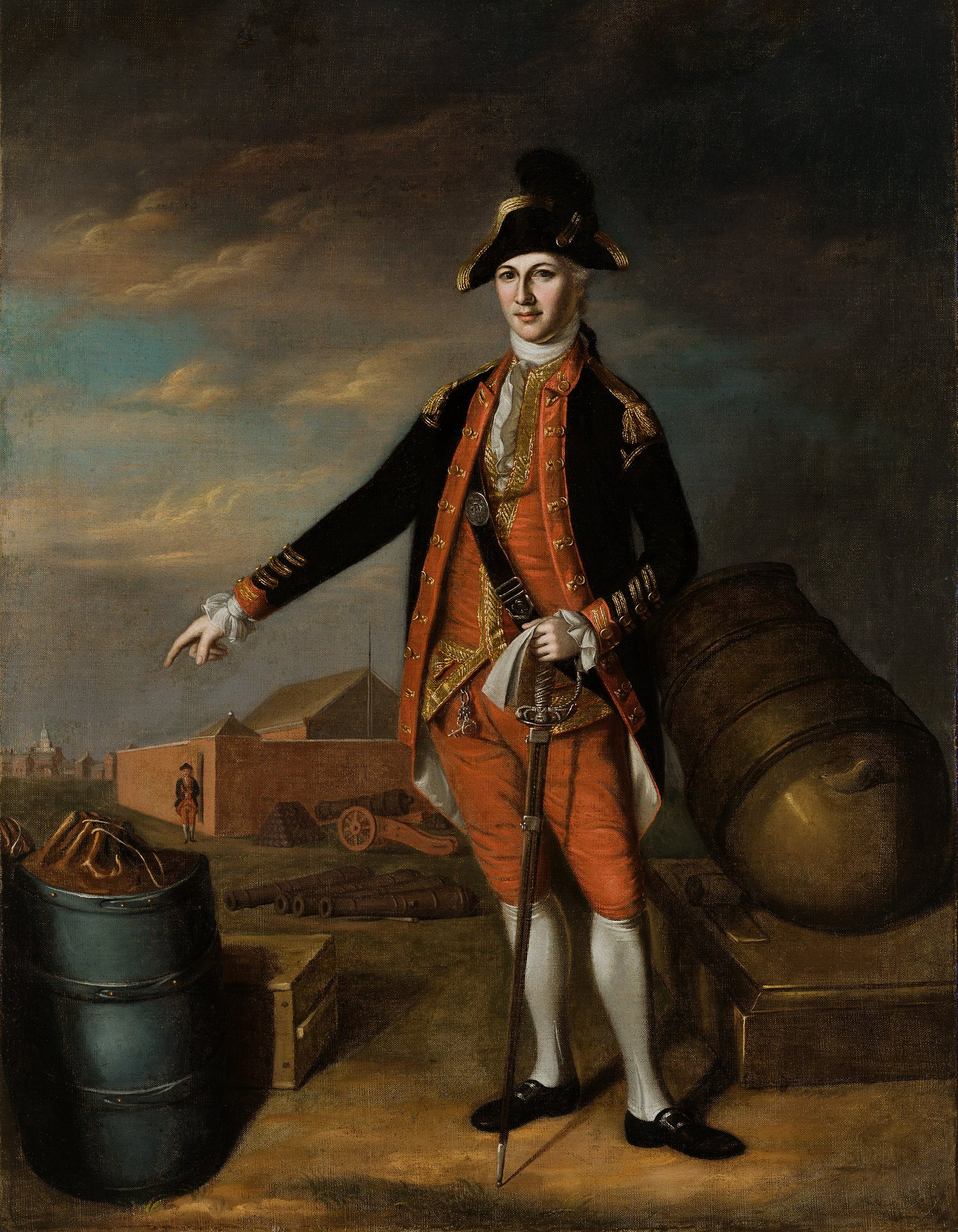
But what did they wear? Did their uniforms (if they had them) match what we know about Continental Artillery uniforms, or did they vary?

Here are all of the sources I've gathered about the appearance of Artificers in the Regiment.

Charles and James Peale's portrait of Benjamin Flower, with a detail of the view of the enlisted soldier in the background, which now belongs to the Star-Spangled Banner Flag House and Museum.

A miniature portrait of Benjamin Flower which sold at auction at Freeman's (Philadelphia) in 2014).

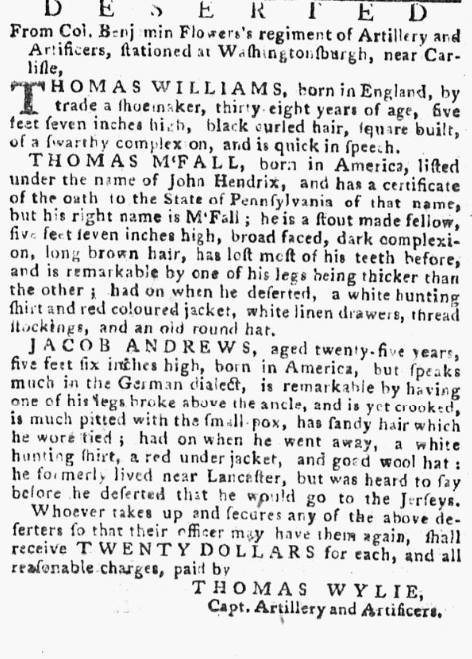
The Pennsylvania Packet, November 14, 1778.

The Pennsylvania Packet, January 26, 1779.

The Pennsylvania Packet, February 16, 1779.

The Pennsylvania Packet, July 20, 1779.

The Pennsylvania Packet, July 27, 1779.

The Pennsylvania Packet, October 12, 1779.

The Pennsylvania Packet, November 27, 1779.

The Pennsylvania Packet, January 29, 1780.

The Pennsylvania Packet, March 28, 1780.

The Pennsylvania Packet, June 13, 1780.

A receipt for hats for the Artificers, June 29, 1780.

The Pennsylvania Packet, September 30, 1780.

The Pennsylvania Packet, December 9, 1780.

Tuesday, November 6, 2018

"Continental" Jackets

Around June 24 or 25, 1777, John Mills, a swarthy, twenty-year-old New Jersey native deserted from George Ross’s company of the 11th Pennsylvania Regiment. Mills was one of thousands of Revolutionary War deserters. What made him unique, at least among runaway ads for these sorts of soldiers, was one of his garments. Two advertisements appeared from Mills that summer, both in the Pennsylvania Packet. One noted his “white Continental jacket” and the second “a white Continental under ditto [jacket].”


These are the only references to a “Continental jacket/underjacket” I’ve encountered, and Captain George Ross certainly meant some sort of waistcoat (that's what these words usually referred to). But what made it Continental? Was it unique in its cut, material, or buttons? Perhaps it was one of the short-cut, belted waistcoats that were becoming popular among American soldiers. Or perhaps it was something else entirely, whether some peculiar uniform or a more mundane garment with a label unique to Ross’s vocabulary. Without more evidence, it’s impossible to say. If you’ve ever seen another reference to such a garment, I’d love to hear from you.

Tuesday, May 10, 2016

What We Actually Know About Petticoat Trousers (alias Slops, alias Skilts, alias Petticoat Breeches)

Some projects languish for a while, waiting for your attention. Such was the case with an old pair of "slops" that I made in 2005. Back then, I constructed them somewhat clumsily and used cotton thread not suitable for the period of living history I use them for (say 1750-1800). When I finally got around to reconstructing them using linen thread recently, I started to wonder what we actually know about these things. Most reenactors call them "slops." But, as it turns out, almost no one did in the eighteenth century.

The author wearing his "slops" at left, with Gwendolyn Basala and Michael McCarty

In the 1799 image below is pretty typical. What we might call "slops" are the thing the guy is wearing that looks something like a white kilt. It's hard to tell in this image, but they're actually two very wide legs attached to a waistband. "Slops" are the sort of garment we associate with sailors and pirates, and you may have seen then being worn by a reenactor, a living historian, or a film extra.

"No. 4, Cook," Thomas Rowlandson, 1799, National Maritime Museum, Greenwich, London

In the the eighteenth and nineteenth centuries, "slops" actually meant all sorts of clothing, not just this type of garment. I wrote a thesis and published an article about "slops" in general, the sort of ready-made garments (coats, jackets, trousers, and so on) sold to and worn by sailors and working men. The Museum of London owns a set of early slops, perhaps worn by a mariner, that includes a shirt and pair of baggy breeches. Their provenance is unclear and they are difficult to date with so few comparable extant garments. There are certainly images of sailors wearing similar clothing in the seventeenth and early eighteenth centuries, some prints of which you can see here. Breeches of this type, the forerunners of later sailor garments, relate directly to the baggy breeches worn by men of all sorts in the seventeenth century.

Shirt and breeches, 1600-1700, from the Museum of London.

By the late eighteenth century, when men of all social levels were wearing tight, knee-length breeches, baggier protective legwear seems to have been used exclusively by sailors, becoming somewhat inseparable from the image of seamen as they appeared in popular media. You can see such garments in sketches, popular prints, and paintings.

"Man Selling Stockings," Paul Sandby, circa 1759, from Kitty Kalash (see also John Styles, Dress of the People [2007], 172). 

"A Sailor Miss Taken," Thomas Rowlandson and G. M. Woodward, 1801, from the Lewis Walpole Library.


"Watson and the Shark," John Singleton Copley, 1778, from the National Gallery of Art.

The only extant example that survives from the period between 1750 and 1815 is fragmentary, recovered recovered from the 1785 shipwreck of the British vessel General Carleton (you can download the report and see an image of one of the fragments here).

There are precious few documentary references to these garments. Copley's painting is the most detailed evidence we have, in fact, for their construction and use. Notice the pleating, for example, and the fact that the sailor is wearing them as a protective garment over regular breeches.

We don't know a lot about these garments. We don't even know what to call them.

Famed eighteenth-century dictionary writer Samuel Johnson defined slops as "Trowsers; open breeches" (here). But I've yet to see "slops" used in a period document to refer specifically to this type of garment rather than ready-made clothing in general. The term "skilts," also a somewhat common label for this garment among maritime reenactors, didn't appear in print until the 1840s (according to the Oxford English Dictionary).

So what did people call these things?

I had thought for some time that they used "petticoat breeches," a term for an earlier type of legwear, but when I recently went searching in period sources, I couldn't find any instances of it in descriptions from the late eighteenth or early nineteenth centuries. Terms like "sailor trousers" appeared frequently in print, but they most often seem to mean a particular cut of trousers (or even ankle-length trousers in general, often associated with sailors in the earlier part of this period when most men still wore knee-length breeches). As Ike points out in the comment below, it's very possible that "trowsers" meant both ankle-length pants and knee-length "slops." The only instances I've come up wit that definitely refer to the latter are a handful of period references to "petticoat trowsers." Still, I think these instances do probably refer to the type of knee-length garment that appears in visual sources.

Servant and former privateer James Wickrey, who ran away from his master in Chester County, Pennsylvania, in 1749 was wearing "petticoat trowsers, half worn" (The Pennsylvania Gazette, June 8, 1749).

Servant Matthew Case wore, among other garments, "Petticoat Trowsers" in New Jersey in 1765. (The Pennsylvania Gazette, February 21, 1765).

An enslaved man, "who commonly call[s] himself Robert Heart amongst his own Colour" but whom his master called only Bob, had "a Pair of Petticoat Ozenbrigs Trowsers" when he ran away from Cecil County, Maryland, late in 1765 (The Pennsylvania Gazette, December 5, 1765).

John Hilt, a Dutch brick maker who skipped bail in Philadelphia in 1766 with "Cloathing much like a Sailor... and frequently wears Petticoat or Sailors Trowsers in the season." (The Pennsylvania Gazette, April 3, 1766).

Detail, "My Poll and My Partner Joe," Isaac Cruikshank, 1799, from the Lewis Walpole Library.

The two British criminals in the links offered by Ike in his comment below were both sailors who wore "trowsers" over breeches. But only James Wickrey among the individuals listed above had any other type of legwear noted (in his case, leather breeches).Were others wearing something underneath their petticoat trousers, like the sailor in Watson and the Shark, or did they wear nothing else at all besides shirttails? Were petticoat trousers really as common among early nineteenth-century sailors, men who might have chosen more fashionable ankle-length trousers, as satires would have us believe? Did anyone use the feminine idea of petticoats to deride wearers of petticoat trousers? They may have been baggy partly because of the shape of earlier breeches styles that inspired them and partly so they could fit over other garments. But they didn't have to be as baggy and skirt-like as they were. How did fashion and function interact when it came to petticoat trousers? Did more men than just bricklayer John Hilt adopt them as a sort of affectation, mimicking real sailors? Did they fall out of favor because men began to wear ankle-legth trousers instead of breeches, or for some other reason?

Mysteries remain for curious researchers. Let me know if you find any answers! I'm still not sure petticoat trousers was the only phrase people used to describe these garments, or that there aren't mentions of "slops" in this specific sense or some other term people used to refer to them lurking in period documents. But I do know that the words we choose to describe the past matter. John Hilt didn't wear skilts or slops. He wore petticoat trousers. If we're not careful, we might end up talking about people like him using words they wouldn't even understand.

Wednesday, October 14, 2015

A Waistcoat with Stockings for Sleeves

I can't remember when I first came across a description of a waistcoat "with stocking sleeves" in an eighteenth-century source, but I know I was immediately intrigued. Men did wear some knit garments in the late eighteenth century, including breeches and coats made from frame-knit material sometimes called "stocking web," but I'd never heard of knit sleeves. As it turns out, people made stocking sleeves not from new knit yardage but from old stockings. A handful of runaway advertisements published in the years around the American Revolution indicate that creative individuals cut the feet off worn-out stockings and sewed them into the armscyes of waistcoats as makeshift (and warm) sleeves.

Don Hagist wrote a brief article in The Brigade Dispatch: Journal of the Brigade of the American Revolution (Spring 2005) and included this interesting 1777 expedient from the orderly book of the British 49th Regiment of Foot:

"Sir Henry Calder desires A Return may be given in of the No. of Caps wanting in each Company The Men are not to wear their Hatts or Coats on any Account; they are to put Sleves to their Waistcoats out of Old Stockings, or Such other Stuff they can procure."

No original such garments, civilian or military, survive. I'm aware of only one period image depicting one. Johan Joseph Zoffany's 1772 portrait of London optician John Cuff and an assistant shows two men wearing distinctive waistcoat sleeves. The man on the viewer's right wears stocking sleeves, identifiable by their contrasting color, the darker binding at the wrist (sewn on to prevent the cut knit from unravelling), and the texture you'd expect from a knit sleeve section.

From the Royal Collection Trust, here.

Detail published in Desmond Shawe-Taylor, The Conversation Piece: Scenes of Fashionable Life (London: Royal Collection Publications, 2009), 122.

I'm not the first person to try recreating a waistcoat with stocking sleeves. Jay Howlett at Williamsburg wears one regularly, and here's a blog post about one made by another reenactor. But I was curious how this sort of garment was assembled and what it felt like to wear. In recreating a stocking-sleeved waistcoat, I chose similarly blue stockings and a white flannel body. Flannel was a common material for waistcoats and underwaistcoats, and numerous runaway ads mention sleeves whose color contrasted with the jacket body, probably because such garments resulted from the combination of old waistcoats and worn-out stockings, with color matching less of a concern. The body of my jacket matches the dimensions of one recovered from the 1785 wreck of the General Carleton (you may remember I wrote about sewing a copy of this jacket here).


Image of my waistcoat with stocking sleeves. You'll forgive the anachronistic beard and glasses, I'm sure.

My waistcoat is indeed warm. The stockings I had to use were for a smaller man than I, and so they they fit my arms more snugly and end higher on the forearm than my own stockings might (at least without being taken in and thus tightened for sleeve use). Where my sleeves end, you can see the same sort of tape binding the wrists as in Zoffany's painting. This is the sort of garment that someone used to the loose clothing of 2015 really feels when they're wearing it. It gives you a sense of how the fit of clothing, whether loose or tight, shapes the body, supporting or hindering certain postures and actions.

Optician John Cuff's use of such sleeves was probably more related to a sensitivity to cold that came with age and historical heating methods. But I've run into two hints that stocking sleeves may have been part of the occupational clothing of weavers, at least in the nineteenth century. In fiction stories from 1825 and 1863, respectively, weavers wore blue-stained aprons (a strange detail I can't explain) and stocking sleeves: "wearing his stocking-sleeves on his arms" (The Hull Advertiser, and Exchange Gazette, November 4, 1825), and "a pair of stocking sleeves drawn over his otherwise bare arms" (The Saturday Press, December 5, 1863). Unrelated to weaving or runaways, stocking sleeves also appeared in two notes on play costuming in 1826 and 1835.

Stocking sleeves even made a much later appearance during the lean years of Britain amid the Second World War. "Sometimes, too," wrote a columnist documenting the make-do solutions of wartime women, "they convert the legs of the boys' wool stockings into sleeves for a jersey which has 'gone' at the elbows," (Somerset County Herald & Taunton Courier, February 12, 1944).

But the most numerous and detailed accounts of stocking sleeves come from American and British newspapers. Using databases, I've located ten American  and five British descriptions of stocking-sleeved garments dating between 1765 and 1829. Certainly more eluded my keyword searches and lurk in undigitized newspapers. I've provided full quotations and citations below for those who may be interested in more detail. In short, they suggest that the people who turned worn-out stockings into sleeves attached them to garments known as jackets, waistcoats, vests, coats, and even "a kind of hunting shirt" (for more on hunting shirts, see Neal Hurst's work here) with little regard for matching sleeve and body color.

The American runaway ads also indicate that stocking-sleeved jackets were a regional garment. All of them appear in advertisements for runaways from the Mid-Atlantic, from Westfield, New Jersey, west of New York City, to Culpeper, Virginia. I don't mean to discount confounding factors (such as the problematic nature of digital keyword searches; the higher number of newspapers and corresponding digitization in this region than in those farther south; and perhaps a higher number of runaways than in New England), but these still can't account for why I couldn't find any examples in digitized sources from New England or the South.

Instances of stocking sleeves with dates, plotted with Google Maps. Some locations are approximate, based on county given.

With the documentation and the sewing behind me, I'm just waiting for an appropriately cool living history event to really break in my stocking-sleeved waistcoat. I figure it needs a few miles and some good stains on it before it will look like the sort of "old flannel jacket" mentioned in the advertisements below. Until then, I'm quite ready for whatever winter has in store.


Thanks to Neal Hurst, Michael McCarty, Joseph Privott, and Nicole Belolan for discussions related to this research.


American Primary Descriptions of Stocking Sleeves (Sources: "America's Historical Newspapers" and "Accessible Archives," unless otherwise noted)

A servant butcher from Kent County, Maryland, "with stockings for sleeves to his jacket," (Pennsylvania Gazette, March 28, 1765).

A servant from Uwchland Township, Chester County, Pennsylvania, wearing a "blue and white striped jacket, with old blue stockings for sleeves," (Pennsylvania Gazette, January 19, 1769).

A supposed servant from Culpeper, Virginia, wearing a "blue waistcoat with stockings for sleeves," (Virginia Gazette, March 22, 1770).

A slave from Westfield, New Jersey, wearing a "white woolen waistcoat with stocking sleeves," (The New Jersey Journal, May 10, 1770; page 14 here).

Two convict servants from Elk-Ridge, Maryland, wearing "an old flannel ditto [jacket], with black stocking sleeves" and "an old flannel ditto [jacket], with grey stocking sleeves," (Virginia Gazette, September 20, 1770).

A convict servant  from Langford Bay, Maryland, wearing "a brown vest, with stocking sleeves," (Pennsylvania Gazette, April 4, 1771).

A servant from Charles Town, Maryland, wearing "a striped linsey ditto [jacket], with blue stocking sleeves," (Pennsylvania Gazette, December 23, 1772).

A servant from Brandywine Hundred, Delaware, wearing "an old blue cloth jacket, with stocking sleeves, of near the same colour," (Pennsylvania Gazette, August 2, 1775).

A servant from Chester County, Pennsylvania wearing a "light coloured cloth coat, with blue stockings for sleeves in it," (Pennsylvania Gazette, July 7, 1784).

A probable servant from York[town], Pennsylvania, wearing "a kind of hunting shirt with grey yarn stocking sleeves," (Carlisle Gazette, May 29, 1787), from here.


British Primary Descriptions of Stocking Sleeves (Source: "The British Newspaper Archive")

An apprentice currier of Southampton, wearing "a short Waistcoat, with the Leggings of a Pair of Blue Stockings for Sleeves," (The Hampshire Chronicle, March 22, 1773)

A man from Morcot, Rutland, "deranged in his intellects" wearing "a brown Fustian Jacket with Greased Stocking Sleeves," (Lincoln, Rutland, and Stamford Mercury, June 6, 1800).

A murder victim of Straid, County Antrim, Ireland, wearing "a wylie-coat (flannel-waistcoat), into which witness had sewed the legs of worsted stockings, as sleeves to it, and put check buttons on it," (Belfast Commercial Chronicle, August 25, 1810).

A young runaway from Higham Ferrers wearing a "yellow striped Waistcoat, with cotton stocking Sleeves" (The Northampton Mercury, December 25, 1825

A Littlebury highway robber wearing "a waistcoat, with stocking legs for sleeves," slash "a waistcoat with stocking sleeves stitched into it," (Evening Mail, December 11, 1829).
Tuesday, September 29, 2015

"Joseph Long's Slops: Ready-Made Clothing in Early America," in Winterthur Portfolio

I'm very happy to note that an article I wrote appears in the current issue of Winterthur Portfolio. Based in part on my master's thesis research, it examines the history of "slops" in early America. These ready-made garments clothed sailors and laborers in port cities. The production and marketing tactics of slops-sellers laid the groundwork for the birth and growth of the ready-made clothing industry in the mid-nineteenth century. You can download a copy of my article here. For some material I had to leave out, including the probate inventories of two Philadelphia slops-sellers and data on clothing production in use in the Philadelphia almshouse, you can read my thesis here.

Among the figures in my article is this image, one of only two known firsthand depictions of early American slop shops. It shows the shop of slops-seller Jacob Abrahams in New York City, circa 1813. Its publication in my article is the first time the shop owner and purpose have been identified


Among the figures in my article is this image, one of only two known firsthand depictions of early American slop shops. It shows the shop of slops-seller Jacob Abrahams in New York City, circa 1813. Its publication in my article is the first time the shop owner and purpose have been identified.

William P. Chappel, The Dog Killer, mid- to late nineteenth century. Oil on slate paper; H. 1⁄8", W. 1⁄4". (Bequest of Edward W. C. Arnold, 1954, Edward W. C. Arnold Collection of New York Prints, Maps, and Pictures, © Metropolitan Museum of Art; source, Art Resource, NY). Online here.

Wednesday, March 20, 2013

The Work of Play Exhibition Catalog

Although I try to avoid indulging in self-promotion here, I do make occasional exceptions. What else are blogs for, after all? This past winter, I had the pleasure of working on a chapter for the Museum of Early Trades and Crafts' new exhibition catalog, The Work of Play: Where Business Meets Leisure. My chapter, "Working Men's Clothes in New Jersey, 1750-1825," covers the sorts of garments worn by sailors, farm laborers, slaves, apprentices, and servants, as well as the makers and materials of such clothing. You can pick up your very own copy of the recently-printed catalog in paperback or Kindle edition here. If you happen to be in the area, you can also attend an evening lecture I'm giving at the museum (in Madison, NJ, outside New York City) on June 6th.


Wednesday, June 29, 2011

One Last Runaway

Over a year ago, I wrote:

"The runaway was something of a cultural icon in early America. Rebellious young apprentices, bold African slaves, and aging indentured servants all had reason to break away from the written contracts and unwritten codes which bound them to a system of human ownership. The newspaper advertisements which proclaimed such fugitives and offered rewards for their return represent a unique window into visual appearance in the era before photography. Because most advertisements minutely describe the clothing worn when the individual "ran away from the subscriber," we can often reconstruct precisely what these people wore on a daily basis. This sort of close study can be expanded to explore the mysteries of social relationships, personal identity, economics, politics, and that most American of all values - independence."

After finishing my graduate degree and a thesis focused on common dress in early America, I feel the same mix of excitement, trepidation, and sadness that I imagine most historical runaways felt. While the internet is full of dead blogs, I'm not quite ready to close up shop here or tweak the blog into something else. Instead, I'll leave these posts here as a repository of information for interested readers. I hope that you've enjoyed following my research in this blog, or if you've just found it, I hope it offers some insights. More than any other aspect of this project, I have enjoyed the very human connection that comes from reading about these forgotten everyday people. I'll leave you with one final runaway ad, this one from the Columbian Centinel of Boston, published on March 7th, 1792.


Friday, May 6, 2011

Guinea Marks (Virgnia Gazette, 6-12-1779)


Conner, a slave who jumped ship from the Jean at Urbanna, Virginia, in the summer of 1779, was almost certainly a native African. Owner Henry Butterfield noted that Conner was "remarkable black" and bore "the Guinea marks [tattoos] on each of his temples," but that he was fluent in English. Conner's clothing was also notable in its adherence to American standards, and he "appeared much like a sailor." He wore "long trousers with one pocket" and a "thick blue sea jacket patched with canvass." Wherever Conner ended up, his adaptability made him as prepared as anyone to confront the dangers and complexities of life among the lower sort in early America.

Thursday, April 14, 2011

Revolutionary Runaways (The Pennsylvania Packet, 6-24-1779)

Advertisements for military runaways appeared throughout the Revolution as soldiers absconded from their service. This ad, for six men who had been recovering at the General Hospital in Philadelphia, reveals details about the clothing of American soldiers at the height of the Revolution. At least four of the men wore overalls, the trousers with gaitered bottoms that were issued to both British and American troops. Some of these men wore recognizable uniform coats; Lawrence Gibbons of the Sixth Virginia Regiment and David Hughes both had black coats "faced" with red. These coats, probably actually dark brown, had red "facings" (cuffs, collars, and lapels), a common color scheme for American uniforms of this period. James McGuff wore a similar brown coat, but his was faced with green. Other recuperating soldiers wore civilian attire; James Samrille had a brown "sleeveless jacket" (waistcoat), John Cardiff wore a blue "sailors jacket," and Richard Thompson owned buckskin breeches and a "short brown coat, [and a] jacket of the same."

Besides their clothing, this advertisement illuminates other aspects of these Revolutionary soldiers. They were not especially young (four were over thirty), one possible reason why they ended up in the General Hospital. Only Samrille had a wound, in his left hand; others bore the scars of past injuries and diseases. Cardiff was missing three fingers, Gibbons had been wracked by smallpox, and McGuff was part of the Invalid Corps, a unit that performed minor duties in lieu of more rigorous active service.

The advertisement also suggests the divide between America and England. Richard Thomson may have been serving in a Maryland regiment, but he was no American. He was "an Englishman."

Monday, March 28, 2011

Linings and Patches (American Weekly Mercury, 7-17/24-1735)

In 1735, William Finn was a twenty-three-year-old servant to Philip Doyl of Gloucester County, south of Philadelphia across the Delaware in New Jersey. Finn was a flax-dresser and worked with the plants used to produce linen, a skill he probably learned in Ireland (a center of flax production) before emigrating. To cover his brown hair, Finn sometimes employed a "Piss-burnt" (brown-stained) wig and an old felt hat with a shortened brim. According to Doyl, when Finn ran away he took a number of garments other than his own. These included "a plain Drugget [thin wool] coat" that was an interesting mix of colors including green, brown, and blue, probably a result of a variety of warp yarns used in the cloth's production. The coat was lined with "brown Sarge"; serge referred to a coarse, twill-woven wool. The coat's mohair (fine goat hair or silk textile) buttons suggested it might be better than the usual coat of an indentured servant. Finn's other theft was an "Olive colour Jacket of fine Broad Cloth" with "Pieces under the Arms," possibly a reference to some sort of attached sleeve in a period when "jacket" was used interchangeably with "waistcoat." This jacket was lined with heavy wool cloths, "Olive colour Stuff" and "Ash colour Sarge."

The rest of Finn's wardrobe merited less description, probably because it was the sort of clothing more often associated with servants. He wore gray wool stockings, a pair of "coarse Shirts," shoes tied with strings, and patched breeches. Most extant garments exhibit no signs of patching because they were set aside before they wore out. But for many people, patching was a common solution to everday wear and tear. A woman's short jacket in the collection of the Chester County Historical Society, for instance, has almost as many patches as original material, and although the jacket and its patches are a cream color, the materials include many kinds of plain-, twill-, and diaper(diamond)-woven cloths.

By the time this advertisement appeared in Philadelphia's American Weekly Mercury, Finn had been gone from Philip Doyl's farm for three months. Perhaps Doyl heard a rumor that Finn was living in Philadelphia. In any case, he had some hope that his description might result in Finn's capture and return. A reader who was unsure of his identification, however, might simply wait until Finn fell asleep, for "he groans very much in his Sleep."

Saturday, February 26, 2011

Knit Breeches (The Maryland Gazette, 8-4-1754)

As war with France loomed in 1754, England mustered its forces in the American colonies. The provincial authorities struggled to recruit and maintain militia, and desertion was endemic. In August of that year, the Maryland commanders advertised for six deserters. Their descriptions include physical details, birthplaces or residences, and clothing. John Brightwell wore "a blue Coat with Metal buttons, a white Shirt, and Osnabrig [unbleached linen] Trowsers." The amusingly-named Rezin Rickets was notable only for his linen breeches and "a Linen jacket without Sleeves." This second garment was probably akin to a waistcoat but may have been tighter-fitting and had shorter tails. William Jones, a carpenter from Prince William County, Virginia, was dressed rather smartly in a white wool coat with a contrasting velvet collar, a blue vest, and "Scarlet knit Breeches." Englishman William Lee invented a frame to knit stockings just after 1600, and eventually this same technology was applied to other legwear (for a later, elaborately-decorated pair, see: http://collections.vam.ac.uk/item/O116319/trousers/).

In early America, knit breeches appeared in a variety of colors, including black, blue, and red. In 1749, Philadelphia merchant James Burd advertised the arrival of his cargo aboard the snow Friendship, which included "mens scarlet knit breeches" (The Pennsylvania Gazette, 11-16-1749). Like buckskin, knit breeches were flexible and tight-fitting. Whether this particular pair was William Jones's downfall, we'll never know.

Sunday, February 13, 2011

A Servant's Uniform (Pennsylvania Gazette, 4-4-1754)

Henry Cole and John Lewis were typical English indentured servants. Both were in their early twenties and well fed. Cole was knock-kneed and Lewis had pockmarks and red spots on his face. But by far the most unique thing about the runaway advertisement with which John Wright sought to recapture them in 1754 was the clothing described. These two men were dressed in precisely the same way; Wright had apparently issued each of them with a sort of uniform. Cole and Lewis both had an old hat, a new wool cap, two homespun shirts, two pairs of breeches (one fustian, a linen-cotton blend, and one leather), wool stockings, and good shoes. Each had a "striped flannel jacket, without sleeves," a sort of straight-bottomed waistcoat. They each had a blue "halfthick" waistcoat, made from coarse wool. These waistcoats had leather buttons, a common feature on indentured servant clothing and probably similar to those recovered from the 1760 wreck of the Machault (page 79):

http://www.sha.org/research_resources/documents/Legacy%20of%20the%20Machault_English.pdf

And each had a "reddish brown bearskin coat, with flat metal buttons." Bearskin was not actually hide, but rather a shaggy, coarse wool comparable to fearnaught and dreadnaught cloths. Like these materials, it was favored by servants and sailors as a cheap and warm outer garment textile. John Lewis also had a "flowered damask jacket," almost certainly of worsted wool rather than silk. While "flowered" sometime connotes a small printed design, in this case it more likely refers to the woven pattern of the damask.

It might have been particularly hard for Cole and Lewis to avoid notice dressed in this fashion. Even if Wright was simply using the same material and tailor for his servants' clothes, the result was to produce two identical and unmistakable wardrobes. Cole and Lewis were not dressed in livery, but they would have been recognizable as bound men nonetheless.

Wednesday, February 2, 2011

Monkey Jackets, Pea Jackets, and Roundabouts

One of the biggest challenges facing scholars of historical clothing is deciphering the terminology used to describe garments. What, for instance, are we to make to the various terms used to describe men's jackets in the eighteenth and early nineteenth centuries? Advertisers in the second decade of the nineteenth century described "monkey jackets," "pea jackets," and "roundabouts" for sale in the same announcement. For these writers, then, the terms referred to distinct types of garments. Most people, however, probably used such terms interchangeably, referring to the sort of tail-less jackets, both single- and double-breasted, favored by sailors. If their precise descriptions remain difficult to discern, the advent of these descriptions is still an interesting way to consider how people understood clothing.
“Pea jacket” was in use in America by at least 1720, when William Glan deserted the Princess Amelia in Boston harbor wearing "a dark coloured Pea Jacket lined with blue baize,” as advertised in the Boston Gazette on May 16th, 1820 (Incidentally, "pea coat" does not appear until the 1780s).
Later, "roundabout" entered the vernacular as another term for men's jackets, as in 1798 when apprentice Colin Carters ran away from Thomas Whitney's Lexington cabinetmaking shop wearing "a round-about sailer's jacket, and overalls of a brown mixed cloth." (Stewart's Kentucky Herald, September 18th, 1798).
"Monkey jacket" is an an even later term, absent from newspapers until the second decade of the nineteenth century. This advertisement from Philadelphia auctioneer John Dorsey appeared in Poulson's American Daily Advertiser on December 10th, 1813. It is a fitting reminder that these terms did not simply replace each other over time, but were rather used interchangeably and seperately in a market that held stunning variety.

Thursday, January 27, 2011

A Musician in Leather Breeches (Pennsylvania Gazette, 8-1-1771)

William Wiley was serving his indenture under Zachariah Nieman in Moyemensing Township outside Philadelphia in 1771. Wiley was used to the servant’s life, having previously worked under both Mary Harper and Francis Holton, tavern-keepers in the city. In turn, these women probably each sold the remainder of Wiley’s indenture when they needed cash. And so the young Irishman finally became impatient with his servitude, and ran away in the summer of 1771. He was stocky, “round faced” and “middling chunky,” but Wiley was no bumpkin. He spoke “a little Dutch” and was not only “sly and artful” but also “a great liar.”

Wiley’s clothing reflected his general work as a servant. His worn short jacket was “cloth coloured” (probably buff) and lined with red flannel for warmth and perhaps even a bit of style. He had recently acquired a pair of leather breeches, a garment favored by both gentlemen (for hunting and riding) and laborers (for durability). Leather breeches were also cut differently than cloth ones, often with no inseam and with very narrow trimmed seam allowances facing outwards to allow for the most form-fitting but flexible shape possible. Like his breeches, Wiley's shoes were new, and featured tin buckles polished to a bright finish. His gray wool stockings and beaver hat completed a wardrobe that might today be compared to a contemporary worker's jeans and t-shirt.

In 1771, the colonies were teetering on the precipice of Revolution. As William Wiley was making his own bid for independence, war loomed on the horizon. It is tempting to imagine Wiley a few years later, now in his mid-twenties, in the uniform of a Continental soldier. When he ran away, he was already a skilled musician, experienced with the martial instruments of the day, the fife and drum. The army would have welcomed him, although his military service might have been little different from his old indenture.

Monday, December 27, 2010

A Crafty Man in A Sailor-Fashion Jacket (Pennsylvania Gazette, 2-11-1789)

Thomas Wetherby was a healthy young indentured servant when he ran away from John Wood of Cumberland County, New Jersey, in the first month of 1789. Besides a wide mouth and "teeth very much gone before," Wetherby was largely unremarkable in his physical appearance and dress. He wore the clothing of a working man, and the state of his garments indicate that he had owned them for some time. He had an "old felt hat," a brown wool jacket "made sailor fashion" (probably double-breasted) with wooden buttons and a homespun tow lining, an old "under jacket" or waistcoat, worn buckskin breeches, and gray "mouse coloured stockings." His shoes featured narrow copper buckles and were "slit in the instep," perhaps a decorative technique of slashing the leather but more likely a functional addition of unknown purpose. Wetherby carried no other clothing, which may indicate that he fled quickly, not planning for the cold weather he would endure during his travel.

John Wood knew that Wetherby might play the fool in order to make his escape. This runaway had the usual "down look" and did not "appear to be a great wit," due in no small part to his buckteeth. But Wetherby was no yokel. Wood suspected Wetherby would "change his name and dress" soon. Wetherby was dressed for work, and once off the farm in Stoney Creek, he may have easily avoided the suspicions of people he met, as he was "very ready to tell a lye."

Sunday, December 5, 2010

A Runaway Poem (Pennsylvania Gazette, 8-7-1746)


The music of the present season,
Has given me one good reason,
With all the carols and their rhymes,
Which can bother the ears sometimes,
To present here a small diversion,
And give to you history's version,
Of a little bit of poetic amusement,
In the form of an advertisement.
With lengthy description I will not bother,
And so remain, your humble author.