Showing posts with label Occupational Images. Show all posts

Wednesday, May 10, 2023

The Uniforms of Flower's Regiment of Artillery Artificers, 1777-1780

In conjunction with my work at the Museum of the American Revolution, where we periodically conducy living history events, I've sporadically conducted research into a group of soldiers and contractors operating in Philadelphia and Carlisle during the Revolutionary War known as the Regiment of Artillery Artificers. 

The regiment was led by Colonel Benjamin Flower (1748-1781) and included dozens of craftspeople. Primarily dedicated to the production and maitenance of armaments and ammunition, the Regiment also included carpenters, blacksmiths, nailers, stonecutters, brass founders, shoemakers, armorers, wheelwrights, tailors, file-cutters, harness makers, sawyers, tin men, accoutrement makers, drum makers, painters, saddlers, coopers, coopers, clerks, curriers, turners, buckle filers and finishers, boat men, millwrights, wheelwrights, and laborers. 

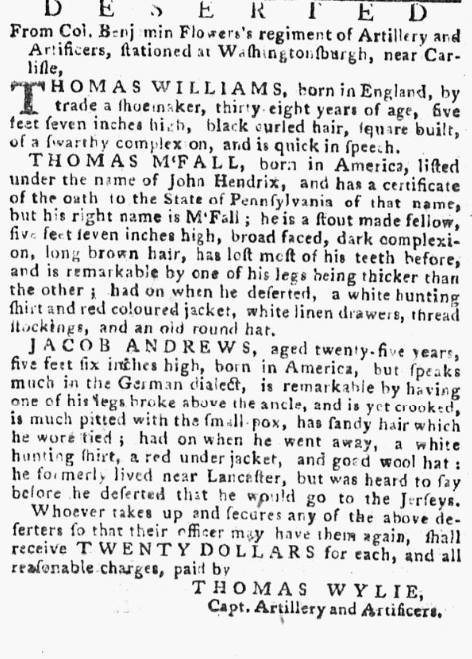
But what did they wear? Did their uniforms (if they had them) match what we know about Continental Artillery uniforms, or did they vary?

Here are all of the sources I've gathered about the appearance of Artificers in the Regiment.
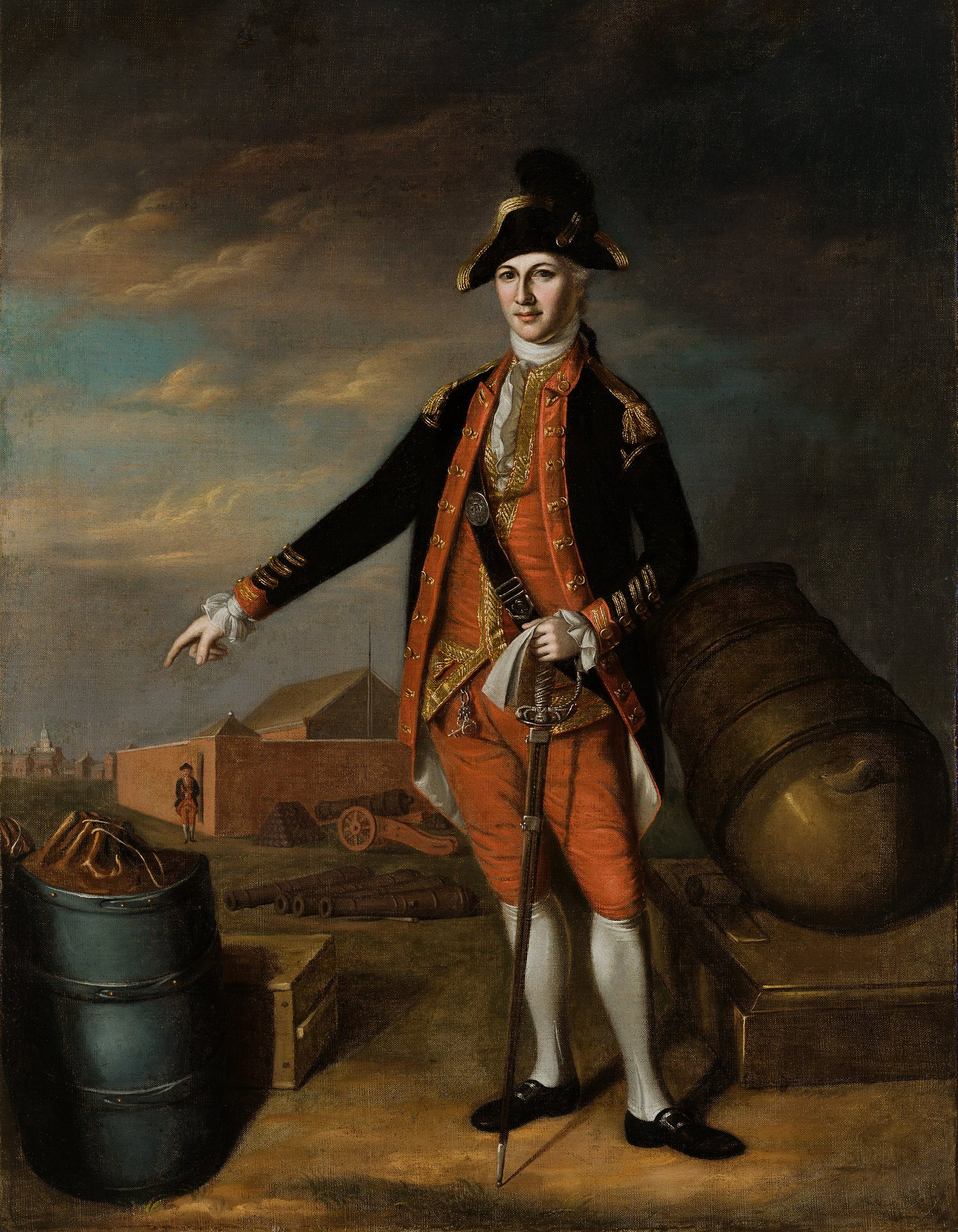
Charles and James Peale's portrait of Benjamin Flower, with a detail of the view of the enlisted soldier in the background, which now belongs to the Star-Spangled Banner Flag House and Museum.

A miniature portrait of Benjamin Flower which sold at auction at Freeman's (Philadelphia) in 2014).

The Pennsylvania Packet, November 14, 1778.

The Pennsylvania Packet, January 26, 1779.

The Pennsylvania Packet, February 16, 1779.

The Pennsylvania Packet, July 20, 1779.

The Pennsylvania Packet, July 27, 1779.

The Pennsylvania Packet, October 12, 1779.

The Pennsylvania Packet, November 27, 1779.

The Pennsylvania Packet, January 29, 1780.

The Pennsylvania Packet, March 28, 1780.

The Pennsylvania Packet, June 13, 1780.

A receipt for hats for the Artificers, June 29, 1780.

The Pennsylvania Packet, September 30, 1780.

The Pennsylvania Packet, December 9, 1780.

Monday, October 3, 2022

There Can Only Be One? Revolutionary War Highland Soldiers, Part One: Visual Sources

With the help of some real experts, I've been beginning to research and make components for a 1770s British Army Highland Regiment impression. In the context of the Revolutionary War in the American theater, Highland regiments included the 42nd/Royal Highland/Black Watch, 71st/Fraser's, 74th/Argyle, 76th/MacDonald's, and the 84th/Royal Highland Emigrants, Regiments of Foot. 

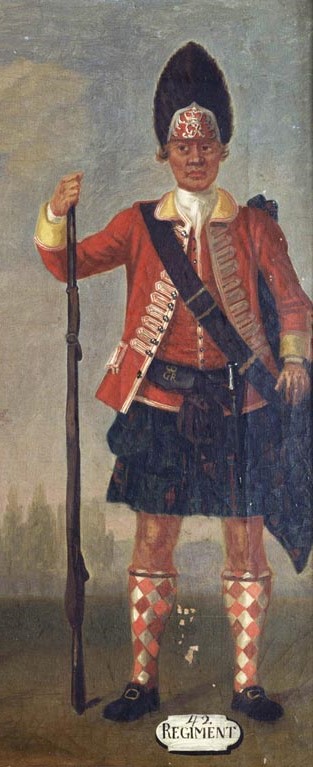
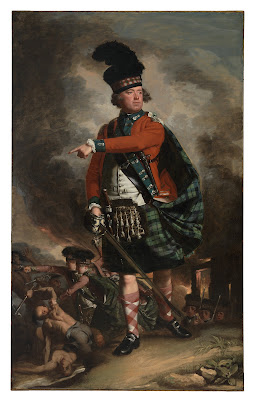
I'll have more to say about kilts, diced hose, sporrans, and bonnets later, but for now I'm just posting all the pertinent period images I've been able to find that are informing this project, for ease of reference by me and anyone else who might follow along. A key note: the images below are just of Highland soldiers and officers in the British Army in the late 18th century, and just ones that are full-length portraits, so I've left out some famous paintings of kilted (non-Army) Highlanders, images from before about 1750 and after about 1790, bust-length portraits of officers, and so on. But let me know if I've missed anyone!


1751-1760: "Grenadiers, 40th Regiment of Foot, and Privates, 41st Invalids Regiment and 42nd Highland Regiment, 1751," by David Morier. This is a single figure in a large series dating to the 1750s in the Royal Collection Trust.


1750s-60s: A portrait that has circulated online as "The Pinch of Snuff" attributed to William Delacour. I've been unable to find its original source or further history, though some suggest it shows an officer in the Seven Years' War version of the 78th/Fraser's.


1759-1763: A portrait of William Gordon, Sutherland Regiment of Fencible Men, by Allan Ramsay, shared online by Peter MacDonald.


1758? 1763?: This portrait is difficult to trace but is supposedly of John Campbell, 42nd Foot, killed at Ticonderoga in 1758.


1768/71: This is one of a series of unsigned depictions of British soldiers. The two known copies are dates 1768 and 1771.


1770s: A portrait supposedly of an officer of the light company of the 73rd Foot (which did not serve in America during the war), without further provenance.


1778: This later copy is based on the series prepared during the war by Hessian Captain Friedrich von Germann, from the New York Public Library.


1778-1783: Until 1945, an exceptionally rare uniform associated with the Northern (Gordon) Fencibles existed in the Zeughaus Museum, Berlin. This image and diagram below were shared online by Peter MacDonald.


1770s/1780s: This uncited but period portrait of a 74th Regiment grenadier officer has been shared online by Al Saguto.


1780: "Portrait of Hugh Montgomerie, Later Twelfth Earl of Eglinton," by John Singleton Copley. This first version is in the Los Angeles County Museum of Art and the second in National Galleries Scotland. Montgomerie raised a fencible regiment in Scotland but did not serve in America, despite this painting.


Post-1786: This watercolor is from some time shortly after 1786 (based on the marker stone and the style), but I've been unable for find further provenance. Shared by R. Scott Stephenson.

Thursday, February 14, 2013

New Tumblr Blog: Occupational Photography

After a rather cataclysmic hard drive loss recently, I've realized that I should share some of the many images I've saved over years of online rambles. The first such project I've undertaken is a new Tumblr blog, "American Occupational," a regularly updated gallery of occupational photography, 1840-1900 or so. You might remember that I've written about occupational photography on this blog before (click the "Occupational Images" label at the bottom of this post to see all such posts). All the images on "American Occupational" have appeared online, chiefly through eBay but also in various public collections. Check it out!

americanoccupational.tumblr.com

Wednesday, October 10, 2012

Occupational Images: Bakers

Part of an intermittent series featuring "occupational" images that have appeared online.

It's fall, and there are few finer pleasures in life than fresh baked loaves on a crisp autumn day. Bakeries have been a fixture of urban centers for centuries, but the professionalization and of the trade in America largely took place in the mid- and late nineteenth century. As city populations expanded and home baking began its long decline, the demand for bakers rose. In both the eighteenth and nineteenth centuries, some bakers specialized in certain products such as pastries or ship's biscuits, and you can read a little about early bakers in the exhibition brochure linked here. As urban bakeries proliferated, photography was also on the rise, and, like nearly every other artisan of the day, bakers sometimes posed for "occupational" photographs wearing their work clothes and holding their tools and products.

In this 1890s cabinet card, two bakers stand in the studio of C.L. Judd in Fargo, North Dakota. The man on the right has a large tray of some sort of pastries.


A similar photograph was taken around the same time in the more lavish studio of E. Burke in London, Ontario. In the Fargo image above, the man on the left is wearing a jacket with built-in short sleeves. In this Canadian image, the bakers have rolled their sleeves up well above the elbows. Their trousers are flour-stained and their caps seem endearingly individual. In this case, their unique clothing suggests their occupation in the absence of any tools or baked goods.


The smaller card photograph below is possibly European (much of contextualizing unidentified photographs ends up being about hunches regarding clothing and style). This baker wears a nice silk tie and patterned suspenders. He also brought various accoutrements, including a cookie cutter, bread pan, rolling pin, and a fresh loaf.


Some bakers carried more than just their products and tools to the photographer's studio. The sitting member of the baking group below holds a large advertising hand sign (or perhaps even a giveaway fan?), on which you can just make out "...BURG, PA" (the image, like all tintypes, is reversed). Don't miss his great checked jacket, either.


The Pennsylvania tintype above reminds me of another of similar date (1870s). In this second image, a baker and his young helper stand proudly with rolling pin, tray, and a crate that was labelled (or perhaps highlighted) by a colorist: "HJ Myers, Bakery." 

From Cowan's Auctions. Forgive the low resolution.

Of course, while baking was increasingly a commercial business, domestic baking remained an essential activity for families well into the twentieth century. It was more common for professional bakers to commemorate their trade in photographs, but there were legions of home workers for whom baking was a chore or, sometimes, a pleasure. So I'll leave you with this fabulous 1860s tintype, currently on ebay, of an African American woman posing proudly with a freshly-baked pie.


Sunday, August 26, 2012

Occupational Images: Tinsmiths

Part of an intermittent series featuring "occupational" images that have appeared online.

I have a soft spot for nineteenth-century tinware. There's something about the diversity of forms and patterns and the relative commonality of the material that draws me in. Like other artisans, tinsmiths regularly sat for photographs, sometimes with the tools of their trade. 

Some images, like this one, are hard to distinguish from those of silversmiths. This early daguerreotype features three teapots with ornate spouts. The "tells" that mark them as tin rather than silver are the pair of tin snips and the heating stove on the table.


Tinsmiths used these stoves to hear soldering irons. The image below shows a similar stove with two irons in the fire. This dapper smith of the 1850s is putting his snips to work for the portrait.


Imitating shop activities was always popular in occupational photography. The late 1840s tinsmith below appears to be working on a cylindrical container.


In another such instance dating to the the 1870s, here's a smith who brought in a stack of completed tin cans. He is shown at work soldering the side seam of another.


Other portraits seem more impromptu. These two smiths brought their snips, stove, and irons into a studio in the 1880s and stood for a photograph without much attention to imitating their craft.


Some tinsmiths showed off their products. The tintype below, from the end of the nineteenth century, features another pair of tinworkers. The man on the right shows off a large case, likely of his own making.


Some craftsmen of the nineteenth century were itinerant, moving from place to place and following work. The 1870s tintype below shows a young man, possibly a tinsmith, with a large carpet bag and a small heating stove.


And finally, here's a trio of young toughs from the 1870s. Two of them wear street clothes that contrast with the third, who wears a striped apron and clutches a hammer and pair of snips. It's easy to imagine the two men on the left stopping into their friend's shop and whisking him away for a quick photograph over his lunch break.


Friday, June 29, 2012

Occupational Images: Artisans of the Photographic Studio

Part of an intermittent series featuring "occupational" images that have appeared online.

People were undeniably the focus of nineteenth-century photographic portraits, but it's easy to forget the innumerable other details went into the composition and construction of photographs. First and foremost were the photographers, artists who occasionally turned their lenses on themselves.

Note that this 1870s photographer sits in front of a plain backdrop on grass and also appeared in a different pose.

Most photographic studios features a variety of painted backdrops. Often these canvases and artificial walls depicted quiet garden or domestic scenes that literally faded into the background. But sometimes photographers stocked backdrops that complimented the mindsets and costumes of their subjects, as in these three images (to take only a small sample):

  
Three mid-late nineteenth-century tintypes with unique backdrops.

Such backdrops were painted, with various degrees of realism, by professional artists who most likely also worked on murals, houses, and even fine art. Occasionally, these backdrop artists had their photographs taken as if caught in the act of preparing the studio.

This 1850s daguerreotype shows a studio backdrop painter at work in his shirtsleeves and straw hat (William Brown dated this image to between 1853 and 1855, Thoughts on Men's Shirts in America 1750-1900, 88).


1870s tintype and CDV of probable backdrop painters. The man on the right, whose photograph was taken in Marion, Ohio, may actually be a house painter (as indicated by his larger bucket and brush) using a studio backdrop as a prop.


 A late nineteenth-century backdrop painter in two views, Collection Jim Linderman. See this blog and book on the subject as well.

A painted backdrop had the advantage of stillness over outdoor scenes, critical because even minute movement caused blurs in early photographs with longer exposure times. This was true for daguerreotypes (on silvered copper), ambrotypes (on glass), ferrotypes (on iron, commonly called tintypes), as well as other photographic processes and their associated paper prints. Even though exposure times in the second half of the nineteenth century were a matter of seconds (contrary to long-standing myths), subjects required metal braces to hold their bodies and necks in one stable position during a photograph. Thus the small tripod feet visible behind many individuals in such images as well as the prop in this 1880s tintype:

Man tinkering with photographic neck brace. Rather than a builder of these braces, he is probably another type of tradesman who simply took the neck brace as a convenient prop for the photo.

Once the standing, bracing, and photographing was over, customers could upgrade their purchase with a variety of solid and paper prints as well as coloring. Here's an example from my collection of a tinted ambrotype.

Tintype 1850s ambrotype, author's collection.

Such tinting was most often done in-house by photographic colorists who used different media depending on the photographs they prepared.

CDV of colorists with CDVs, 1860s.

Colorist working with paper prints, 1860s. 

Colorist with framed full plate tintype, 1880s.

Of course, some photographers were versatile artists who combined a variety of trades into their new pursuit. It's thanks to people like these, along with the other tradesmen who built cameras, painted backdrops, and printed photographs, that we have such vivid and moving images of the nineteenth century.

1860s CDV of photographer/artist.