Showing posts with label First Oval Office Project. Show all posts

Wednesday, April 16, 2014

Washington's Tent on "Enfilade" and the 38th Voyage

I was delighted to contribute a reflective essay on the First Oval Office Project to the scholarly blog "Enfilade" recently. The post, which emerged from a panel at the recent American Society for Eighteenth-Century Studies conference, is only a small part of what Enfilade has to offer.

38th Voyage

I'm also excited to announce that I'll be part of Mystic Seaport's "38th Voyage" this summer. The Charles W. Morgan, built in 1841, is the only wooden whaleship still afloat. This summer, she will depart on the 38th voyage of her long history, along the coasts of Connecticut, Rhode Island, and Massachusetts. Participants in the various legs of this cruise, the "38th Voyagers," are undertaking a variety of projects focusing on marine life, the history of whaling, shipboard activities, artwork, and many other subjects. My small part of this project involves sailing for a night and a day aboard the Morgan between New London, Connecticut, and Newport, Rhode Island. Even a brief time aboard the ship opens up opportunities to test assumptions about life at sea. For me, that means thinking about how clothing impacts work aboard ships, a subject connected to my longstanding interest in ready-made and work clothing in the eighteenth and nineteenth centuries. I'm working on an understudied component of sailor clothing, protective outer garments. Sailors aboard the Morgan and other whaleships hoped jackets and hats made from painted, oiled, or rubberized cloth would keep them a bit drier in rainstorms. If all goes well, I'll construct reproductions of some sample garments for members of the Morgan's contemporary crew to test this summer. I'm looking forward to finding out how certain waterproofing formulations work, how garments affect kinesthetics and shipboard movement, what 2014 sailors wear to stay dry, and what they think about their forebears' options. Stay tuned for more on this project!

Saturday, January 4, 2014

Hands of Tentmakers

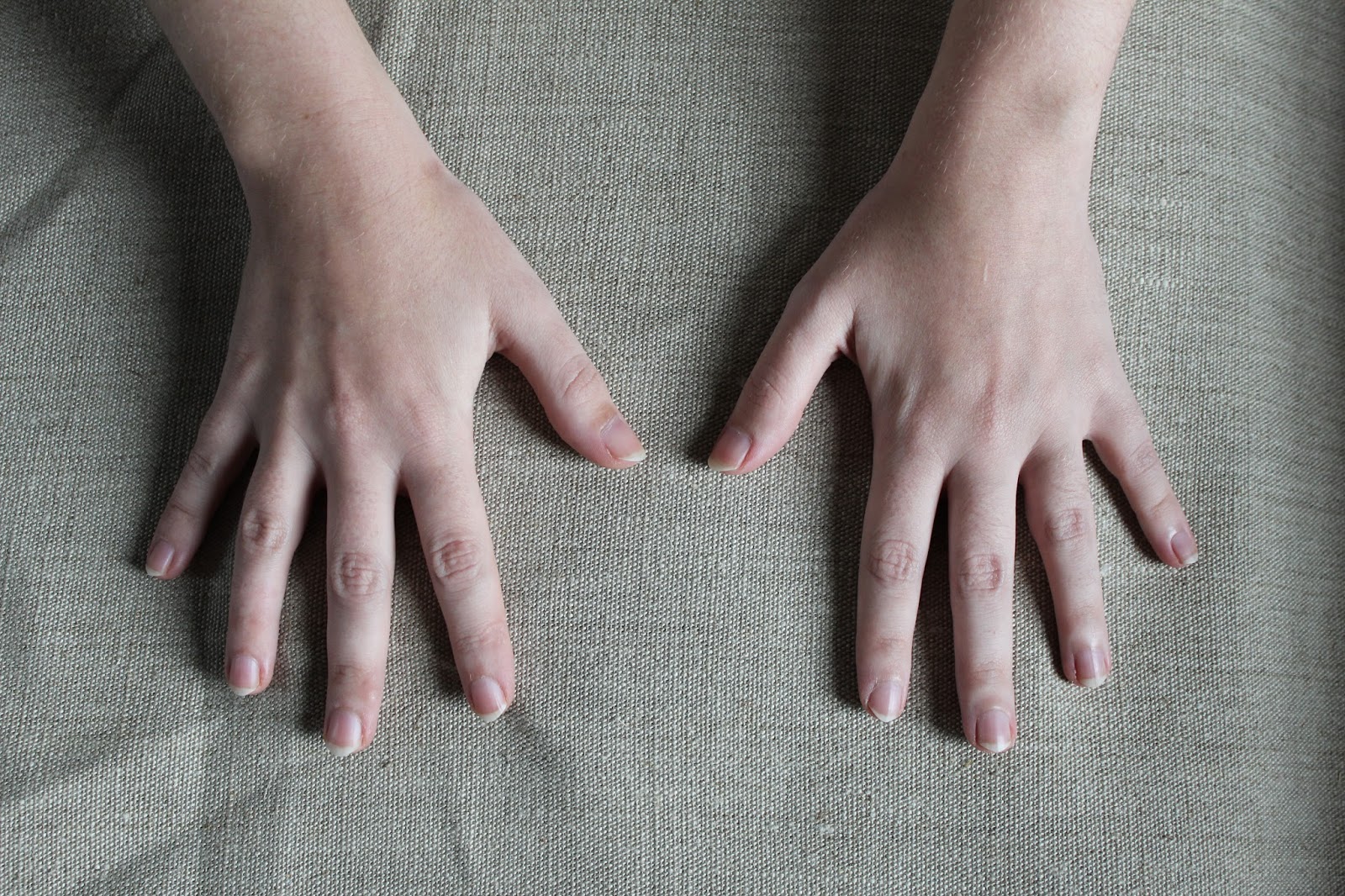
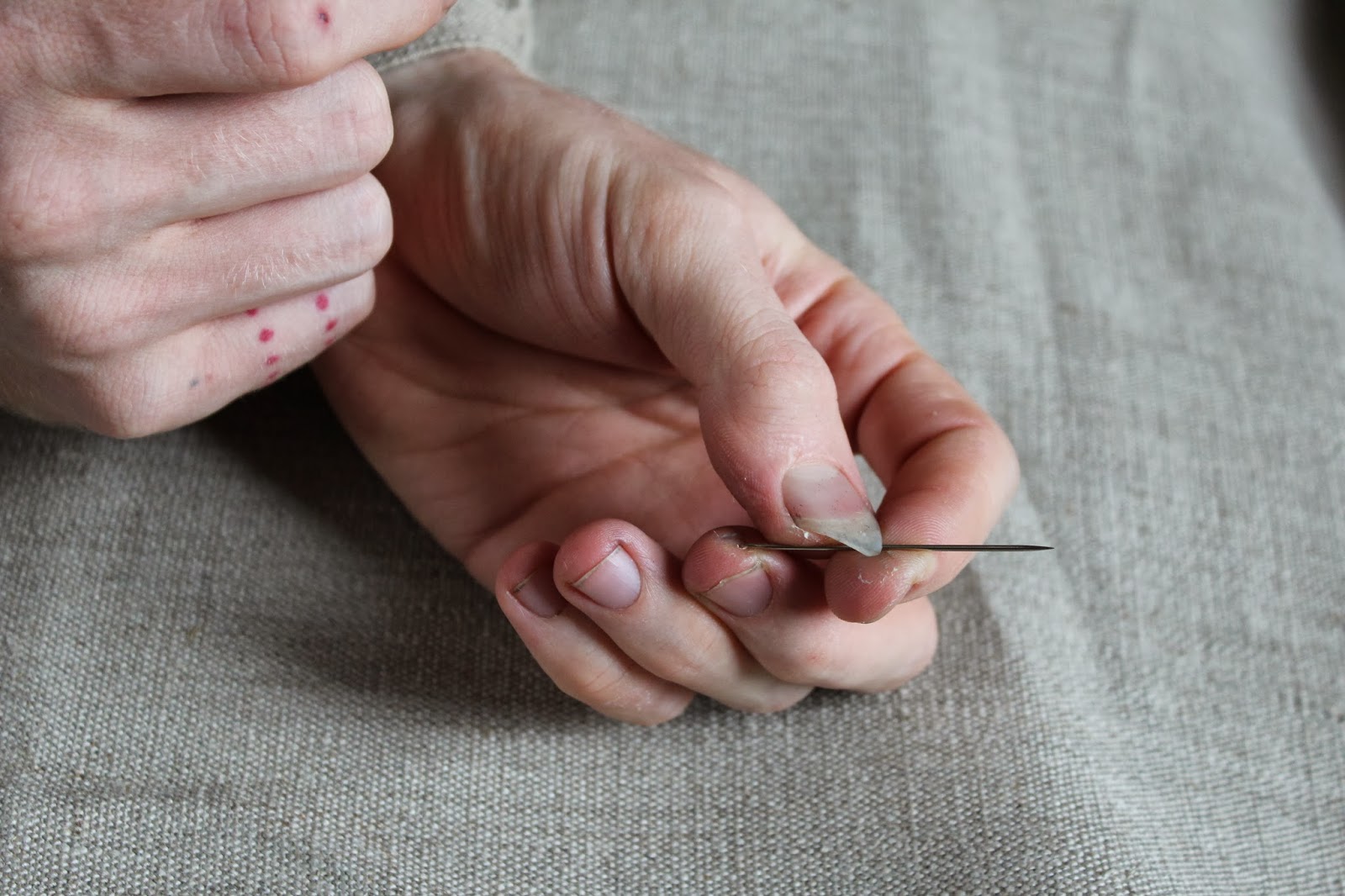
On the very last day of my summer involvement with the First Oval Office Project, I took photographs of our remaining crew's hands and quizzed each of them about what they had noticed after three months of full-time sewing. As with so many other dimensions of this undertaking, witnessing how our bodies reacted to the work was a prime example of experimental archaeology in action. I now know, for instance, what it feels like to sit tailor fashion, cross-legged, for most of a work day, and how, by the end of many such days, I usually began to slouch to one side, perhaps the result of my back muscles giving out more on the left side of my scoliatic spine. I noticed how, in the midst of a long seam, I could almost drift off into a doze while still sewing. All of us observed changes in our hands brought on by regular, if not unremitting, hand-sewing.

I'm posting the photographs and notes below without much editing or commentary. I don't mean to fetishize craftspeople's hands. That's been done before and, I'll admit, sometimes with significant artistic accomplishment. In this case, I hope these photographs will be more intriguing and useful from a scholarly standpoint. I believe they may be of some interest to those seeking to understand historical labor, the history of the body, and the impact of a very specific type of physical activity on the human form. You can read more about the First Oval Office Project on this blog or the facebook page, and it almost goes without saying that our hands are not perfect doppelgangers of those of the tentmakers of 1777. After all, most of us grew up eating wholesome food and avoiding much manual labor. We generally enjoy a lifestyle that is remarkably kind to our hands compared to those of most past ages. But, at the very least, this data provides some hint of how hand-sewing affects the body and also of the many idiosyncrasies in technique that existed in our shop, as they certainly did in the shops of the Revolution.

Gwendolyn Basala (Right-Handed)
Gwendolyn has been sewing for over a decade, including professional work in theater and living history costuming. Although she developed calluses on her right hand in this previous, primarily machine-sewing work, it was only with this project that she noticed many pricks and minor calluses on her left hand, a result of regular contact with needle tips.


Mark Hutter (Right-Handed)
When Mark first started sewing years ago, he had carpal tunnel symptoms until he learned to relax the tension in his hands when sewing. Now, he notices a stronger pinch in his right thumb, index, and middle fingers than in his left. He has a permanent flat callus on the tip of his right index finger and a small ridge from writing and seating a thimble on his right middle finger. He keeps his thumb and index finger nails a bit longer for picking up pins and needles, and notices that when he's working regularly on a project, his nail growth speeds up significantly.


Brendan Menz (Left-Handed/Ambidextrous)
Brendan, who also works in leather and can sew with both hands, has calluses on his index and middle finger tips, as well as on the top tips of his thumbs. His index and middle fingers grew in thickness over the summer. 


Joseph Privott (Left-Handed)
Joseph, who works in many media, noticed a few old calluses returning this summer, including one on the tip of his left index finger, from rubbing against the needle, and pricks on his right thumb and forefinger. Like most of the crew, he does not typically wear a thimble, resulting in a small gouged pocket in his left middle finger. On this particular day, his hands were somewhat stained from blackberries and featured traditional tattoos. 


Tyler Putman (Right-Handed)
As for me, I noticed calluses developing on the thumb-side tips of my right index and middle fingers soon after the project began. Around the same time, I had some minor issues with wrist pain. You can see the distinctive green tarnish on my right middle finger from my brass thimble. Among other things, my right thumb and index finger are noticeably larger than those on my left hand, but it's hard to say whether this was a result of the sewing of this summer. I'll have to look closely in a year to see if they've atrophied at all. 


Michael Ramsey (Right-Handed)
Michael has previous sewing experience and noticed calluses on right thumb tip and right forefinger tip. His right middle finger has less of a callus since he began using a thimble in mid-summer. Michael noticed minor wrist issues and his feet falling asleep after sitting cross-legged for too long. As can be seen in the last photograph, Michael's right index finger ended up substantially larger than his left.


Nicole Rudolph (Right-Handed)
A shoemaker and seamstress, Nicole has a slice on her right thumb from her cordwaining work. She noticed that the inside of her right middle finger went numb after using the large shears repeatedly. She has calluses on her right middle finger, on her left index and middle fingers from repeated pricking, and on her right pinky finger from pulling thread. She found that tentmaking required less strength than shoemaking, but also noticed that both her arms had grown larger over the past six months. 


Tuesday, November 19, 2013

Making Washington's Tent: Debut

This past weekend, Colonial Williamsburg officially opened the Anderson Armoury Complex and the First Oval Office Project debuted the first version of George Washington's sleeping marquee. The second version, to be completed this winter, will be made from the custom-woven linen produced this summer and just recently bleached by Jeff Krauss at the North Carolina State University College of Textiles. While I'll be finishing up my Ph.D. coursework at the University of Delaware, some of my compatriots will be sewing this winter on a final version of the marquee. I'll be following that work closely, as should you, via the project's facebook page and live webcam.

With the newly bleached linen, ready for the next version of the marquee.

When I left at the end of this summer, our mahogany tent poles had been completed by the Colonial Williamsburg's joiners, but awaited the iron collar sleeves that facilitate the two parts of each pole locking together as well as a final oiling. This work was completed over the last few weeks.

Joseph Privott, Aaron Walker, and Tyler Putman with the marquee tent poles.

A closeup of the iron sleeves attached to the tent poles. Each of the three tent poles (two uprights and a ridge) are, just like the originals, made from two scarf-jointed sections.

Over the course of the weekend, the crew erected the marquee three times, each time learning more about the process and getting faster. On our second trial on Saturday, we had the tent completely set up in about half an hour. I can only imagine that the men of Washington's guard assigned to this task during the Revolutionary War could have managed it in even less time. The photographs below are snapshots of the process, all taken by Nicole Belolan. 

Spreading out the roof of the marquee. The rope line in the foreground will be the center line of the tent.

Placing the poles.

Fitting the two uprights into the ridge pole, which has been inserted into a sleeve in the roof of the inner chamber.

Mark Hutter, at left, is holding two of the weather lines and will begin pulling on them to lift up the ridge pole. Nicole Rudolph and Samantha McCarty, in the center of the image, will hold the bases of the two uprights in place as the tops lift up. Two people will guide the upright poles to their final vertical position.

With the tent upright, the four weather lines are pinned to the ground.

Several of the guy lines on each end of the marquee are pinned to the ground.

The guy lines are pinned in, radiating around the tent's sides.

Each pin is pounded into place.
  
Nicole Belolan took a break from taking most of these photos to help pound in one of the tent pins.

The ceiling of the inner chamber is pulled out towards the marquee roof by a series of ropes, grommets, and wooden buttons.

The wall of the marquee, in several sections, is put into place.

The marquee wall is suspended from the roof by hooks and eyes.

Nicole Rudolph hooking in the wall, from The First Oval Office.

Michael Ramsey pounds in smaller tent pins around the base of the wall, from The First Oval Office.

A view of the inner chamber and one upright pole.

An upright pole with the inner chamber ceiling and marquee roof, from The First Oval Office.

The ceiling of the inner chamber, from The First Oval Office.

The marquee and two of our common tents, from The First Oval Office.

Michael Ramsey interprets the First Oval Office for Colonial Williamsburg visitors.

Inside the First Oval Office.