Showing posts with label WWI. Show all posts

Tuesday, January 15, 2013

Secrets and Surprises of 2013

2013 is only two weeks old, but it's been an exciting few days for those interested in military material culture.

To start chronologically, conservators last week discovered that a Revolutionary War cannon previously displayed in New York City's Central Park was still, after some 230 years, loaded. The cannon, supposedly recovered in the mid-nineteenth century from the HMS Hussar, which struck rocks and wrecked in the East River in 1780, was disarmed by the police department. You can read the full story and watch a video here. The load of 1.8 pounds of black powder was wrapped in wool, according to the New York Times.

The Central Park cannon. CBS 2 from here.

1.8 pounds of powder removed from the cannon. CNN from here.

Moving forward in history, a collector and photographer recently found a dozen undeveloped glass plate negatives in an antique French camera. The images date to the First World War, and you can see all of them here. The same photographer highlighted some great magic lantern slides of Russia during WWI and the Russian Revolution in this entry.

Newly-discovered photograph of French WWI soldiers with bombs. From The Photo Palace.

Speaking of France, a young Frenchman recently returned a lost duffel bag he found in his grandfather's attic. As it happens, the original owner, William Kadar, is still alive and last saw the bag while in the Army's 36th Division in the fall of 1944. Kadar was captured by the Germans that December, and he lost 80 pounds and while a POW. "It's a miracle I made it back alive," he says. Now, a relic of his service has found him again, and you can watch a video here.
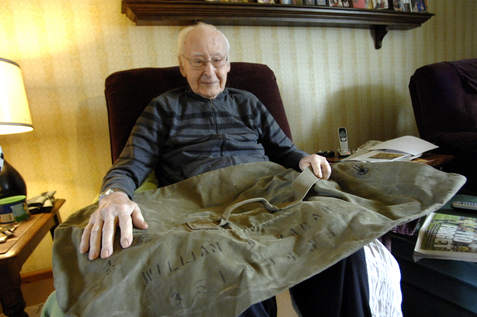
WWII veteran William Kadar with his long-lost duffel bag. Stephanie Dowell/Sun-Times Media, from here.

On the subject of military material culture, I volunteered a couple days over the last two weeks as part of the University of Delaware Museum Studies "SWAT" program. This year, student volunteers are spending two weeks at the Vineland Historical and Antiquarian Society sorting, cleaning, accessioning, and organizing the collection. The Society has some really interesting military artifacts, including a trunk of mostly late nineteenth-century clothing belonging to Civil War veteran Lt. Harry Wilson of the 18th Pennsylvania Cavalry, who was captured and imprisoned at Richmond's Libby Prison from 1864 to 1865. They also have the WWII Navy uniforms and paperwork of Pharmacist's Mate Clarence St. John and several unique identified WWI uniforms. Here's me working with St. John's jumpers, the dress uniform of which includes his service ribbons for the following medals: Navy Good Conduct, American Campaign, Asiatic-Pacific Campaign with four campaign stars, Phillipine Liberation with two campaign stars, and (mysteriously, given that it was issued to Spanish-American War veterans before St. John was probably even born) Spanish War Service with two campaign stars.


Monday, October 8, 2012

1812 and 1916

As you may remember, I've posted before about WWI archaeological discoveries. The whole Western Front is rife with caved-in bunkers, trenches, artifacts, and unexploded ordinance. Most municipalities in the area still manage regular collections of shells, grenades, and other ammunition kicked up by farmers and construction work. In other cases, the remains of the Great War run so deep that they are inaccessible to all but the professionals. Here's an interesting video about the tunnels dug some 80 feet below the Somme battlefield during attempts to detonate explosives below enemy lines. You can read more about the excavations in this area here.

In the Somme tunnels. ITV Meridian.

This might ring a bell for Civil War buffs - it was much the same strategy as that used at Petersburg in 1864, which resulted in the "Battle of the Crater."

In fact, the Civil War has been in the news a lot lately, chiefly because we're in the midst of the conflict's 150th anniversary. Simultaneously, the War of 1812 is also enjoying some much-deserved attention during its 200th anniversary. Not all of this press is coming from the United States, either. Canada has been significantly more engaged in promoting the anniversary than we have (although certain states, like Maryland, have been pushing historical tourism related to 1812). Here's an interesting story from The New York Times about Canada's promotional efforts and their connections with the controversial politics of Prime Minister Stephen Harper. Don't miss the promotional advertisement, which you can watch here. It's actually pretty well produced from a material culture and costume viewpoint. But its attracted some controversy for its overtly militaristic and nationalistic tone. These are troubling aspects given the succeeding 200 years of peaceful (minus a Fenian raid or two) relations between Canada and the U.S. and, from an historical standpoint, the fact that Canada was not even a country at the time of the war. The hope is that we can get past all the nationalistic rhetoric and understand the conflict for all it was - a complicated, violent, and multifaceted war that, if militarily indecisive, left significant marks on the cultures and mindsets of two nations.